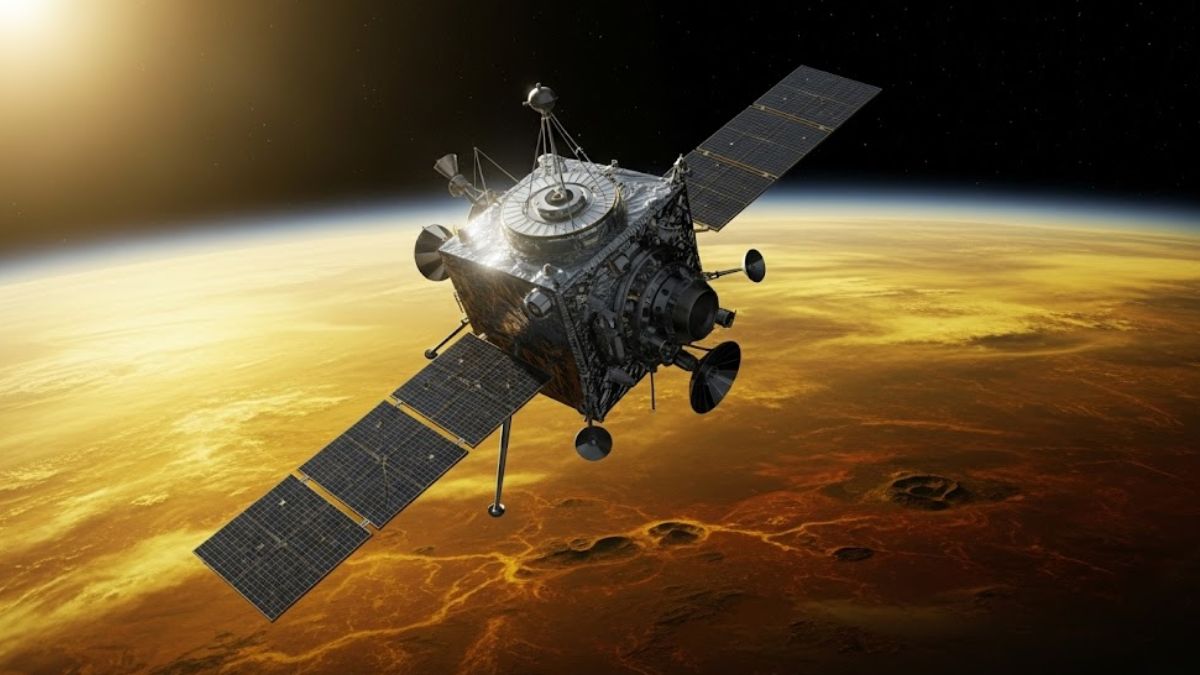
Russia Venera-D Venus Mission will launch by 2036 with an orbiter, lander, and balloon probe to explore Venus. Learn about its design, timeline, and exam relevance.
Russia Plans Venera-D Mission to Venus by 2036
Ambitious Return to Planetary Exploration
Russia has officially announced its intention to launch Venera-D, an interplanetary mission to Venus, scheduled to occur no later than 2036. Preliminary design work for the mission is slated to commence in January 2026, under the aegis of the newly adopted national space program
Multicomponent Mission Architecture
The Venera-D mission is expected to be a comprehensive exploration endeavor. It will incorporate an orbital spacecraft, a lander, and a balloon probe—a design that enables detailed atmospheric, surface, and orbital study of Venus
Design Phase Timeline and Collaboration
Oleg Korablev, head of Planetary Physics at Russia’s Space Research Institute (IKI), confirmed that the initial design phase will span approximately two years. This design work is being undertaken in collaboration with the Lavochkin Association, a major Russian aerospace enterprise
Launch Window and Planning Horizon
While the mission’s exact launch date remains undetermined pending design completion, officials affirm it will take place within the current planning horizon—by 2036 at the latest. Scientific director Lev Zeleny has suggested that the launch is likely to occur not before 2034 or 2035, implying a smaller time window for execution
Marking a New Chapter in Space Ambitions
This mission marks a bold step in Russia’s comeback to planetary exploration. For decades, Russian space missions were mostly Earth-centric or focused on lunar endeavors. The Venera-D mission, with its lander and atmospheric probe components, suggests a renewed interest and capability in deep-space science

B) Why This News Is Important
Strategic Revival of Space Ambitions
Russia’s renewed commitment to sending a mission to Venus reflects its broader ambition to reassert itself as a leading spacefaring nation. By allocating resources and initiating planning for a mission as complex as Venera-D, Russia signals its intent to re-engage in planetary science and technological development.
Enhancing Scientific Knowledge and Global Prestige
The mission’s inclusion of multiple elements—a lander, orbiter, and balloon probe—enables diverse pathways for scientific discovery. These components can provide invaluable data about Venus’s atmosphere, geology, and climate systems. For students preparing for government exams, this underscores Russia’s aspiration to contribute meaningfully to global space research.
Relevance for Government Exams
Current affairs in space exploration often feature prominently in General Studies and Science & Technology sections of government exams. Understanding the Venera-D mission’s timeline, components, and strategic implications prepares aspirants for questions on international space initiatives and geopolitics in technology.
C) Historical Context
Legacy of the Soviet Venera Program
The Venera series, conducted by the Soviet Union between 1961 and 1984, achieved groundbreaking milestones: the first craft to enter another planet’s atmosphere (Venera-3, 1966), the first soft landing (Venera-7, 1970), the first images from an alien surface (Venera-9, 1975), and the first atmospheric sounds recorded (Venera-13, 1981)
Evolution of Venera-D
Initially proposed around 2003, Venera-D’s scope and timeline have undergone multiple revisions. Early plans envisaged a complex suite of vehicles—landed, balloon, orbiter—by 2013–2014, later pushed to 2018 due to development delays. The 2011 failure of Phobos-Grunt further hampered planetary mission timelines. As of 2024–2025, the mission is realigned to launch no sooner than 2031, with current announcements confirming dates by 2036
Global Scientific Interest in Venus
Global interest in Venus exploration has surged, spurred by findings like phosphine detection in its atmosphere (2020), which sparked speculation about possible microbial life. This has reignited international attention and investment in missions exploring Venus’s atmosphere and surface
D) Key Takeaways from “Russia Plans Venera-D Mission to Venus”
| S. No. | Key Takeaway |
|---|---|
| 1 | Russia plans to launch Venera-D mission to Venus before 2036. |
| 2 | The mission includes an orbiter, a lander, and a balloon probe for comprehensive exploration. |
| 3 | Design work begins in January 2026 and will last about two years. |
| 4 | The mission is coordinated with the Lavochkin Association and the Russian Academy of Sciences (IKI). |
| 5 | The launch is expected no earlier than 2034–2035, depending on design completion. |
FAQs: Frequently Asked Questions
1. What is the Venera-D mission?
The Venera-D mission is Russia’s planned interplanetary project to explore Venus using an orbiter, lander, and balloon probe.
2. When is Russia planning to launch Venera-D?
Russia plans to launch the Venera-D mission before 2036, with design work starting in January 2026.
3. Who is developing the Venera-D mission?
The mission is being developed by the Russian Academy of Sciences’ Space Research Institute (IKI) in collaboration with the Lavochkin Association.
4. Why is the Venera-D mission significant?
It signifies Russia’s return to planetary exploration after decades, with potential discoveries about Venus’s atmosphere, surface, and habitability.
5. What scientific instruments will be included?
The mission will include a balloon probe to study the atmosphere, a lander for surface exploration, and an orbiter for long-term monitoring.
6. What is the historical context of the Venera program?
The Soviet Union’s Venera program (1961–1984) achieved many firsts in Venus exploration, such as the first landing and first images from another planet.
7. When did the first Venera mission succeed?
The first successful mission was Venera-7 in 1970, which made the first soft landing on Venus.
8. What is the likely launch window?
According to scientists, the mission will likely be launched in 2034 or 2035.
9. Why is Venus attracting scientific interest now?
Recent findings such as phosphine detection in Venus’s atmosphere (2020) raised questions about potential microbial life, renewing global focus.
10. How is this relevant for government exams?
Questions on space missions, international collaborations, and technological advancements often appear in UPSC, SSC, banking, railways, and defence exams.
Some Important Current Affairs Links