







NIEPID Jai Vakeel Foundation MoU 2025 aims to implement structured education for children with intellectual disabilities across India using DISHA Abhiyan tools and DALM scheme support.
NIEPID & Jai Vakeel Foundation Partner to Transform Education for Children with Intellectual Disabilities
Overview of the MoU
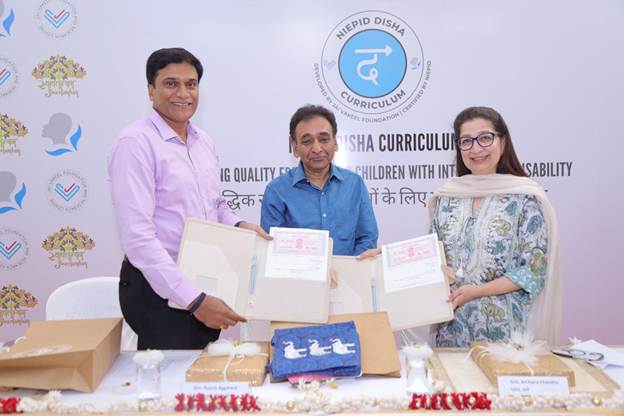
On 18 July 2025, the National Institute for Empowerment of Persons with Intellectual Disabilities (NIEPID) and the Jai Vakeel Foundation (JVF) signed a landmark Memorandum of Understanding (MoU) in Mumbai, aiming to implement a structured and uniform curriculum across India for children with intellectual disabilities
Combining Expertise & Outreach
This alliance combines NIEPID’s training and research strength with JVF’s grassroots implementation through the DISHA Abhiyan model—an approach already used successfully since 2019 in Maharashtra Under the MoU, JVF’s DISHA resources—Assessment Checklist for IEPs, multisensory curriculum, digital portal, and teacher-training modules—will now be nationally deployed.
Inclusive Education through DISHA Curriculum
The NIEPID DISHA Curriculum, aligned with the Indian government’s Accessible Learning Materials (DALM) Scheme, supports Individualized Education Plans (IEPs), multisensory teaching (VAKT model), and multi-language workbooks. Training will reach schools, centres, and community-based organizations
Government Support & Implementation Strategy
The initiative is backed by the Department of Empowerment of Persons with Disabilities (DEPwD) under the Ministry of Social Justice & Empowerment. Secretary Rajesh Aggarwal announced scale-up of the curriculum to CDEIC, DDRS centres, and voluntary schools, with free materials and CRE‑accredited training for teachers and parents
Alignment with SDGs and Viksit Bharat Vision
The MoU assists India in achieving UN Sustainable Development Goals — specifically SDG 4 (inclusive quality education) and SDG 10 (reducing inequalities). It also supports the national agenda of Viksit Bharat by ensuring that no child with intellectual disability is left behind
Looking Ahead: Nationwide Inclusion Impact
Following proof‑of‑concept in 453 schools, reaching 18,000 students and training 2,600 educators, the goal is to exponentialize the program across India—providing structured education in regional languages like Hindi, Marathi, English, and Telugu, backed by digital tools and community support

B) Why This News Is Important
Transforming Special Education in India
This MoU marks a vital execution stage in the long‑standing need for a uniform, structured curriculum for children with intellectual disabilities—a demographic numbering in millions with historically limited access to specialized education It ensures standardization across systems and removes variability in quality.
Empowering Educators and Families
By providing free workbooks, trainings, and CRE‑accredited modules, the initiative empowers not only teachers but also caregivers and parents, making inclusive education a community responsibility rather than bureaucratic compliance.
Strengthening Government–NGO Partnerships
This collaboration underscores India’s increasing reliance on NGO–government synergy, leveraging innovation (DISHA Abhiyan) and scaling through national schemes like DALM—clearly articulated by Secretary Aggarwal, who said “neuro‑diversity … emotionally difficult,” meaning diverse partnerships are essential
Meeting Global & National Commitments
By aligning with SDG 4 and 10, and the Viksit Bharat vision, this MoU reflects India’s public policy evolution—from braille‑centric accessibility to include cognitive disabilities—signaling a broader, more inclusive definition of educational equity
C) Historical Context
From NIMH to NIEPID: A Legacy of Empowerment
Founded in 1984 as the National Institute for Mentally Handicapped (NIMH), later renamed NIEPID, the institute has pioneered training, R&D, intervention models, and parent‑training initiatives
DISHA Abhiyan: The Pilot for Change
Launched in 2019 by JVF in Maharashtra, DISHA Abhiyan demonstrated what a multisensory and IEP‑based structured approach could achieve—18,000 students and 2,600 educators onboarded, setting the benchmark for national rollout
Policy Milestones
The Rights of Persons with Disabilities (RPwD) Act, 2016, mandated inclusive education—Sections 16 and 17 emphasized the need for equal educational access. The current effort builds on this legal framework, representing a culmination of decades-long policy and social advocacy.
D) Key Takeaways from ‘NIEPID–JVF DISHA MoU’
| S.No. | Key Takeaway |
|---|---|
| 1 | National MoU signed on 18 July 2025 between NIEPID and Jai Vakeel Foundation in Mumbai to implement a structured curriculum |
| 2 | DISHA Abhiyan resources—IEP Checklist, multisensory curriculum, digital portal, and training modules—will be deployed nationwide |
| 3 | Coverage: Over 18,000 students and 2,600 educators in 453 schools have already used the model since 2019 |
| 4 | Government support: Under DEPwD and Ministry of Social Justice, with free training, CRE accreditation, and educational materials via the DALM scheme |
| 5 | Alignment with SDGs & RPwD Act: Promotes SDG 4 & 10, and fulfills the RPwD Act, supporting India’s Viksit Bharat inclusive vision |
FAQs: Frequently Asked Questions
Q1. What is the purpose of the MoU signed between NIEPID and Jai Vakeel Foundation?
The primary purpose of the MoU is to implement a structured and uniform curriculum for children with intellectual disabilities across India.
Q2. What is DISHA Abhiyan?
DISHA Abhiyan is an inclusive education model created by Jai Vakeel Foundation. It includes tools like an IEP checklist, multisensory learning resources, a digital portal, and teacher training modules.
Q3. How many schools and students have benefited from DISHA so far?
The program has impacted 453 schools, reaching over 18,000 children and 2,600 educators across Maharashtra since 2019.
Q4. Which government department is supporting this initiative?
The initiative is backed by the Department of Empowerment of Persons with Disabilities (DEPwD) under the Ministry of Social Justice and Empowerment.
Q5. How is this initiative linked to India’s policy goals?
It aligns with India’s commitment to the Rights of Persons with Disabilities (RPwD) Act, 2016, the DALM scheme, and SDGs (especially SDG 4 and SDG 10) while contributing to the Viksit Bharat vision.
Q6. What languages are the DISHA learning materials available in?
Currently, materials are available in Hindi, English, Marathi, and Telugu.
Q7. Will the teachers and parents receive training under this scheme?
Yes. The program includes free CRE-accredited training programs for both teachers and parents to implement inclusive education effectively.
Q8. What is the significance of the DALM scheme mentioned in the article?
The Developing Accessible Learning Materials (DALM) scheme ensures that all educational content is accessible to persons with disabilities, including those with cognitive challenges.
Q9. Is the MoU focused only on government schools?
No. The program targets special schools, community centres, CDEICs, DDRS institutions, and voluntary organizations working in the disability sector.
Q10. What role does the NIEPID play in this initiative?
NIEPID is the nodal agency responsible for training, research, and curriculum standardization in the field of intellectual disabilities. It will guide and monitor the implementation.
Some Important Current Affairs Links