









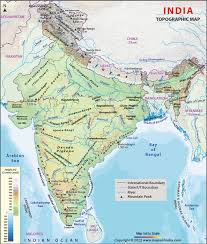
The Survey of India (SoI) is the premier mapping and surveying organization responsible for creating topographical maps of India. Established in 1767, it operates under the Department of Science & Technology, Government of India. Topographical maps play a crucial role in planning infrastructure, defense strategies, environmental conservation, and urban development.
Role of the Survey of India in Topographical Mapping
Mapping and Cartography
The Survey of India is responsible for producing accurate topographical maps that depict terrain features, elevation, rivers, roads, and administrative boundaries. These maps are vital for military operations, disaster management, and civil planning.
Use in Infrastructure Development
The data from topographical maps aid in planning roads, railways, bridges, and other infrastructural projects. Engineers and town planners rely on these maps to ensure sustainable urban growth.
Defense and Security Applications
The Indian defense forces use topographical maps for strategic planning, border security, and combat operations. The accuracy of these maps is crucial for national security and surveillance.
Environmental and Disaster Management
Topographical maps help in assessing land use, identifying flood-prone areas, and planning afforestation projects. They are also critical for disaster preparedness, particularly in regions prone to landslides, earthquakes, and tsunamis.

Why This News is Important
Importance in National Development
The Survey of India’s work directly impacts various developmental projects across the nation. From constructing new highways to ensuring accurate geographic data for industrial zones, its contributions are indispensable.
Technological Advancements in Mapping
With the introduction of Geographic Information Systems (GIS) and satellite imagery, the accuracy and usability of topographical maps have improved significantly. This advancement enhances disaster management, environmental conservation, and resource allocation.
Historical Context
The Survey of India has a rich legacy dating back to the British era. It was initially formed to assist in administrative and military planning. Over the years, it has evolved into a modern institution integrating satellite technology, GPS, and GIS to produce high-precision maps. The Great Trigonometric Survey (GTS), conducted in the 19th century, was one of its landmark achievements in mapping the Indian subcontinent.
Key Takeaways from Survey of India’s Role in Topographical Mapping
| S.No | Key Takeaway |
|---|---|
| 1 | The Survey of India is responsible for creating topographical maps of India. |
| 2 | These maps aid in defense, infrastructure planning, and environmental management. |
| 3 | The organization operates under the Department of Science & Technology, Government of India. |
| 4 | Technological advancements like GIS and satellite imagery have improved the accuracy of topographical maps. |
| 5 | The Survey of India has a historical significance dating back to the British colonial era. |
FAQs
- What is the Survey of India?
- The Survey of India is the national mapping and surveying organization responsible for creating topographical maps of the country.
- Under which government department does the Survey of India operate?
- It operates under the Department of Science & Technology, Government of India.
- What are topographical maps?
- These are detailed maps that depict landforms, elevations, rivers, roads, and other geographical features.
- How do topographical maps help in defense?
- They are used for strategic planning, border security, and military operations.
- What technological advancements have improved topographical mapping?
- GIS, GPS, and satellite imagery have significantly enhanced the accuracy and usability of these maps.
Some Important Current Affairs Links