
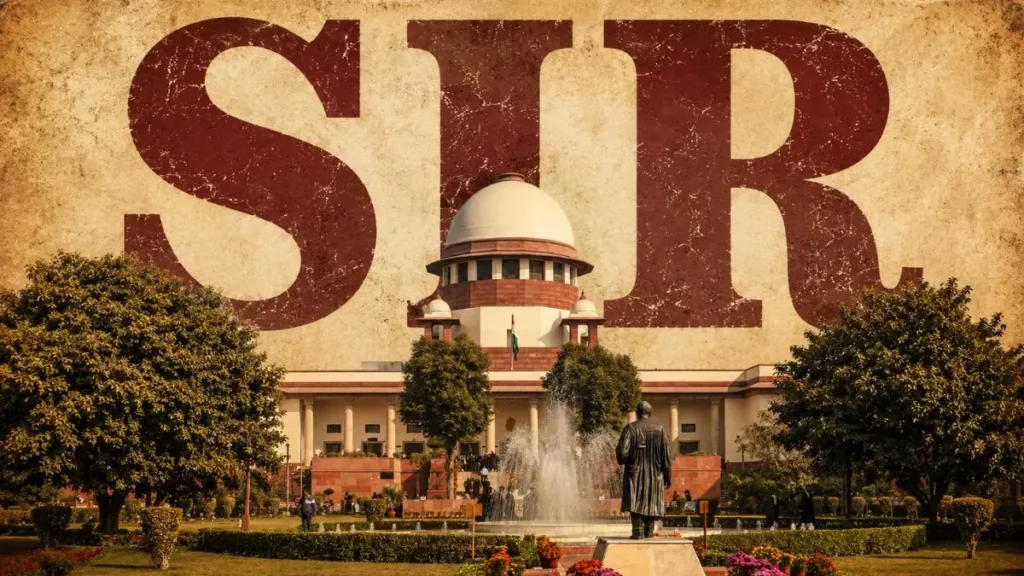
Supreme Court SIR verdict upholds Election Commission voter revision exercise in Bihar and other states, confirming constitutional validity of electoral roll updates and strengthening India’s election reform framework for fair elections.
Supreme Court Validates EC’s Authority on Electoral Roll Revision (SIR)
Supreme Court Verdict Strengthens Election Commission’s Powers
The Supreme Court of India has upheld the constitutional validity of the Election Commission of India’s (ECI) Special Intensive Revision (SIR) exercise of electoral rolls conducted in Bihar and several other states. The judgment confirms that the Election Commission acted within its statutory and constitutional authority while carrying out the voter list revision process.
The court ruled that the SIR exercise is not “ultra vires” and does not violate the Representation of the People Act, 1950. It emphasized that the primary objective of the Election Commission is to ensure free, fair, and accurate elections, which requires periodic verification and correction of voter lists.
Electoral Roll Purification and Democratic Integrity
The apex court observed that maintaining the accuracy of electoral rolls is essential for strengthening democracy. It noted that the SIR process helps eliminate duplicate, deceased, shifted, or ineligible voters while ensuring inclusion of eligible citizens.
The court further clarified that the Election Commission has the authority to adopt modern and revised methods of voter verification, provided that due process is followed. This includes giving opportunities for objections and corrections, ensuring transparency in the exercise.
Legal Challenges and Court’s Response
Several petitions were filed challenging the SIR exercise, arguing that it violated constitutional rights and could lead to wrongful deletion of voters. However, the Supreme Court rejected these claims, stating that the process includes adequate safeguards to protect voter rights.
The bench also highlighted that citizenship verification issues arising during the process must be referred to the competent authorities under the Citizenship Act, 1955, ensuring that the Election Commission does not overstep its jurisdiction.

📌 Why this News is Important
Constitutional and Electoral Significance
The Supreme Court’s decision is highly significant for understanding the balance between constitutional authorities and electoral reforms in India. It strengthens the Election Commission’s independence in managing electoral rolls, which is a core requirement for conducting fair elections.
For students preparing for UPSC, State PSC, SSC, Banking, Railways, and Defence exams, this judgment is crucial because it directly relates to topics such as constitutional bodies, election reforms, and democratic governance.
Impact on Governance and Citizenship Verification
The ruling also clarifies the legal framework regarding voter eligibility and the limits of Election Commission authority. It reinforces the idea that electoral roll revision is a continuous administrative process essential for democratic integrity.
This judgment may also influence future debates on citizenship verification, voter exclusion concerns, and electoral transparency in India.
📚 Historical Context
Evolution of Electoral Roll Revision in India
Electoral roll management in India has evolved significantly since independence. The Election Commission of India, established in 1950, is responsible for maintaining accurate voter lists under the Representation of the People Act, 1950.
Over the decades, various methods such as summary revisions and intensive revisions have been introduced to update voter records. Special Intensive Revision (SIR) is a more rigorous process involving door-to-door verification and detailed scrutiny of voter data.
Past Electoral Reforms and Legal Interventions
India has witnessed multiple judicial interventions related to electoral reforms, including issues of voter inclusion, exclusion, and electoral transparency. The Supreme Court has consistently emphasized free and fair elections as a basic structure of democracy.
This current verdict continues the judicial tradition of supporting institutional autonomy while ensuring constitutional safeguards for citizens.
🔑 Key Takeaways from “SC Upholds SIR Exercise”
| S.No | Key Takeaway |
|---|---|
| 1 | Supreme Court upheld the constitutional validity of the Election Commission’s SIR exercise. |
| 2 | The Court ruled that the Election Commission acted within its statutory and constitutional powers. |
| 3 | SIR process was declared essential for ensuring accurate and purified electoral rolls. |
| 4 | The judgment emphasized that free and fair elections depend on updated voter lists. |
| 5 | Citizenship-related disputes during SIR must be handled by competent authorities, not ECI alone. |
FAQs: Supreme Court Upholds ECI SIR Exercise
Q1. What is the SIR exercise conducted by the Election Commission?
The Special Intensive Revision (SIR) is a detailed process of updating electoral rolls through door-to-door verification, removal of duplicate entries, and inclusion of eligible voters.
Q2. Why was the SIR exercise challenged in the Supreme Court?
It was challenged on the grounds that it could lead to wrongful deletion of voters and allegedly violated constitutional rights and electoral fairness.
Q3. What did the Supreme Court decide on the SIR exercise?
The Supreme Court upheld the constitutional validity of the SIR exercise, stating that the Election Commission acted within its legal and constitutional powers.
Q4. Which law governs electoral roll preparation in India?
Electoral rolls are governed primarily by the Representation of the People Act, 1950, along with constitutional provisions under Article 324.
Q5. Can the Election Commission decide citizenship during SIR?
No, the Court clarified that citizenship-related disputes must be handled by competent authorities under the Citizenship Act, 1955, not by the Election Commission.
Q6. Why is SIR important for elections?
It ensures accuracy in voter lists by removing ineligible entries and maintaining the integrity of free and fair elections.
Some Important Current Affairs Links

