
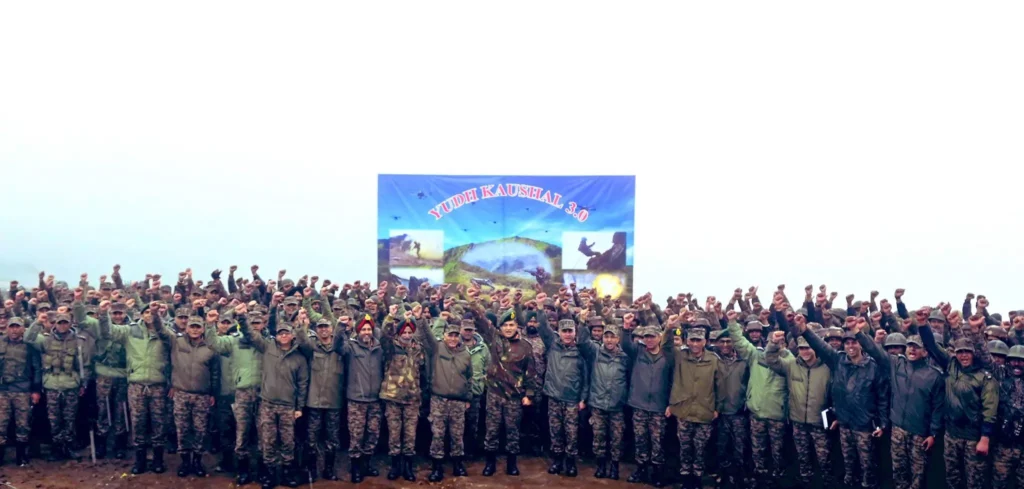
Yudh Kaushal 3.0 exercise details: The Indian Army conducted a multi-domain drill in Arunachal Pradesh showcasing drones, ASHNI platoons, and indigenous defence systems under Aatmanirbhar Bharat. Read full coverage with FAQs, MCQs, and exam relevance.
Indian Army Conducts Yudh Kaushal 3.0 Multi-Domain Exercise in Arunachal Pradesh
Multi-Domain Operational Readiness Demonstrated
The Indian Army recently conducted Exercise Yudh Kaushal 3.0 in the Kameng region of Arunachal Pradesh, a strategically important area along the eastern sector of the Line of Actual Control (LAC). The exercise aimed to showcase the Army’s multi-domain operational capabilities in extreme high-altitude conditions and demonstrate readiness against potential threats. The drill was carried out in one of the most challenging terrains, where weather and geography test the endurance of soldiers and the efficiency of technology.
Integration of Next-Generation Technology
One of the defining aspects of Yudh Kaushal 3.0 was the use of next-generation warfare technologies. The Army deployed drones, real-time surveillance systems, advanced communication tools, and precision strike capabilities. The exercise highlighted how technology-driven combat strategies are becoming a crucial part of modern warfare. The operational debut of ASHNI platoons, designed to integrate cutting-edge tools with traditional combat formations, underlined India’s commitment to future-ready defence mechanisms.
Active Role of Civil Defence Industry
The exercise also witnessed active participation from India’s civil defence industry, reflecting the government’s focus on the Aatmanirbhar Bharat initiative. Indigenous weapon systems, surveillance platforms, and artificial intelligence-driven applications were tested during the drill. This collaboration not only strengthened India’s defence preparedness but also emphasized the importance of self-reliance in national security.
Emphasis on Joint Operations and Coordination
Yudh Kaushal 3.0 placed strong emphasis on joint operations, where infantry, artillery, engineers, and aviation units worked in close coordination. The exercise included battlefield manoeuvres, troop movements, integrated firepower demonstration, and air-littoral dominance exercises. Such practices enhance the Army’s preparedness for real-time combat situations and improve synergy among different arms of the military.
Strategic Significance in Arunachal Pradesh
Conducting this exercise in Arunachal Pradesh carries immense strategic significance. Given the sensitive nature of the eastern Himalayan border, the exercise sends a strong message of India’s readiness to defend its territorial integrity. It also reassures local populations about the Army’s commitment to maintaining peace and stability in the region.
Why this News is Important
Relevance for Competitive Exams
For aspirants preparing for government exams, this development is crucial because questions on defence exercises and military preparedness are often asked in General Awareness sections of exams like UPSC, SSC, CDS, CAPF, and state-level services. Yudh Kaushal 3.0 represents a blend of modern military technology, indigenous development, and strategic preparedness, making it a highly relevant topic.
Impact on India’s Defence and Security Policy
The news also holds importance from a policy and international relations perspective. It demonstrates India’s proactive approach to strengthening its defence posture in sensitive regions. Understanding such exercises helps aspirants connect topics of defence modernization, national security, and self-reliance with larger governance and policy-making issues. This context is valuable not just for prelims but also for mains and interview stages of civil services examinations.
Historical Context
Previous Editions of Yudh Kaushal
The Indian Army has conducted earlier editions of Exercise Yudh Kaushal to test its tactical preparedness. The first two versions laid the foundation for multi-domain operational drills. With each edition, the scope has expanded, and the third edition in 2025 marked a technological leap by integrating advanced combat systems.
Similar Military Drills in the Region
India has also been conducting other major exercises such as Achook Prahar and Him Vijay in Arunachal Pradesh and other border areas. These drills are aimed at improving mountain warfare capabilities and ensuring rapid mobilization of troops in the eastern sector. Together, they contribute to strengthening India’s defensive posture along the LAC.
Link to Aatmanirbhar Bharat in Defence
The government has consistently emphasized indigenous defence production under the Aatmanirbhar Bharat initiative. Past defence exercises have been platforms to test home-grown systems, and Yudh Kaushal 3.0 continued this trend by showcasing the operational utility of domestically developed weapons and surveillance platforms.
Key Takeaways from Yudh Kaushal 3.0
| S.No. | Key Takeaway |
|---|---|
| 1 | Indian Army conducted Exercise Yudh Kaushal 3.0 in the Kameng region of Arunachal Pradesh. |
| 2 | The exercise demonstrated multi-domain operational readiness in extreme high-altitude conditions. |
| 3 | Next-generation technologies like drones, precision weapons, and real-time surveillance were deployed. |
| 4 | Indigenous defence systems and civil defence industry actively participated under Aatmanirbhar Bharat. |
| 5 | The exercise highlighted India’s preparedness and strategic focus on the eastern Himalayan border. |
Frequently Asked Questions (FAQs)
1. What is Exercise Yudh Kaushal 3.0?
Exercise Yudh Kaushal 3.0 is a multi-domain military exercise conducted by the Indian Army in the Kameng region of Arunachal Pradesh to demonstrate operational readiness using next-generation technology.
2. Why was Arunachal Pradesh chosen for Yudh Kaushal 3.0?
The Kameng sector in Arunachal Pradesh is a high-altitude and strategically important region along the Line of Actual Control (LAC), making it an ideal location to test combat capabilities in extreme conditions.
3. What new technologies were used in Yudh Kaushal 3.0?
The Indian Army used drones, real-time surveillance, advanced communication systems, precision weapons, and AI-enabled platforms. It also introduced ASHNI platoons for integrating emerging technology with traditional warfare.
4. How does Yudh Kaushal 3.0 support Aatmanirbhar Bharat?
The exercise featured active participation of India’s civil defence industry, where indigenous surveillance platforms, weapon systems, and tactical solutions were tested, aligning with the goal of self-reliance in defence.
5. Which other military exercises has India conducted in Arunachal Pradesh?
Other major exercises include Achook Prahar and Him Vijay, both focused on enhancing mountain warfare capabilities and rapid troop deployment in the eastern sector.
6. Which exams might ask questions on Yudh Kaushal 3.0?
This news is important for UPSC (Prelims & Mains), CAPF, CDS, NDA, SSC, State PSCs, Banking exams (General Awareness), and Defence recruitment tests.
7. What is the role of ASHNI platoons in Yudh Kaushal 3.0?
ASHNI platoons made their operational debut in this exercise, focusing on fusing advanced technology with conventional combat tactics to enhance battlefield efficiency.
8. How does this exercise strengthen India’s defence posture?
By demonstrating joint operations, real-time target acquisition, and technological integration, it reassures preparedness for safeguarding India’s eastern borders.
9. What type of terrain was used in the exercise?
The exercise was conducted in extreme high-altitude, mountainous terrain with harsh weather conditions, testing both soldiers’ endurance and equipment reliability.
10. How is Yudh Kaushal 3.0 relevant to India’s strategic goals?
It reflects India’s commitment to border security, technological modernization, and regional stability, while sending a strong deterrence message to adversaries.
Some Important Current Affairs Links

