
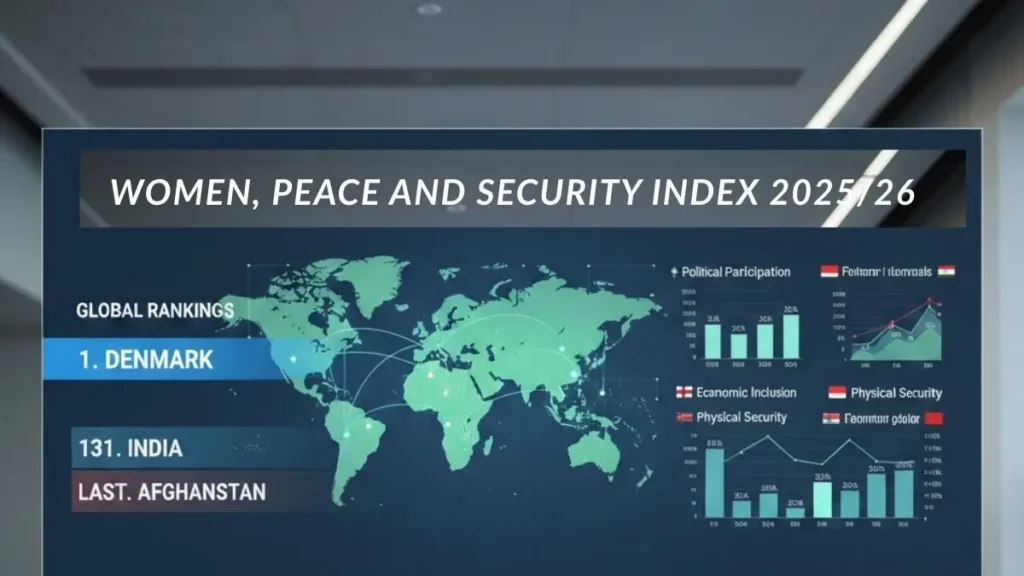
Women Peace Security Index 2025 ranking highlights Denmark first, Afghanistan last, and India’s position. Learn key facts, analysis, and exam-focused insights.
🌍 Women, Peace and Security Index 2025-26: Denmark Tops, Afghanistan Ranks Last — India and US Positions Revealed
The Women, Peace and Security (WPS) Index 2025-26 report has been released, ranking 181 countries globally on the status of women across three key dimensions — inclusion, justice, and security. The ranking reflects how nations are performing in ensuring safety, equality, participation, and legal justice for women in society.
The WPS Index is compiled by the Georgetown Institute for Women, Peace and Security (GIWPS) in collaboration with the Peace Research Institute Oslo (PRIO). It uses 13 robust global indicators to produce comparative scores between countries. Scoring close to 1 indicates strong progress, while scores closer to 0 signal poor outcomes for women’s status.
🥇 Denmark Retains Top Spot as Best Country for Women
For the third consecutive time, Denmark remains the top-ranked country in the WPS Index with a leading score of 0.939, showcasing its strong policies on gender equality, social welfare, justice, and safety for women. Nordic nations dominate the top spots, with Iceland (0.932) and Norway (0.924) following closely.
📉 Afghanistan at the Bottom of the Index
At the other end of the scale, Afghanistan continues to rank last (181st) with a score of 0.279, more than three times lower than Denmark. This reflects ongoing instability, lack of security, and limited rights for women due to prolonged conflict and governance challenges. Other low-ranking countries include Yemen, Central African Republic, and Syria — most of which are conflict-affected states.
🇺🇸 United States Improves, India Shows Steady Progress
The United States improved its ranking, rising from 37th to 31st, primarily due to recorded improvements in maternal mortality rates — its first such improvement in almost two decades.
India ranked 131st with a score of 0.607, indicating uneven yet steady progress in women’s inclusion, justice, and security. The ranking shows that while India has made measurable gains, challenges persist in areas such as safety, legal protections, workforce participation, and political representation for women.
💡 Key Insights and Global Trends
The report also highlighted disturbing global trends: approximately 676 million women worldwide were exposed to conflict last year, marking a 74% increase since 2010 — a sign that peace and security progress for women is either stagnating or reversing in many regions.
The WPS Index serves as a critical tool for policymakers, researchers, and global institutions to identify areas where improvements are needed and to evaluate the effectiveness of gender-responsive policies.

📌 Why This News Is Important for Government Exam Aspirants
📖 Understanding Global Gender and Security Issues
Gender equality, women’s rights, and security are key themes in modern governance, international relations, and development studies — all crucial areas for competitive exams like UPSC, SSC, PSC, banking, railways, defence, and teaching positions. The WPS Index highlights how nations perform in ensuring women’s participation in society, access to justice, and personal safety.
🌍 Relevance to India’s Policy Framework
India’s ranking at 131st throws light on domestic challenges related to gender justice, women’s safety, workforce participation, and legal support systems. Understanding these metrics helps aspirants answer gender issues, social justice, and international reports related questions in exams.
📘 Impact on International Affairs and Diplomacy
Comparative global indices like WPS influence diplomatic discourse, foreign policy debates, and international development strategies. Aspirants preparing for admin services must be familiar with global rankings and interpret the implications of such reports on foreign and domestic policymaking.
📊 Integration with GS and Essay Sections
Items such as this report can be quoted or referenced in General Studies papers, essay writing, interview discussions, and ethics segments, especially when responding to topics related to gender equality, peace and security, or global development indices.
🕰 Historical Context: Women’s Status in Global Peace and Security
📅 Origin of the WPS Index
The Women, Peace and Security Index was first introduced in 2017 by the Georgetown Institute for Women, Peace and Security with support from PRIO. It was designed to monitor and evaluate how countries perform in key areas impacting women’s lives — inclusion, justice, and safety.
📌 Why Such an Index Matters
For decades, policy makers and researchers have emphasized that women’s empowerment is critical for sustainable development, peacebuilding, and economic progress. The WPS Index offers a quantitative tool to assess these dimensions at global and national levels.
📈 Trends Since 2017
Since its inception, the WPS Index has tracked improvements and setbacks in women’s status. Although some countries — primarily in Europe — consistently rank high due to strong legal protections, welfare systems, and gender-inclusive policies, many conflict-affected and fragile states remain at the bottom, illustrating how insecurity and governance challenges continue to undermine women’s basic rights worldwide.
🧠 Key Takeaways from Women, Peace and Security Index 2025-26
| S.No. | Key Takeaway |
|---|---|
| 1 | The WPS Index ranks 181 countries based on women’s inclusion, justice, and security. |
| 2 | Denmark tops the index with a high score of 0.939, showing strong performance in gender equality and safety. |
| 3 | Afghanistan ranks last (181st) with a score of 0.279, reflecting extreme gender inequality and insecurity. |
| 4 | The United States improved to 31st due to better maternal health indicators. |
| 5 | India sits at 131st with a score of 0.607, indicating uneven but steady progress in women’s wellbeing. |
FAQs: Women, Peace and Security Index 2025–26
1. What is the Georgetown Institute for Women, Peace and Security Women, Peace and Security Index?
The Women, Peace and Security (WPS) Index is a global ranking that measures women’s wellbeing across countries based on inclusion, justice, and security indicators. It evaluates how safe and empowered women are in different societies.
2. Which organization publishes the WPS Index?
The index is produced by the Georgetown Institute for Women, Peace and Security in partnership with the Peace Research Institute Oslo, using internationally recognized datasets.
3. Which country ranked first in the WPS Index 2025–26?
Denmark ranked first, reflecting strong performance in gender equality, safety, and institutional support for women.
4. Which country ranked last in the index?
Afghanistan ranked last (181st) due to severe challenges in women’s rights, safety, and participation.
5. What is India’s rank in the WPS Index 2025–26?
India ranked 131st, showing moderate progress but continued challenges in women’s safety and economic participation.
6. How did the United States perform in the ranking?
United States improved its ranking to 31st, mainly due to improvements in maternal health indicators.
7. What are the three main dimensions measured in the WPS Index?
The index measures inclusion (economic and political participation), justice (legal equality and discrimination), and security (safety and exposure to violence).
8. Why is the WPS Index important for competitive exams?
It helps aspirants understand global gender issues, international rankings, and social development indicators frequently asked in UPSC, PSC, SSC, and banking exams.
Some Important Current Affairs Links

