
Uttar Pradesh Budget 2026‑27 announced with ₹9.13 trillion outlay, major allocations in education, health, agriculture, IT, infrastructure, and employment. Explore key highlights for exam preparation.
Uttar Pradesh Presents ₹9.13 Trillion Budget for 2026‑27: A Boost to Growth and Development
Introduction: A Larger and More Strategic Budget
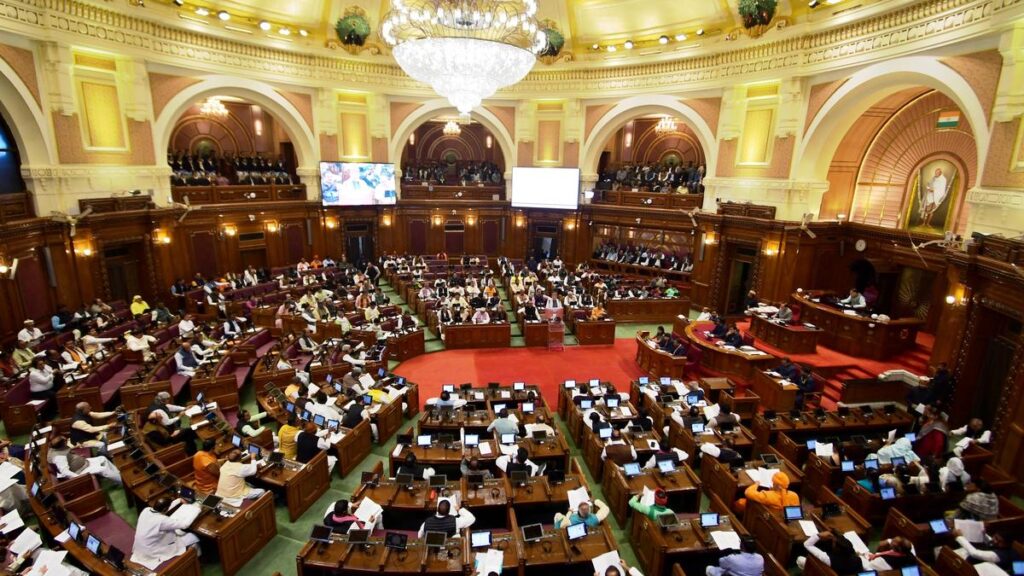
Uttar Pradesh Finance Minister Suresh Khanna presented the State Budget for the financial year 2026‑27 with a total outlay of ₹9.13 trillion, marking a significant 12.2% increase over the previous year’s budgetary allocation. This budget reflects the state government’s commitment to fiscal discipline, infrastructure development, human capital investment, and socio‑economic welfare.
The Budget was tabled in the Uttar Pradesh Legislative Assembly amid growing aspirations for rapid economic growth, job creation, and improved public services. It also aligns with the recommendations of the Sixteenth Central Finance Commission, which advises a fiscal deficit cap of 3% of Gross State Domestic Product (GSDP).
Fiscal Management: Discipline and Deficit Control
One of the standout features of the Budget is the emphasis on fiscal prudence. The state has maintained the fiscal deficit target at 3% of GSDP, in line with central financial guidelines, ensuring that expenditure growth remains sustainable and borrowing remains under control. Responsible fiscal management is crucial for maintaining investor confidence and stable economic growth.
Key Sector Allocations: Education, Health and Agriculture
The Budget strategically allocates funds across key socio‑economic sectors:
- Education received 12.4% of the total outlay, underlining the state’s focus on enhancing academic infrastructure, vocational training, and skill development programs.
- Health sector allocation stands at 6%, aiming to improve healthcare services, strengthen medical facilities and increase access to quality health services.
- Agriculture and allied services were allocated 9% of the total budget, showing emphasis on rural development, agrarian support, and farmer welfare.
These allocations show that the government is placing human capital and rural livelihoods at the center of its growth strategy.
Infrastructure and Employment: The Growth Engine
The Budget lays significant emphasis on infrastructure development as a catalyst for economic growth and job creation:
- Transport and connectivity projects such as the expansion of Noida International Airport with an allocation of ₹750 crore aim to enhance logistics and global connectivity.
- Substantial increases in allocations for IT sector growth, digital infrastructure, and skill centers demonstrate a vision for tech‑driven economic transformation and employment generation.
This infrastructure push is expected to stimulate investment, improve ease of doing business, and generate long‑term employment for youth entering the workforce.
Support to Key Sectors and Welfare
Several important measures targeting specific sectors and public welfare have been announced:
- Textiles and village industries received financial support to boost employment and preserve traditional crafts.
- The energy sector was allocated an increased ₹65,926 crore to enhance power reliability and promote smart metering.
- A historic push to modernize policing and public safety, with more than ₹44,000 crore earmarked for technology‑driven law enforcement enhancements.
These measures aim to not only improve economic infrastructure, but also strengthen the social safety net and create opportunities for citizens across different sectors.
Aligning Growth with Future Needs
The Uttar Pradesh Budget 2026‑27 represents a blend of fiscal discipline and growth‑oriented expenditure. By prioritizing infrastructure, education, health, and employment, the state government aims to prepare Uttar Pradesh for a rapidly changing economic landscape. This ambitious budgeting reflects a larger vision of transforming Uttar Pradesh into a centre for inclusive development and sustained growth.

Why This News is Important for Government Exams
Understanding State Economy and Public Finance
The Uttar Pradesh Budget 2026‑27 is a key current affairs topic for competitive exams like UPSC, PCS, banking, railways, police and teacher recruitment exams because state budgets form an essential component of the Indian fiscal federal structure. Budgetary allocations reveal government priorities, fiscal health, and socio‑economic strategies which are often asked in prelims and mains.
The Budget’s emphasis on sectors like education, health, agriculture, and infrastructure provides students with insights into governance priorities. Questions on fiscal deficit ceiling, sector allocations, and infrastructure initiatives are frequently included in quizzes and papers.
This news also links to schemes and development plans that influence employment trends, investment policies, digital transformation, and public welfare programs—topics that appear in general studies papers, economics, and current affairs sections of competitive exams. Understanding budgetary decisions is vital for interpreting government strategies that impact national and state economies.
Historical Context: Budget Evolution in Uttar Pradesh
The state of Uttar Pradesh has been progressively expanding its budget size over the years to meet rising developmental needs. From a budget outlay of around ₹8.08 lakh crore in 2025 with a focus on social welfare and infrastructure, Uttar Pradesh’s financial plan has grown by over 12% in 2026‑27.
Historically, the state budget reflects shifts in economic strategy—from basic connectivity projects to major infrastructure, technology, and human capital investments. The growth in allocations for sectors like education and health over the years showcases a greater emphasis on human development indicators.
The consistency in maintaining the fiscal deficit within the 3% limit adheres to financial discipline norms recommended by the Finance Commission and aligns Uttar Pradesh with national fiscal management goals. This historical evolution underscores the state’s trajectory toward becoming a major economic hub with modern infrastructure, robust social services, and diversified economic sectors.
Key Takeaways from Uttar Pradesh Budget 2026‑27
| S.No. | Key Takeaway |
|---|---|
| 1 | Uttar Pradesh presented a ₹9.13 trillion budget for FY 2026‑27. |
| 2 | The Budget outlay witnessed a 12.2% increase compared to the previous year. |
| 3 | Fiscal deficit target capped at 3% of GSDP for sustainable fiscal health. |
| 4 | Significant allocations were made for education (12.4%), health (6%), and agriculture (9%). |
| 5 | Major focus on infrastructure, employment generation, and tech‑driven growth including airport expansion, IT sector boost, and smart policing. |
FAQs: Frequently Asked Questions
1. What is the total budget outlay of Uttar Pradesh for 2026‑27?
The total budget outlay of Uttar Pradesh for FY 2026‑27 is ₹9.13 trillion, which is an increase of 12.2% from the previous fiscal year.
2. What is the fiscal deficit target set by the UP government?
The fiscal deficit is targeted at 3% of the Gross State Domestic Product (GSDP), in line with the recommendations of the Central Finance Commission.
3. How much has been allocated for education in the UP Budget 2026‑27?
Education has received 12.4% of the total budget allocation, reflecting a strong focus on skill development, academic infrastructure, and vocational training.
4. Which sectors received major allocations in the UP Budget 2026‑27?
Key sectors include education, health (6%), agriculture (9%), infrastructure, IT, energy, textiles, village industries, and modern policing.
5. How does the UP Budget 2026‑27 aim to boost employment and infrastructure?
The budget includes investments in Noida International Airport expansion (₹750 crore), IT sector development, digital infrastructure, and rural/urban skill centers, aiming to create jobs and improve connectivity.
6. Why is this budget important for students preparing for government exams?
It provides insights into fiscal policies, sectoral priorities, public welfare schemes, and infrastructure projects, all of which are commonly asked in UPSC, PCS, banking, railways, and teacher recruitment exams.
7. What is the historical significance of this budget?
It reflects Uttar Pradesh’s progressive fiscal planning, aligning infrastructure, education, and social welfare investments with modern development needs, while maintaining fiscal discipline.
Some Important Current Affairs Links

