
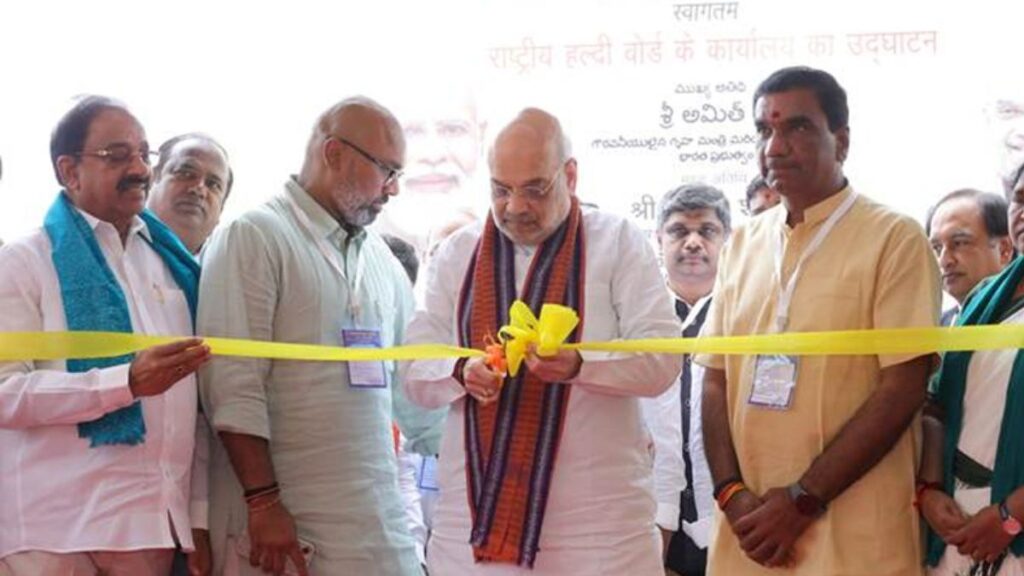
Turmeric Board Nizamabad Inaugurated by Amit Shah to boost farmer income, quality production, and target $1B turmeric exports by 2030. Learn key facts for UPSC, SSC, and other exams.
Turmeric Board HQ Inaugurated in Nizamabad by Union Home Minister Amit Shah
Union Home Minister Amit Shah officially inaugurated the National Turmeric Board headquarters on June 29, 2025, at Nizamabad, Telangana—a region renowned as the “turmeric capital” of India location was strategically selected because Telangana ranks as India’s third-largest turmeric producer in 2024–25 The Board, formally notified in October 2023, was established under the Ministry of Commerce & Industry to promote cultivation, processing, branding, and export of turmeric—an initiative farmers have long demanded .
In his inaugural speech, Shah unveiled the Board’s official logo and announced a commitment to farmers’ welfare, stating the government had earmarked ₹200 crore for quality enhancement, research, and income support measures Farmers recently received INR 18 000–19 000 per quintal; the output target aims at an additional INR 6 000–7 000 per quintal over the next three years The Nizamabad Agriculture Market yard, a major turmeric trade hub since 1933 and part of the eNAM network, will work synergistically with the Board
The Board’s ultimate ambition is to achieve $1 billion in turmeric exports by 2030, leveraging global demand in health, food, beauty, and wellness segments Additionally, farmer cooperatives like National Cooperative Exports Ltd will guide international packaging, standards compliance, and training—helping reduce intermediaries and elevate farmer earnings

Why This News Is Important 🟨
Enhancing Farmer Income & Livelihood
The establishment of the National Turmeric Board directly addresses long-standing issues farmers faced—such as low prices, lack of quality control, and dependence on intermediaries. The Board’s mandate includes providing better planting material, advanced agronomic practices, and direct market linkages, all aimed at ensuring sustainable income growth
Strategic Export Goal & Marketing Support
With a clear roadmap to reach $1 billion in exports by 2030, this initiative aligns with the government’s broader strategy to position India as the global leader in turmeric trade. Investment in branding, packaging, and international certifications will build India’s reputation as a quality supplier .
Policy & Governance Focus
Turmeric’s elevation to a stand-alone board underscores governmental prioritization of critical agricultural commodities. Drawing parallels to successful boards for tea, coffee, and spices, this move signifies emphasis on sectoral governance and integrated development .
Historical Context: Roots of the Turmeric Board
Turmeric—a rhizomatous herb native to India—is central to the country’s spice production, holding a 75% share of global cultivation and a 62% share of international trade in 2022–23 . Despite this, turmeric growers struggled with fluctuating prices, inadequate processing infrastructure, and limited export capacity. Farmers in regions like Nizamabad often had to rely on distant markets like Sangli (Maharashtra) for fair pricing—a situation greatly improved by the eNAM platform integration in 2016
Farmers have been demanding a dedicated Turmeric Board for decades. In response, the government announced its plan in 2023, and operations began in early 2025, culminating in the HQ inauguration Telangana’s inclusion as the base is significant—its agricultural grid, robust cooperative sector, and responsive millet infrastructure make it a natural choice .
Key Takeaways from Turmeric Board Inauguration
| S. No. | Key Takeaway |
|---|---|
| 1 | National Turmeric Board formally opened on June 29, 2025, in Nizamabad, Telangana. |
| 2 | Telangana is the third-largest producer of turmeric in India for 2024–25. |
| 3 | Government committed ₹200 crore to boost quality, research, and farmer incomes. |
| 4 | Target set for $1 billion in turmeric exports by 2030. |
| 5 | Farmers to receive advanced planting material, training, and better market linkages. |
FAQs: Frequently Asked Questions
Q1. What is the National Turmeric Board?
The National Turmeric Board is a dedicated body set up by the Government of India under the Ministry of Commerce & Industry to promote turmeric cultivation, processing, value addition, branding, and export.
Q2. When and where was the headquarters of the National Turmeric Board inaugurated?
The headquarters was inaugurated on June 29, 2025, in Nizamabad, Telangana, a major turmeric-producing region in India.
Q3. Why is Nizamabad chosen as the HQ for the Turmeric Board?
Nizamabad is one of the highest turmeric-producing districts in the country, with rich agricultural history and existing turmeric trade infrastructure including the Nizamabad Agriculture Market Yard.
Q4. What is the export target set by the government for turmeric?
The government aims to achieve $1 billion in turmeric exports by 2030 through better branding, quality control, and market linkages.
Q5. How much budget has been allocated for turmeric development?
The government has allocated ₹200 crore to support farmers through research, quality enhancement, and improved market access.
Q6. Which ministry governs the National Turmeric Board?
It falls under the jurisdiction of the Ministry of Commerce and Industry.
Q7. How will this Board benefit farmers?
The Board will provide training, access to better planting material, value addition support, export opportunities, and reduce dependence on middlemen.
Q8. How is this development relevant to competitive exams?
It connects with topics such as agriculture policies, rural development, economic reforms, farmer welfare schemes, and India’s export strategies—important for exams like UPSC, SSC, Banking, Railways, and State PCS.
Some Important Current Affairs Links

