
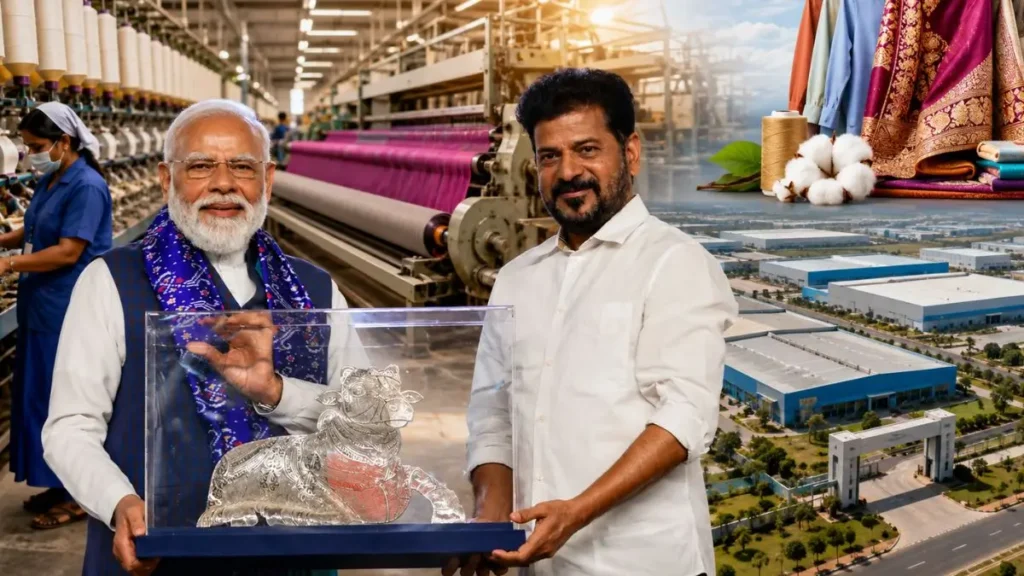
PM MITRA Park Warangal Telangana 2026 marks India’s first mega textile hub under the PM MITRA scheme, boosting jobs, investment, exports, and integrated textile manufacturing under the 5F Vision.
Introduction to the PM MITRA Park Initiative
India has taken a major step toward strengthening its textile industry with the inauguration of the country’s first operational PM MITRA Park in Warangal, Telangana. The park was inaugurated by Narendra Modi and is being seen as a landmark development in India’s industrial and manufacturing sector. The PM MITRA scheme is aimed at building world-class textile infrastructure and positioning India as a global textile hub.
The Warangal PM MITRA Park has been developed at an estimated cost of ₹1,695 crore and spreads across nearly 1,327 acres. The project is expected to attract investments worth more than ₹6,000 crore while generating over 24,400 direct and indirect employment opportunities.
What is PM MITRA?
PM MITRA stands for Prime Minister Mega Integrated Textile Region and Apparel Park. The scheme was launched by the Government of India to establish integrated textile parks with modern infrastructure and seamless logistics. These parks are designed to support the complete textile value chain, ranging from raw material production to export-ready garments.
The initiative follows the government’s “5F Vision”:
- Farm to Fibre
- Fibre to Factory
- Factory to Fashion
- Fashion to Foreign
This vision aims to increase textile exports, encourage manufacturing, and improve India’s competitiveness in the global textile market.
Why Warangal Was Chosen
Warangal in Telangana has a strong historical connection with cotton cultivation and textile manufacturing. Telangana has significant cotton-producing regions, making Warangal an ideal location for a mega textile park. The region also has excellent transport connectivity through highways, railways, and proposed infrastructure projects.
The park is strategically located near the proposed Nagpur–Vijayawada Greenfield Expressway, ensuring easier transportation of goods to ports and industrial corridors. This connectivity is expected to reduce logistics costs and improve export efficiency.
Infrastructure and Facilities Inside the Park
The PM MITRA Park in Warangal has been designed as a modern industrial ecosystem. It includes advanced facilities such as:
- Dedicated power substations
- Water supply systems
- Internal road networks
- Common Effluent Treatment Plant (CETP)
- Zero Liquid Discharge technology
- Solar power facilities
- Worker housing and support infrastructure
These facilities are expected to create a sustainable and environmentally friendly textile manufacturing ecosystem.
Employment and Economic Impact
One of the most important aspects of the PM MITRA Park is employment generation. The project is expected to create over 24,400 jobs directly and indirectly. A significant number of these jobs are likely to benefit women workers in textile and garment manufacturing sectors.
The project is also expected to encourage MSMEs, boost local industries, and increase textile exports from India. Several companies have already shown interest in investing in the park, and around 62% of the area has reportedly been allotted to industries.
Government Support and Incentives
Under the PM MITRA scheme, industries setting up operations in the park will receive Competitive Incentive Support and benefits under other government schemes like the Production Linked Incentive (PLI) Scheme. The government has allocated ₹300 crore to each PM MITRA Park to improve investor confidence and infrastructure quality.
The integrated approach is expected to reduce production costs and improve ease of doing business in the textile sector.
Importance for India’s Textile Sector
India is one of the world’s largest textile producers, but it has often faced challenges such as fragmented supply chains, outdated infrastructure, and high logistics costs. The PM MITRA model aims to solve these problems by creating integrated industrial zones where all textile-related activities can happen in one location.
The Warangal PM MITRA Park is expected to become a model for the six other parks planned under the scheme in states like Gujarat, Tamil Nadu, Karnataka, Maharashtra, Uttar Pradesh, and Madhya Pradesh.

Why This News is Important
Important for Government Exam Preparation
The inauguration of India’s first PM MITRA Park is highly important for competitive examinations because it combines topics related to economy, industry, infrastructure development, employment generation, and government schemes.
Questions related to flagship government initiatives, textile industry reforms, Make in India, industrial corridors, and employment schemes are frequently asked in exams like UPSC, SSC, Banking, Railways, State PCS, Defence, and Teaching examinations.
Boost to Manufacturing and Exports
The PM MITRA Park represents India’s strategy to become a global textile manufacturing hub. The project aligns with the goals of “Make in India” and “Atmanirbhar Bharat.” The textile industry is one of India’s largest employment-generating sectors after agriculture.
By improving infrastructure and reducing logistics costs, the government aims to increase textile exports and attract foreign investment. This development is therefore important from both economic and international trade perspectives.
Employment and Women Empowerment
The textile and apparel sector traditionally employs a large number of women workers. The PM MITRA Park is expected to create thousands of employment opportunities, especially for women in Telangana and surrounding regions.
For exam preparation, students should understand how industrial projects contribute to inclusive growth, rural development, and women empowerment.
Historical Context
India’s Textile Legacy
India has historically been one of the world’s oldest textile-producing civilizations. From handloom weaving during ancient times to cotton exports during the Mughal period, textiles have played a major role in the Indian economy.
During the colonial era, India’s textile industry suffered due to British industrial policies. However, after independence, India gradually rebuilt its textile manufacturing capabilities.
Modern Textile Reforms
In recent decades, India has attempted to modernize the textile sector through schemes like:
- Technology Upgradation Fund Scheme (TUFS)
- Scheme for Integrated Textile Parks (SITP)
- Production Linked Incentive (PLI) Scheme
- PM MITRA Scheme
The PM MITRA initiative represents the next phase of industrial modernization by creating mega integrated textile hubs with global-standard infrastructure.
Warangal’s Textile Background
Warangal has traditionally been associated with cotton farming and textile activities. The region’s black soil is highly suitable for cotton cultivation. Telangana has also promoted industrial growth through textile parks and industrial corridors over the past decade.
The Kakatiya Mega Textile Park project, which later became associated with the PM MITRA initiative, was originally conceptualized to revive Warangal’s historic textile importance.
Key Takeaways from This News
| S.No. | Key Takeaway |
|---|---|
| 1 | India’s first operational PM MITRA Park has been inaugurated in Warangal, Telangana. |
| 2 | The project is developed at a cost of approximately ₹1,695 crore over 1,327 acres. |
| 3 | The park is expected to attract investments worth over ₹6,000 crore and generate 24,400+ jobs. |
| 4 | PM MITRA follows the government’s “5F Vision” — Farm to Fibre to Factory to Fashion to Foreign. |
| 5 | The project aims to strengthen India’s textile manufacturing, exports, infrastructure, and employment generation. |
FAQs (Frequently Asked Questions)
1. What is the PM MITRA Park scheme?
PM MITRA (Prime Minister Mega Integrated Textile Region and Apparel) Park scheme is a Government of India initiative to develop large-scale, integrated textile manufacturing hubs with world-class infrastructure to boost the textile sector.
2. Where has India’s first operational PM MITRA Park been inaugurated?
India’s first operational PM MITRA Park has been inaugurated in Warangal, Telangana.
3. What is the main objective of the PM MITRA Parks?
The main objective is to integrate the entire textile value chain—from raw material production to garment manufacturing and exports—under one ecosystem to reduce costs and improve efficiency.
4. How many jobs are expected to be created in the Warangal PM MITRA Park?
The park is expected to generate more than 24,400 direct and indirect employment opportunities.
5. What is the “5F Vision” under the textile scheme?
The 5F Vision stands for Farm to Fibre, Fibre to Factory, Factory to Fashion, and Fashion to Foreign, aimed at strengthening India’s textile export ecosystem.
6. Why is Warangal selected for the PM MITRA Park?
Warangal was selected due to its strong cotton production base, industrial potential, and strategic connectivity to transport corridors and export routes.
7. How will PM MITRA Parks benefit India’s economy?
They will attract investment, boost exports, generate employment, strengthen MSMEs, and position India as a global textile manufacturing hub.
Some Important Current Affairs Links

