
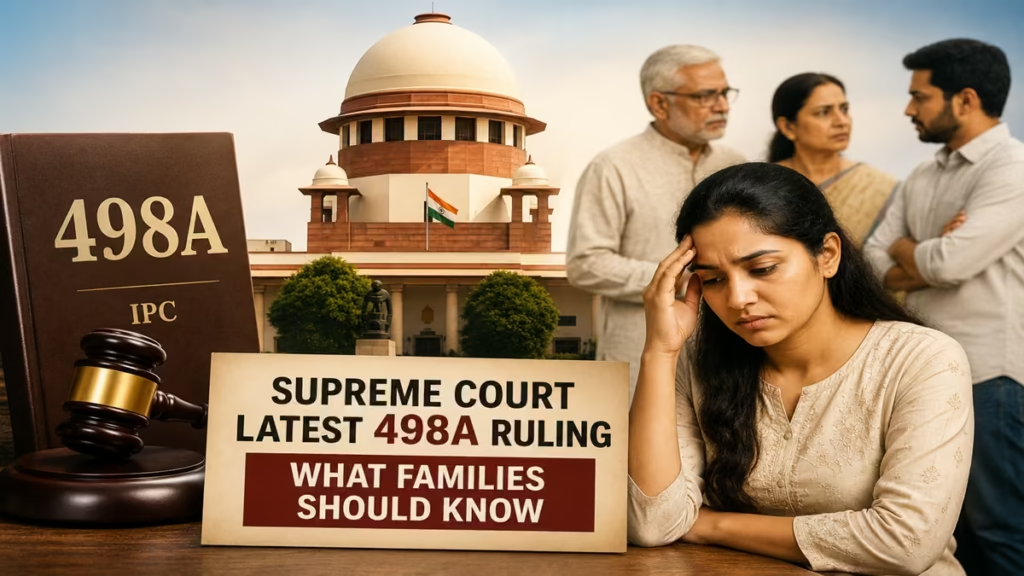
Section 498A Supreme Court ruling explains latest observations on dowry harassment cases, misuse of law, and protection of women under IPC for UPSC and competitive exams.
Supreme Court Latest 498A Ruling Explained for Families: What Government Exam Aspirants Should Know
Understanding Section 498A of IPC
Section 498A of the Indian Penal Code (IPC), now reflected under the Bharatiya Nyaya Sanhita (BNS), was introduced to protect married women from cruelty, domestic violence, and dowry harassment by husbands or their relatives. Over the years, this law has become one of the most discussed legal provisions in India because of debates surrounding both its necessity and alleged misuse. Recently, the Supreme Court of India delivered important observations regarding vague allegations and misuse of Section 498A, which has become highly relevant for judiciary, UPSC, SSC, police, and state PCS examinations.
Supreme Court’s Latest Observation on 498A Cases
The Supreme Court recently emphasized that merely naming family members in matrimonial disputes without specific allegations should not automatically result in criminal prosecution. The Court observed that generalized accusations against husbands’ relatives often lead to unnecessary harassment of innocent family members. According to the ruling, criminal proceedings should be based on concrete evidence and clearly defined acts of cruelty.
The Court also clarified that misuse of Section 498A cannot become a reason to strike down the law entirely because genuine victims of domestic violence and dowry harassment still require strong legal protection. This balanced approach reflects the judiciary’s attempt to protect women while also preventing abuse of legal provisions.
What the Court Said About “Cruelty”
In several recent judgments, the Supreme Court clarified that cruelty under Section 498A must involve grave physical or mental harassment capable of causing serious injury or forcing a woman into extreme distress. Simple domestic disagreements, financial disputes, or ordinary marital tensions do not automatically amount to criminal cruelty.
The Court further noted that vague allegations without dates, incidents, or supporting evidence cannot justify prosecution against in-laws or distant relatives. This observation is important because courts across India receive many matrimonial cases involving multiple family members who may not have direct involvement in the dispute.
Importance of the Judgment for Indian Society
The ruling has sparked nationwide discussion because matrimonial disputes have significant social and legal implications in India. Supporters of the judgment believe it will reduce harassment caused by false or exaggerated complaints. At the same time, women’s rights activists stress that Section 498A remains crucial for protecting women facing genuine abuse and dowry-related violence.
The judgment also highlights the judiciary’s growing focus on balancing individual rights with social justice. Courts are increasingly encouraging mediation, reconciliation, and careful investigation before criminal proceedings are initiated in family disputes.
Relevance for Competitive Examinations
This issue is highly important for government exam aspirants because questions related to the Indian judiciary, women’s rights, social justice, constitutional law, and recent Supreme Court judgments frequently appear in examinations like UPSC, State PCS, SSC CGL, Judiciary exams, banking awareness tests, and police recruitment exams.
Students should remember that Section 498A was enacted in 1983 to combat dowry-related cruelty and domestic violence. They should also understand the current debate regarding safeguards against misuse while ensuring justice for genuine victims. Questions may also focus on judicial activism, gender justice, and reforms in criminal law.
Impact on the Indian Legal System
The Supreme Court’s ruling reinforces the principle that criminal law should not be used as a weapon for personal vendetta. Courts have repeatedly warned against indiscriminate prosecution of entire families in matrimonial disputes. This judgment may influence lower courts to scrutinize complaints more carefully before issuing summons or arrests.
At the same time, the judiciary has reiterated that genuine complaints must receive full legal protection. Therefore, the judgment attempts to create a balance between protecting women and preventing abuse of criminal provisions.

Why This News is Important
Importance for Judiciary and Governance
The recent ruling of the Supreme Court of India is important because it addresses a major social and legal issue involving matrimonial disputes, dowry harassment, and misuse of criminal laws. Section 498A has remained controversial for decades due to allegations that innocent family members are sometimes implicated without sufficient evidence. The Court’s observations are significant because they strengthen the principle of fair investigation and protection of individual rights.
Importance for Women’s Rights and Social Justice
The judgment is equally important because the Supreme Court refused to weaken or abolish Section 498A despite acknowledging misuse in some cases. The Court emphasized that genuine victims of domestic violence still need strong legal safeguards. This balanced approach demonstrates how the judiciary attempts to protect vulnerable groups while ensuring that laws are not misused for harassment.
Importance for Competitive Exams
For students preparing for UPSC, State PCS, SSC, judiciary, railway, police, banking, and defence examinations, this news is highly relevant under topics such as Indian Polity, Judiciary, Social Issues, Women Empowerment, and Current Legal Developments. Questions may be asked about Section 498A, judicial reforms, misuse of laws, or recent Supreme Court observations on criminal justice. Understanding this case can help aspirants answer both objective and descriptive questions effectively.
Historical Context
Origin of Section 498A
Section 498A was added to the Indian Penal Code in 1983 amid increasing cases of dowry deaths and cruelty against married women. During the 1970s and early 1980s, India witnessed growing public concern over domestic violence and harassment linked to dowry demands. Women’s rights groups demanded stronger legal protection for married women facing abuse.
The law made cruelty by a husband or his relatives a cognizable and non-bailable offence. Its objective was to deter dowry harassment and provide immediate legal remedies to victims.
Debate Over Misuse
Over time, courts observed instances where complaints under Section 498A allegedly included exaggerated or false allegations against multiple family members. Several judgments from the Supreme Court and High Courts highlighted concerns regarding misuse of the provision.
In earlier cases such as Arnesh Kumar vs State of Bihar (2014), the Supreme Court issued guidelines to prevent automatic arrests under Section 498A. The judiciary emphasized that police authorities must conduct proper investigations before making arrests.
Transition Under Bharatiya Nyaya Sanhita
With the replacement of IPC by the Bharatiya Nyaya Sanhita (BNS), the provisions relating to cruelty against married women continue under the new criminal law framework. The recent Supreme Court rulings indicate that the judiciary will continue balancing women’s protection with safeguards against misuse of criminal laws.
Key Takeaways from This News
| S.No. | Key Takeaway |
|---|---|
| 1 | Section 498A was introduced in 1983 to protect married women from cruelty and dowry harassment. |
| 2 | The Supreme Court stated that vague allegations against family members are insufficient for criminal prosecution. |
| 3 | The Court clarified that misuse of Section 498A cannot justify abolishing the law. |
| 4 | Genuine victims of domestic violence and cruelty still require strong legal safeguards. |
| 5 | The judgment is important for UPSC, PCS, SSC, judiciary, banking, police, and other competitive examinations. |
FAQs (Frequently Asked Questions)
1. What is Section 498A of IPC?
Section 498A of the Indian Penal Code deals with cruelty by husband or his relatives against a married woman, mainly related to dowry harassment and domestic violence.
2. What is the main issue discussed in the Supreme Court ruling on 498A?
The Supreme Court highlighted concerns about vague and generalized allegations in matrimonial disputes, especially where multiple family members are implicated without specific evidence.
3. Can Section 498A cases be filed against all family members?
Yes, but the Court has clarified that only those against whom specific and credible allegations exist should be prosecuted.
4. Why is Section 498A considered important in India?
It provides legal protection to married women facing cruelty, domestic abuse, or dowry-related harassment.
5. What did the Supreme Court say about misuse of 498A?
The Court stated that misuse of the provision cannot be a reason to remove or weaken the law, as it is essential for protecting genuine victims.
6. Is Section 498A a bailable offence?
No, Section 498A is a cognizable and non-bailable offence under Indian criminal law.
7. Why is this judgment important for exams?
It is relevant for Polity, Judiciary, Social Justice, and Current Affairs sections in UPSC, SSC, Banking, Railway, Defence, and State PCS exams.
Some Important Current Affairs Links

