
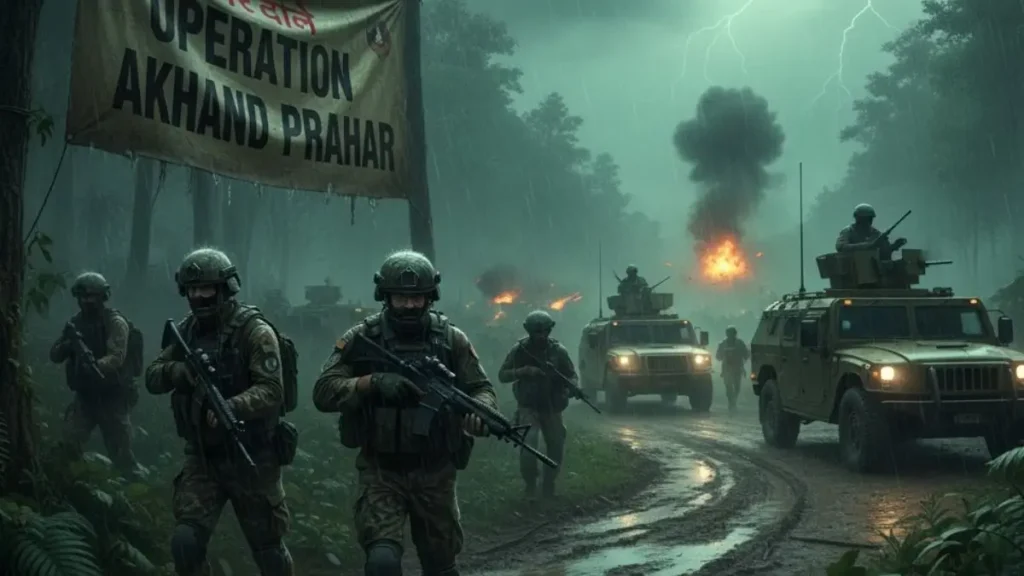
RUDRA Brigade desert exercise showcases Operation Akhand Prahar, highlighting India’s multi-domain warfare, indigenous defense technology, and army modernization for strategic preparedness.
RUDRA Brigade Goes ‘Prachand’: Inside India’s Futuristic Desert Warfare Exercise
In a powerful demonstration of combat-readiness, the Indian Army recently carried out Operation Akhand Prahar in the deserts of Jaisalmer, Rajasthan, marking a turning point in its multi‑domain warfare capabilities. The exercise put the newly formed RUDRA Brigade through its paces — validating its integrated combat strength, advanced technology usage, and ability to execute high-intensity operations.
What Is Operation Akhand Prahar?
Operation Akhand Prahar is designed as a multi-domain warfare drill, emphasizing coordinated action across land, air, and technology fronts. Held under the Indian Army’s Southern Command, the exercise was also a critical part of the larger Tri-Services Exercise Trishul, with strong participation from the Indian Air Force. The mission: test real-world battlefield scenarios under the harsh conditions of the desert, integrating modern systems like drones, AI-based surveillance, and counter-drone platforms
Key Features of the Operation
- Multi‑Domain Coordination
- The exercise featured extensive coordination between infantry, armoured units, mechanised infantry, and air defence artillery.
- Real‑time battlefield operations were carried out using UAVs, counter‑drone systems, and other indigenous technologies.
- Validation of RUDRA Brigade
- The RUDRA Brigade — whose name symbolizes Lord Shiva — conducted large-scale violent maneuvers (“Prachand” meaning fierce) to demonstrate its strength.
- This brigade is particularly significant because it’s India’s first fully integrated all-arms combat formation, able to respond to complex, high-intensity conflicts.
- Innovation & Atmanirbharta
- The exercise showcased a number of indigenously developed technologies, aligning with India’s self-reliance (Atmanirbharta) goals.
- Deployed systems included smart recon drones, real-time data-sharing networks, portable anti-drone devices, and AI-assisted battlefield control systems.
Participating Forces and Leadership
- Lt. Gen. Dhiraj Seth, General Officer Commanding-in-Chief of the Southern Command, oversaw the exercise.
- Key combat units such as the Konark Corps and the Battle Axe Division were involved.
- The Indian Air Force played a crucial role, ensuring air-land synergy was tested through coordinated missions.
RUDRA Brigade: India’s Next‑Gen Combat Formation
The RUDRA Brigade is a cutting-edge force structure that integrates:
- Infantry, Armoured, Mechanised infantry units
- Artillery, Air Defence Artillery, and Engineers
- Support from UAVs, AI-based surveillance, and counter-drone systems for real-time intelligence and rapid strike capability.
- High mobility and precision strike capability, making it effective across different terrains and mission scales.
Atmanirbharta in Action: Indigenous Tech Front & Center
Operation Akhand Prahar was as much about validating new doctrine as it was about testing Indian-developed technologies. Some of the notable indigenous systems used:
- Smart reconnaissance drones for battlefield surveillance
- Portable anti-drone systems to neutralize aerial threats
- AI-assisted command systems for faster decision-making and control
- Data-sharing networks to provide real-time situational awareness across units
The “JAI” Mantra: Philosophy Behind the Transformation
Lt. Gen. Dhiraj Seth emphasized a guiding philosophy for this modernization, called the JAI mantra:
- J – Jointness: Seamless integration between Army, Navy, and Air Force
- A – Atmanirbharta: Reliance on domestically built technology
- I – Innovation: Embracing modern, adaptive tactics and systems
This philosophy underpins the Indian Army’s shift toward becoming a 21st-century technological force, ready to handle complex and multi-front threats with agility and resilience.
Static Facts
- Operation name: Akhand Prahar
- Location: Jaisalmer, Rajasthan
- Formation validated: RUDRA Brigade (all-arms)
- Command: Southern Command, Indian Army
- Senior leader: Lt. Gen. Dhiraj Seth
- Technologies used: UAVs, counter‑drone systems, AI-based systems

Why This News Is Important
Strategic Significance for Defence Preparedness
This development is a major leap in India’s defense posture. The validation of the RUDRA Brigade in an integrated all-arms role demonstrates the Army’s increasing readiness for modern, high-intensity conflicts. It signals India’s intent to build a multi-domain operational capability — combining land, air, and technological warfare — to respond swiftly to emerging threats.
Reinforcing Self‑Reliance (Atmanirbharta)
The heavy use of indigenous technologies like AI‑driven systems, reconnaissance drones, and counter-drone platforms shows that India is not just expanding force structure, but also strengthening its self-reliant defense ecosystem. This aligns with the national vision of Atmanirbharta in defense, reducing dependency on foreign imports.
Improving Jointness and Inter‑Service Synergy
By integrating Army operations with the Indian Air Force and testing collaborative missions in real-time, the exercise strengthens tri-service coordination. This jointness is critical for future operations, especially in complex theatres where land and air forces must operate in concert.
Exam-Relevant for Aspirants
For students preparing for defense exams (like NDA, CDS), civil services (UPSC-PCS/IAS), and other government roles, this news is a key current affairs topic. It highlights India’s changing strategic doctrine, modernization priorities, and future military capabilities — topics often tested in General Studies, Defense, and Security segments.
Historical Context
Origins of Multi‑Domain Warfare
Historically, military operations were domain-centric (land, air, sea). However, in the 21st century, warfare has evolved into multi-domain operations (MDO), where simultaneous coordination across different domains — including cyber and space — is critical. India’s recent exercises reflect this global shift.
Formation of RUDRA Brigade
The RUDRA Brigade is part of a broader push by the Indian Army to modernize and streamline its structure. According to reports, it integrates infantry, mechanised units, armour, artillery, engineers, and air defense under a single command. This is aligned with India’s emerging doctrine of “Cold Strike”, which emphasizes high readiness and rapid deployment, in contrast to older doctrines that relied on large-scale mobilisation.
Tri-Services Exercise Trishul
Operation Akhand Prahar was conducted as a part of Exercise Trishul, a tri-services war game that underscores the Indian military’s growing emphasis on joint operations. Such exercises are increasingly common, reflecting the need to validate integrated strategies in real-world-like scenarios — from land battles to aerial support to technological warfare.
Key Takeaways from This News
| S.No | Key Takeaway |
|---|---|
| 1 | Operation Akhand Prahar is a multi-domain desert warfare exercise conducted by the Indian Army in Jaisalmer, under Southern Command. |
| 2 | The RUDRA Brigade, India’s first fully integrated all-arms combat formation, was operationally validated during this exercise. |
| 3 | Exercise featured real-time coordination among infantry, mechanised units, artillery, air defense, and even engineers. |
| 4 | Indigenous technologies like UAVs, AI-assisted battlefield systems, and counter‑drone platforms were heavily used, promoting Atmanirbhar Bharat in defense. |
| 5 | The exercise was guided by the JAI mantra: Jointness (services), Atmanirbharta (self-reliance), and Innovation, reflecting India’s strategic priorities. |
FAQs: Frequently Asked Questions
1. What is Operation Akhand Prahar?
Operation Akhand Prahar is a multi-domain desert warfare exercise conducted by the Indian Army in Jaisalmer, Rajasthan, to validate integrated combat capabilities and modern warfare technologies.
2. What is the RUDRA Brigade?
The RUDRA Brigade is India’s first fully integrated all-arms combat formation, combining infantry, mechanised units, armour, artillery, air defense, and engineers for rapid high-intensity operations.
3. Which technologies were prominently used in this exercise?
The exercise employed UAVs, AI-assisted command systems, counter-drone devices, and real-time data-sharing networks, reflecting India’s push for Atmanirbharta in defense.
4. Who oversaw the exercise?
The exercise was led by Lt. Gen. Dhiraj Seth, General Officer Commanding-in-Chief of the Indian Army’s Southern Command.
5. What is the JAI mantra?
The JAI mantra stands for Jointness, Atmanirbharta, and Innovation, guiding India’s strategy for integrated modern warfare.
6. Why is this news important for government exam aspirants?
It highlights India’s defense modernization, multi-domain operational capability, and indigenous technology adoption, all of which are crucial topics for General Studies, Defense, and Security segments in competitive exams.
7. Where was the exercise conducted?
The exercise took place in the desert region of Jaisalmer, Rajasthan, chosen for its harsh conditions to simulate real battlefield scenarios.
Some Important Current Affairs Links

