
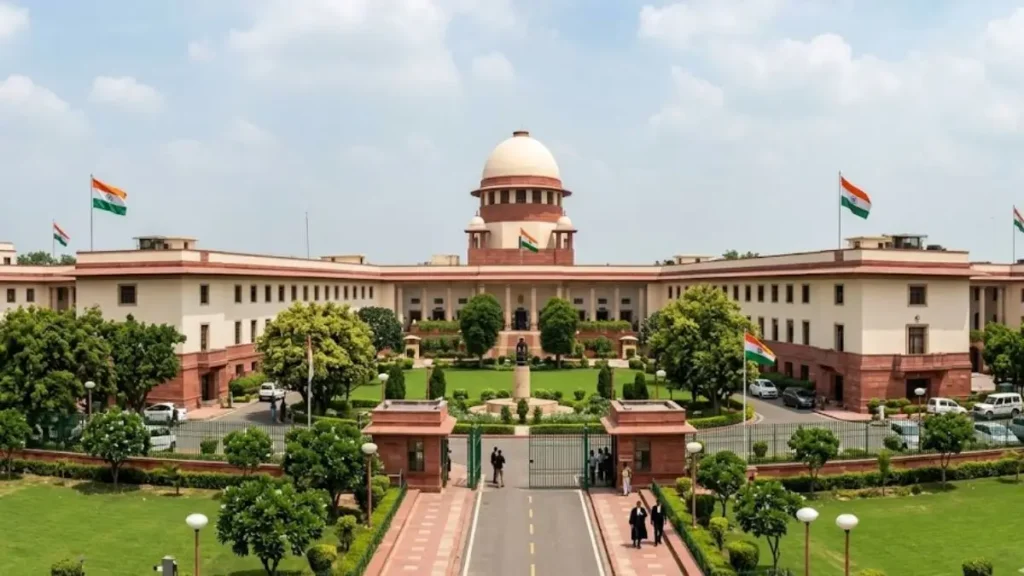
Right to vote not a fundamental right explained with Supreme Court judgment, electoral laws, and exam-relevant facts for UPSC, SSC, and PCS preparation.
Supreme Court Clarifies Legal Status of Voting and Election Participation Rights in India
Introduction: Landmark Clarification by the Supreme Court
The Supreme Court of India has recently delivered a significant judgment clarifying the legal status of voting and election participation rights in India. The ruling reaffirmed that the right to vote and the right to contest elections are not fundamental rights but statutory rights, governed by laws enacted by Parliament and state legislatures.
This decision has major implications for understanding democratic participation and constitutional law in India, making it highly relevant for competitive exams like UPSC, SSC, Banking, and State PCS.
Understanding the Supreme Court Verdict
The judgment was delivered by a bench comprising Justices B.V. Nagarathna and R. Mahadevan. The Court reiterated a well-established legal position that:
- The right to vote is a statutory right, not a fundamental right.
- The right to contest elections is a separate and additional right, subject to eligibility conditions.
- Both rights exist only within the framework of statutory provisions.
This means citizens cannot claim these rights under Part III of the Constitution, which guarantees fundamental rights.
Distinction Between Voting and Contesting Elections
The Court clearly differentiated between two key electoral rights:
Right to Vote
The right to vote allows eligible citizens to participate in elections. However, it is derived from statutory laws such as:
- Representation of the People Act, 1950
- Representation of the People Act, 1951
Right to Contest Elections
This is a distinct right that goes beyond voting. The Court emphasized that:
- It can be restricted through eligibility conditions.
- Criteria such as qualifications and disqualifications can be imposed legally.
Thus, contesting elections is not an inherent right but a regulated privilege.
Case Background: Rajasthan Cooperative Society Dispute
The ruling emerged from a dispute related to elections in District Milk Producers’ Cooperative Unions in Rajasthan. The issue revolved around eligibility conditions such as:
- Minimum participation in cooperative activities
- Operational continuity requirements
The Rajasthan High Court had earlier struck down these conditions, but the Supreme Court overturned that decision, stating that such eligibility criteria are legally valid and do not violate constitutional rights.
Statutory Nature of Electoral Rights
The Court emphasized that electoral rights are created and regulated through legislation. These laws determine:
- Who can vote (based on age, citizenship, registration)
- Who can contest elections
- Grounds for disqualification (e.g., criminal records, corrupt practices)
Thus, Parliament and state legislatures have the authority to modify or regulate these rights.
Why This News is Important
Clarity for Constitutional Understanding
This judgment is crucial because it removes common confusion regarding whether voting is a fundamental right. Many citizens assume voting is constitutionally guaranteed, but the Court clarified that it is a statutory entitlement. This distinction is vital for aspirants preparing for polity-related questions in exams.
Impact on Electoral Reforms
Since electoral rights are statutory, Parliament has the flexibility to introduce reforms such as:
- Eligibility conditions
- Disqualification rules
- Election process modifications
This gives lawmakers the power to strengthen electoral integrity without constitutional amendments.
Relevance for Judiciary and Governance
The ruling reinforces judicial restraint in electoral matters, especially in cases involving cooperative societies and internal governance. It also highlights that courts will not interfere unless there is a violation of statutory provisions.
Exam-Oriented Significance
For competitive exams, this topic is highly important because:
- It relates to Indian Polity (a core subject)
- It connects with constitutional provisions and electoral laws
- It is a frequently tested conceptual area in UPSC and State PCS exams
Historical Context: Evolution of Voting Rights in India
Constitutional Framework
The Indian Constitution provides for elections under Articles 324–329 but does not explicitly define voting as a fundamental right. Instead, it leaves the regulation of elections to statutory laws.
Role of Representation of the People Acts
The Representation of the People Acts (1950 & 1951) form the backbone of electoral governance in India. These laws define:
- Electoral rolls
- Voting eligibility
- Election procedures
Judicial Precedents
Over the years, the Supreme Court has consistently maintained that:
- Voting is a statutory right
- Contesting elections is not a fundamental right
The latest judgment simply reiterates and strengthens this long-standing legal position.
Key Takeaways from This News
| S. No. | Key Takeaway |
|---|---|
| 1 | The right to vote is a statutory right, not a fundamental right. |
| 2 | The right to contest elections is separate and subject to eligibility conditions. |
| 3 | Electoral rights are governed by laws like the Representation of the People Acts. |
| 4 | Parliament and state legislatures can regulate or modify election-related rights. |
| 5 | The Supreme Court reaffirmed judicial restraint in electoral and cooperative disputes. |
Frequently Asked Questions (FAQs)
1. Is the right to vote a fundamental right in India?
No, the right to vote is not a fundamental right. It is a statutory right granted under laws like the Representation of the People Act, 1950 and 1951.
2. Which court clarified the legal status of voting rights recently?
The clarification was given by the Supreme Court of India.
3. What is the difference between the right to vote and the right to contest elections?
The right to vote allows citizens to elect representatives, while the right to contest elections allows individuals to become candidates. Both are statutory rights, but contesting elections involves stricter eligibility criteria.
4. Under which laws are electoral rights governed in India?
Electoral rights are governed by:
- Representation of the People Act, 1950
- Representation of the People Act, 1951
5. Can Parliament change voting rights in India?
Yes, since voting is a statutory right, Parliament has the authority to amend laws governing electoral rights.
6. Which Articles of the Constitution deal with elections?
Articles 324 to 329 of the Indian Constitution deal with elections and the powers of the Election Commission.
7. What was the main issue in the recent case?
The case involved eligibility conditions in cooperative society elections in Rajasthan, which were upheld by the Supreme Court.
8. Why is this topic important for competitive exams?
It is important because it relates to:
- Indian Polity
- Constitutional Law
- Electoral Reforms
9. Is contesting elections a constitutional right?
No, it is not a constitutional or fundamental right. It is a statutory right subject to legal conditions.
10. Which body conducts elections in India?
The Election Commission of India is responsible for conducting elections.
Some Important Current Affairs Links

