
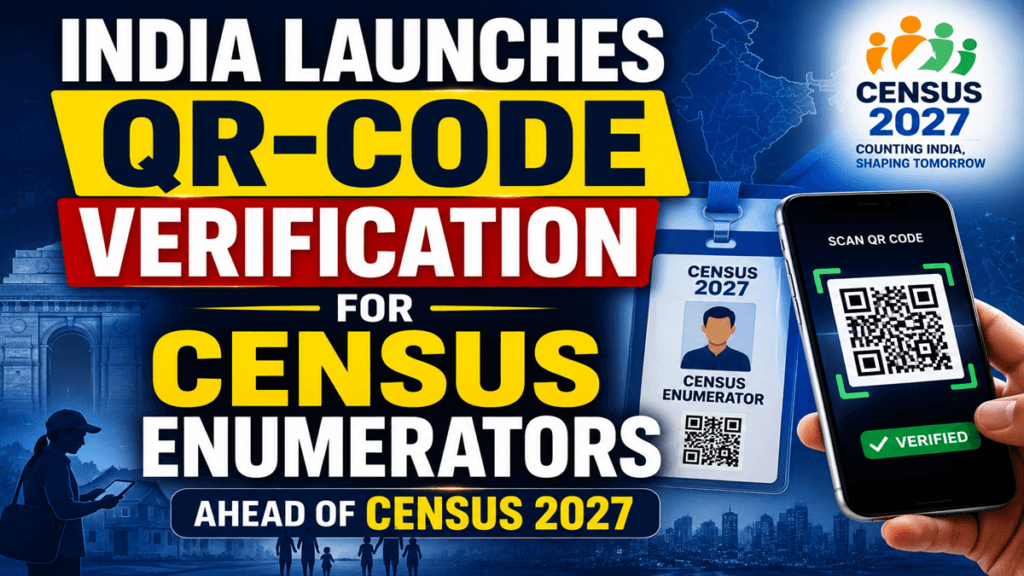
QR code census India introduces a digital verification system for Census 2027 enumerators, enabling citizens to authenticate officials, improving transparency, security, and governance through India’s first fully digital census initiative.
Introduction to the Digital Census Initiative
India has taken a major technological step in the conduct of Census 2027 by introducing QR-code-enabled identity verification for census enumerators. The initiative is part of the country’s first fully digital census exercise and aims to improve transparency, security, and public trust during the enumeration process. Citizens can now verify the identity of census officials by scanning the QR code printed on their official ID cards using smartphones.
The Ministry of Home Affairs and the Office of the Registrar General and Census Commissioner of India are leading the digital transformation of the census process. Around 30 lakh enumerators are expected to participate in the nationwide exercise using mobile applications and centralized digital platforms.
What is QR-Code Verification for Census Enumerators?
The QR-code verification system has been introduced to help citizens confirm whether a person visiting their home is an authorized census official. The QR code embedded on the enumerator’s identity card contains official authentication details that can be instantly verified through mobile scanning.
This move is especially important in urban areas, gated societies, and residential colonies where concerns about fake officials and fraud are increasing. By scanning the QR code, residents can ensure that the enumerator is genuinely associated with the Census 2027 operation.
The system also strengthens cybersecurity and reduces the possibility of impersonation during the large-scale data collection exercise.
India’s First Fully Digital Census
Census 2027 is being described as India’s first fully digital census. Unlike previous paper-based census operations, this edition uses mobile applications, self-enumeration portals, geotagging, and real-time data transmission systems.
The government has launched multiple digital tools for this exercise, including:
- Self-Enumeration Portal
- Houselisting Block Creator Application
- Census Management and Monitoring System
- Mobile Applications for Enumerators
These digital platforms were developed with support from the Centre for Development of Advanced Computing (C-DAC).
The census process is divided into two phases:
- House Listing and Housing Census
- Population Enumeration
The first phase started in April 2026 and focuses on housing conditions, household assets, sanitation, drinking water facilities, and other socio-economic indicators.
Self-Enumeration Facility for Citizens
For the first time in Indian history, citizens have been given the option to self-enumerate online through the official census portal. People can fill in their household details digitally before the enumerator visits their residence.
After completing the online process, households receive a unique Self-Enumeration ID which must be shown to census officials during physical verification. This hybrid model combines digital convenience with field verification to ensure accuracy and reliability of data.
The self-enumeration portal supports multiple regional languages, making it more accessible for citizens across India.
Importance of Data Security in Digital Census
The government has emphasized that all census data collected during the exercise will remain confidential under the provisions of the Census Act, 1948. Officials have stated that the digital system includes multi-layer security and encryption mechanisms for data collection, transmission, and storage.
Only authorized personnel can access the information, and the collected data cannot be used for police investigations, taxation, or legal action. This assurance is intended to increase public confidence and encourage citizen participation.
Role of Technology in Governance
The digital census reflects India’s growing focus on technology-driven governance and administrative reforms. Real-time monitoring, digital verification, geotagging, and centralized dashboards will help reduce delays and improve the efficiency of data collection.
Accurate census data is essential for policymaking, welfare schemes, urban planning, resource allocation, and constituency delimitation. Government programs related to housing, health, education, employment, and infrastructure rely heavily on census statistics.
The integration of QR-code verification demonstrates how digital tools are being used to improve citizen safety and administrative transparency.

Why this News is Important
Significance for Governance and Policy Planning
The launch of QR-code verification for census enumerators is important because the census serves as the foundation for national planning and governance. Census data helps the government understand population trends, literacy levels, migration patterns, employment conditions, and housing infrastructure.
With the adoption of digital tools, India aims to improve the speed and accuracy of data collection. Reliable data is essential for implementing welfare schemes, infrastructure development, and public policy decisions. The digital census also supports evidence-based governance and efficient allocation of government resources.
Importance for Security and Public Trust
The QR-code verification system is also important from a security perspective. Many citizens hesitate to allow unknown individuals into their homes due to concerns about fraud and impersonation. The QR-based authentication mechanism allows residents to instantly verify whether the visitor is an authorized census worker.
This initiative increases public trust in government operations and encourages greater participation in the census process. It also highlights India’s broader push toward digital governance, e-governance services, and technology-based administrative reforms.
For competitive exams, this topic is important because questions may be asked about:
- Census 2027
- Digital governance initiatives
- Census Act, 1948
- Self-enumeration system
- Role of technology in administration
- Ministry of Home Affairs initiatives
Historical Context
Evolution of Census in India
The census in India has a long history dating back to 1872 during British rule. However, the first synchronous and systematic census was conducted in 1881 under British administration. Since then, the census has generally been conducted every ten years.
After Independence, the census became an essential tool for developmental planning and governance. The Census of India is conducted under the Census Act, 1948, and falls under the Union List of the Constitution.
India conducted its last full census in 2011. The next census operation was delayed due to the COVID-19 pandemic and logistical challenges. Census 2027 is therefore highly significant as it will provide updated demographic and socio-economic data after a long gap.
Transition from Traditional to Digital Census
Traditionally, census operations relied on paper schedules and manual data processing, which often required several years for compilation and publication of final reports.
With advances in digital infrastructure, smartphone penetration, and online services, the Government of India decided to modernize the census system. Census 2027 introduces mobile applications, self-enumeration portals, real-time monitoring dashboards, geotagging, and QR-code authentication systems.
This marks a major shift toward digital governance and reflects India’s broader Digital India mission aimed at improving transparency, efficiency, and public service delivery.
Key Takeaways from This News
| S.No. | Key Takeaway |
|---|---|
| 1 | India has introduced QR-code verification for census enumerators in Census 2027. |
| 2 | Citizens can verify the authenticity of census officials by scanning QR codes on ID cards. |
| 3 | Census 2027 will be India’s first fully digital census exercise. |
| 4 | The census includes self-enumeration, mobile applications, and real-time digital monitoring systems. |
| 5 | Census operations in India are conducted under the Census Act, 1948, and are crucial for policymaking and governance. |
FAQs (Frequently Asked Questions)
1. What is QR-code verification in Census 2027?
QR-code verification is a digital system where census enumerators carry ID cards with QR codes. Citizens can scan these codes using smartphones to verify the authenticity of the official visiting their home.
2. Why has India introduced a digital census system?
India has introduced a digital census to improve accuracy, reduce human errors, ensure faster data collection, and increase transparency in the entire enumeration process.
3. Who is conducting the Census 2027 in India?
The Census 2027 is being conducted by the Office of the Registrar General and Census Commissioner of India under the Ministry of Home Affairs.
4. Is Census 2027 India’s first digital census?
Yes, Census 2027 is India’s first fully digital census, using mobile applications, online self-enumeration, and real-time monitoring systems.
5. Can citizens fill census data themselves?
Yes, citizens can use the self-enumeration portal to submit household information online before the physical visit of enumerators.
6. Is census data shared with tax or police departments?
No, census data is strictly confidential under the Census Act, 1948, and cannot be used for taxation, legal, or police purposes.
7. Why is QR-code verification important for exams?
It is important for exams because it is linked to digital governance, cybersecurity in administration, census reforms, and government welfare planning.
Some Important Current Affairs Links

