
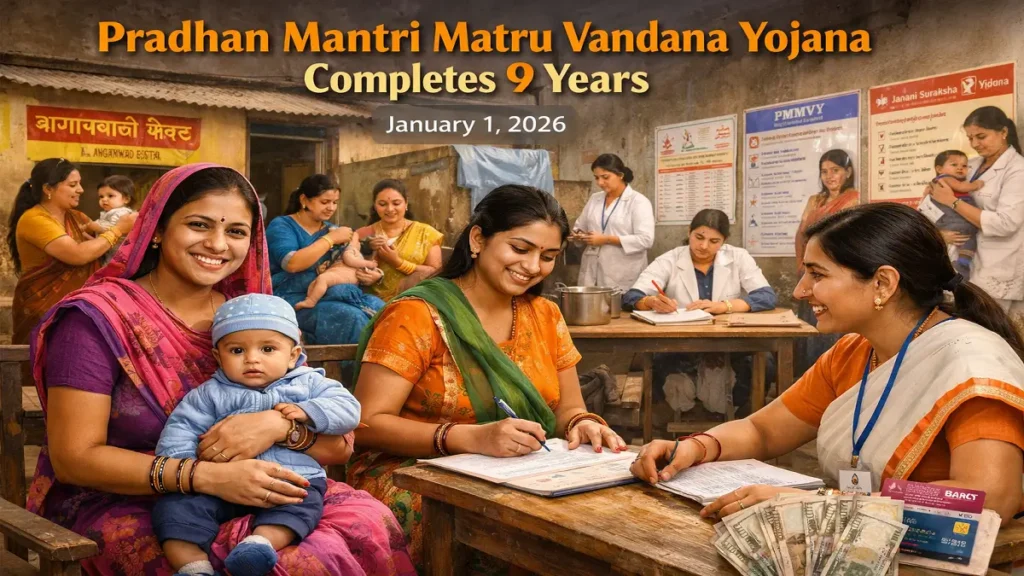
Pradhan Mantri Matru Vandana Yojana benefits 2026: Learn about PMMVY eligibility, financial incentives, objectives, and how the scheme supports maternal and child health across India.
Pradhan Mantri Matru Vandana Yojana Completes Nine Years (2026)
Introduction to PMMVY and Its Milestone
The Pradhan Mantri Matru Vandana Yojana (PMMVY), one of India’s flagship maternity benefit programmes, has completed nine years of service as of 1st January 2026. Launched by the Government of India on January 1, 2017, this Centrally Sponsored Scheme has aimed to provide crucial financial support to pregnant women and lactating mothers, especially those belonging to socially and economically disadvantaged sections. Over the past nine years, the scheme has reached millions of beneficiaries across the country, improving maternal health outcomes and promoting nutritional well-being.
Objectives and Purpose of the Scheme
The primary objective of PMMVY is to give partial compensation for wage loss during pregnancy and to encourage better health-seeking behaviour. The scheme provides financial incentives to expectant and new mothers to ensure proper medical care, nutritional support, safe delivery, and early childhood health monitoring. It also emphasizes the promotion of institutional deliveries through conditions tied to antenatal check-ups and health milestones that beneficiaries must meet to receive the full benefit.
Key Features and Benefits Provided
Under PMMVY, eligible pregnant women and lactating mothers receive financial assistance in the form of cash incentives. Initially, a total of ₹5,000 is given for the first child — ₹3,000 at the time of pregnancy registration and ₹2,000 after childbirth upon meeting specific criteria. For a second child who is a girl, beneficiaries are entitled to a total of ₹6,000. These payments are directly transferred to the beneficiary’s bank or post office accounts via the Direct Benefit Transfer (DBT) mechanism.
Implementation and Funding Pattern
PMMVY is implemented by the Ministry of Women & Child Development (MoWCD) and follows a central-state shared funding pattern. It also aligns with the provisions of the National Food Security Act (NFSA), 2013, which mandates maternity benefits for eligible women. The scheme’s inclusive design ensures that women from various states and union territories benefit through uniform guidelines, while states contribute to co-funding and grassroots execution via Anganwadi centres and health workers.
Impact and Outreach Over Nine Years
Since its inception, PMMVY has achieved significant reach: over 4.5 crore beneficiaries have been enrolled and more than ₹19,000 crore disbursed to support women during pregnancy and lactation. This extensive coverage has not only provided financial relief but also encouraged improved maternal nutrition and timely health check-ups, contributing to overall maternal and child health.

Why This News Is Important for Government Exam Aspirants
Relevance to GS and Social Policy Sections
The completion of nine years by PMMVY is highly relevant for UPSC, State PSC, SSC, Banking, Police, and other competitive exams because it reflects an important milestone in India’s social welfare and public health policy. Aspirants must understand the objectives, impact, and implementation mechanisms of key government schemes — particularly those targeting women and child development — as these topics frequently appear in General Studies Paper II/III and Current Affairs sections.
Policy Impact on Maternal and Child Health
This news highlights how central government initiatives play a role in achieving maternal health, nutrition, and gender equality goals, which connect directly to National Health Missions and Sustainable Development Goals (SDGs) — specifically SDG 3 (Good Health and Well-being) and SDG 5 (Gender Equality). Understanding this helps aspirants analyse how policies affect socio-economic indicators and public health outcomes.
Exam-Ready Insights and Key Facts
For candidates preparing for government exams, it is crucial to remember key facts like the launch date, the ministry responsible, eligibility criteria, benefit details (₹5,000/₹6,000), the funding pattern, and how the scheme supports broader welfare objectives. Questions in prelims often test factual recall, while mains require explanations of policy design and societal impact.
Link to Government Schemes and Social Welfare Questions
Further, this topic intersects with other welfare schemes (e.g., Janani Suraksha Yojana, National Food Security Act provisions), making it useful for comparative answers and deeper analytical discussions in essays or interviews.
Historical Context: Background of PMMVY
Origin and Launch (2017)
The Pradhan Mantri Matru Vandana Yojana was launched on 1st January 2017 by the Government of India under the Ministry of Women & Child Development (MoWCD) as a Centrally Sponsored Scheme. Its foundation was based on the need to provide partial wage compensation during pregnancy and to improve maternal and child health indicators, particularly for economically disadvantaged women.
Legal and Policy Framework
The scheme is implemented in adherence to Section 4 of the National Food Security Act (NFSA), 2013, which entitles eligible women to maternity benefits. This legal backing made PMMVY more structured and accountable in terms of delivery, funding, and monitoring.
Evolution and Revisions
Over the years, PMMVY has evolved to include enhanced benefits and wider eligibility criteria. For example, benefits for the second child who is a girl were introduced in PMMVY 2.0, reflecting a policy shift to further support gender equity and incentivise the birth and care of girl children.
Integration with Health and Nutrition Programmes
PMMVY works in conjunction with other health initiatives such as Janani Suraksha Yojana, Anganwadi nutritional support, and institutional delivery efforts under the National Health Mission, creating a broader ecosystem for maternal and child welfare.
Key Takeaways from “Pradhan Mantri Matru Vandana Yojana Completes Nine Years”
| S. No. | Key Takeaway |
|---|---|
| 1 | PMMVY completed nine years of implementation on 1 January 2026. |
| 2 | It was launched on 1 January 2017 by the Ministry of Women & Child Development. |
| 3 | The scheme provides financial benefits of ₹5,000 for the first child and ₹6,000 for the second girl child. |
| 4 | Over 4.5 crore beneficiaries have been enrolled, with ₹19,000+ crore disbursed. |
| 5 | PMMVY supports maternal health, nutrition, institutional deliveries, and aligns with broader public health goals. |
FAQs: Frequently Asked Questions on PMMVY
Q1. What is Pradhan Mantri Matru Vandana Yojana (PMMVY)?
A: PMMVY is a maternity benefit scheme launched by the Ministry of Women & Child Development to provide partial wage compensation to pregnant women and lactating mothers to improve maternal and child health.
Q2. When was PMMVY launched?
A: The scheme was launched on 1st January 2017.
Q3. Who is eligible for PMMVY benefits?
A: Pregnant and lactating women who are above 19 years of age, for their first or second child (girl child), belonging to below poverty line (BPL) families or as per NFSA eligibility criteria.
Q4. What is the total financial assistance provided under PMMVY?
A: ₹5,000 for the first child and ₹6,000 for the second child if it is a girl, provided in installments linked to pregnancy and postnatal milestones.
Q5. Which ministry implements PMMVY?
A: The Ministry of Women & Child Development (MoWCD), Government of India.
Q6. How is the benefit of PMMVY transferred to beneficiaries?
A: Benefits are provided directly to the beneficiary’s bank or post office account through the Direct Benefit Transfer (DBT) system.
Q7. How does PMMVY promote maternal and child health?
A: By providing financial support linked with antenatal care, institutional deliveries, immunization, and nutrition, encouraging timely health check-ups and better care.
Q8. Which legal act provides the framework for PMMVY?
A: Section 4 of the National Food Security Act (NFSA), 2013.
Q9. How many beneficiaries have been covered under PMMVY till now?
A: Over 4.5 crore beneficiaries have received benefits since the scheme’s inception.
Q10. Is PMMVY applicable for both urban and rural areas?
A: Yes, the scheme is implemented across India in both rural and urban areas via Anganwadi centres and health institutions.
Some Important Current Affairs Links

