
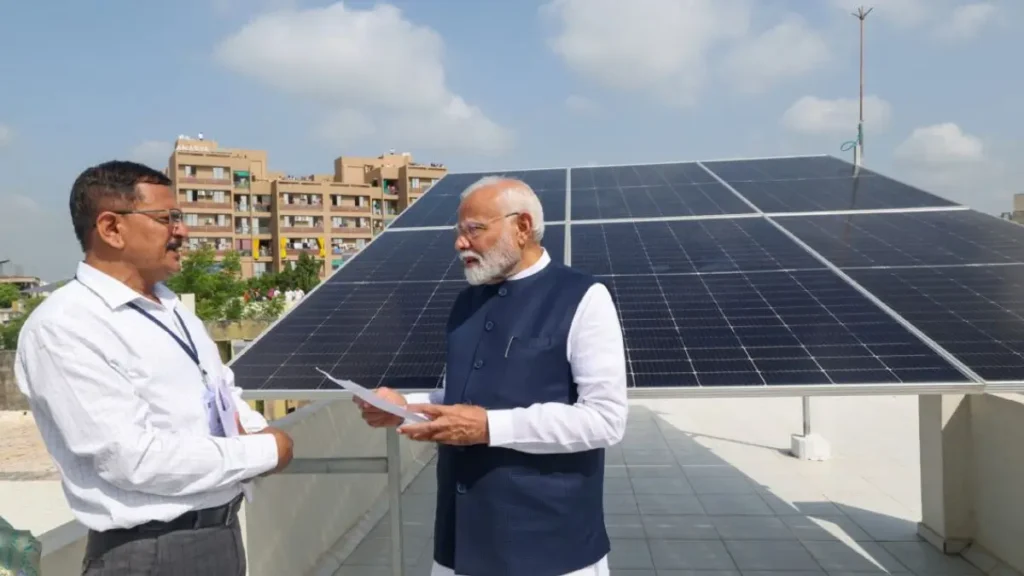
PM Surya Ghar Scheme 2 Years Analysis covering rooftop solar subsidy, 1 crore household target, net metering benefits, implementation challenges, and its role in India’s 500 GW renewable energy goal for 2030.
PM Surya Ghar Scheme: Two Years of Rooftop Solar Revolution in India
The PM Surya Ghar: Muft Bijli Yojana has completed two years since its launch by the Government of India to transform households into clean power producers. Under this flagship renewable energy scheme, residential solar rooftop installations have received a massive push, with millions of homes adopting solar power systems. The programme targets 1 crore households by 2026-27, aiming to decentralize energy generation while cutting electricity costs and carbon emissions.
In the past two years, the scheme has deployed millions of rooftop solar panels across urban and rural India, boosting solar adoption and expanding renewable energy infrastructure. According to industry and government data, the scheme has facilitated over 28 lakh household solar installations with substantial subsidies amounting to over ₹16,000 crore. This has significantly reduced monthly electricity expenses for families and contributed to India’s clean energy goals.
📈 Rapid Growth Amid Renewables Push
One of the remarkable impacts has been the surge in rooftop solar generation. Residential installations have grown from a few thousand per month in early 2021 to nearly 200,000 installations per month by 2026, reflecting strong demand and policy support from the central and state governments. This surge has enabled households not only to generate their own electricity but also to feed surplus power into the grid through net metering.
💸 Subsidies & Benefits for Households
The scheme offers subsidies of up to ₹78,000 for systems up to 3 kW capacity and free electricity of up to 300 units per month for beneficiaries. Additionally, homeowners can access low-interest, collateral-free loans to bridge any upfront installation costs, making solar adoption more affordable for middle and lower-income groups.
🔎 Key Challenges and Bottlenecks
Despite the rapid expansion of solar rooftops, the programme faces operational bottlenecks. Delays in loan processing by banks, slow subsidy disbursals, and uneven implementation across states have posed challenges to achieving installation targets. Some experts highlight that while applications are rising, actual completed installations lag due to infrastructure and finance hurdles.
🌍 Clean Energy & National Goals
As India pushes toward its renewable energy target of 500 GW by 2030, the Surya Ghar scheme contributes to increasing decentralized solar capacity and reducing reliance on fossil fuels. By empowering households to adopt clean energy, the programme also supports environmental goals such as lowering carbon emissions and enhancing energy security.

🧠 Why This News Is Important for Government Exam Aspirants
📌 Impact on National Renewable Energy Goals
The PM Surya Ghar Scheme is integral to India’s climate and energy strategy, aligning with commitments to increase renewable energy capacity and reduce carbon emissions. It directly contributes to meeting national targets under the National Solar Mission and India’s pledge at international climate forums. Knowledge of such flagship programmes is crucial for questions in environmental ecology, economy, and energy sectors in exams like UPSC, PSCs, SSC, and Banking.
📌 Social & Economic Relevance
For aspirants in exams related to governance and public policy, the scheme exemplifies how government interventions can improve household economic conditions through subsidized electricity and access to clean energy finance. Understanding these benefits, including subsidies and free electricity provisions, helps answer questions on welfare economics, energy policy and inclusive growth.
📌 Linkage to Sustainable Development Goals
This scheme touches multiple aspects of sustainable development goals (SDGs), particularly affordable and clean energy (SDG 7), climate action (SDG 13) and sustainable cities and communities (SDG 11). Exam questions often focus on the government’s role in advancing SDGs, making this news highly relevant.
📌 Insight into Implementation Challenges
Recognition of bottlenecks and operational challenges is essential for analytical questions in governance papers. Aspirants must understand both successes and limitations of policy execution to discuss reforms, financing gaps, and institutional coordination — topics often covered in GS papers and interviews.
📜 Historical Context: Evolution of Solar Initiatives in India
The PM Surya Ghar: Muft Bijli Yojana builds upon decades of India’s renewable energy policies aimed at reducing dependency on fossil fuels. The National Solar Mission (NSM) launched in 2010 under the National Action Plan on Climate Change sought to accelerate solar deployment across ground-mounted and rooftop projects. NSM’s ambitious targets were revised multiple times to align with India’s expanding solar landscape.
India has witnessed exponential growth in solar power capacity over the past decade, moving from under 3 GW in 2014 to over 120 GW by 2025. Residential rooftop solar adoption has grown from being a niche segment to a central component of decentralized energy policy. PM Surya Ghar represents the largest domestic rooftop initiative, focusing on empowering households to become clean energy producers while reducing national electricity demand from conventional sources.
📊 Key Takeaways from “2 Years of PM Surya Ghar Scheme: Rooftop Solar Boom or Bottlenecks?”
| No. | Key Takeaway |
|---|---|
| 1. | The PM Surya Ghar Scheme aims to install rooftop solar systems in 1 crore households by 2026-27. |
| 2. | The programme has achieved millions of installations and provided subsidies exceeding ₹16,000 crore. |
| 3. | Beneficiaries receive up to ₹78,000 subsidy and up to 300 units of free electricity monthly. |
| 4. | Implementation challenges include loan delays and slow subsidy disbursals, affecting rollout pace. |
| 5. | The scheme supports India’s clean energy transition and energy security goals by expanding decentralized solar capacity. |
Frequently Asked Questions (FAQs)
1. What is the objective of the PM Surya Ghar: Muft Bijli Yojana?
The objective of the PM Surya Ghar: Muft Bijli Yojana is to promote rooftop solar installations in 1 crore households across India by 2026–27. It aims to provide affordable electricity, reduce power bills, promote renewable energy, and contribute to India’s climate commitments.
2. When was the PM Surya Ghar Scheme launched?
The scheme was launched in February 2024 by the Government of India to accelerate residential rooftop solar adoption and expand decentralized renewable energy capacity.
3. How much subsidy is provided under the scheme?
Eligible households can receive subsidies up to ₹78,000 for rooftop solar systems (up to 3 kW capacity). The subsidy amount depends on system size and government guidelines.
4. Who is eligible to apply?
Indian residential households with suitable rooftop space and valid electricity connections are eligible. Applicants must register through the official national portal and follow DISCOM approval procedures.
5. How does net metering work under this scheme?
Under net metering, excess electricity generated by rooftop solar panels is fed back into the grid. Consumers receive credits that adjust against their electricity bills.
6. How does this scheme help India achieve climate goals?
The scheme contributes to India’s renewable energy target of 500 GW by 2030 and aligns with the goals of the National Solar Mission under the National Action Plan on Climate Change.
7. What are the key challenges in implementation?
Major bottlenecks include loan disbursement delays, procedural approvals from DISCOMs, supply chain constraints, and uneven state-level execution.
8. Why is this important for UPSC and State PSC exams?
The scheme is relevant for topics such as renewable energy, climate change mitigation, government subsidies, inclusive growth, sustainable development goals (SDGs), and public policy implementation.
Some Important Current Affairs Links

