
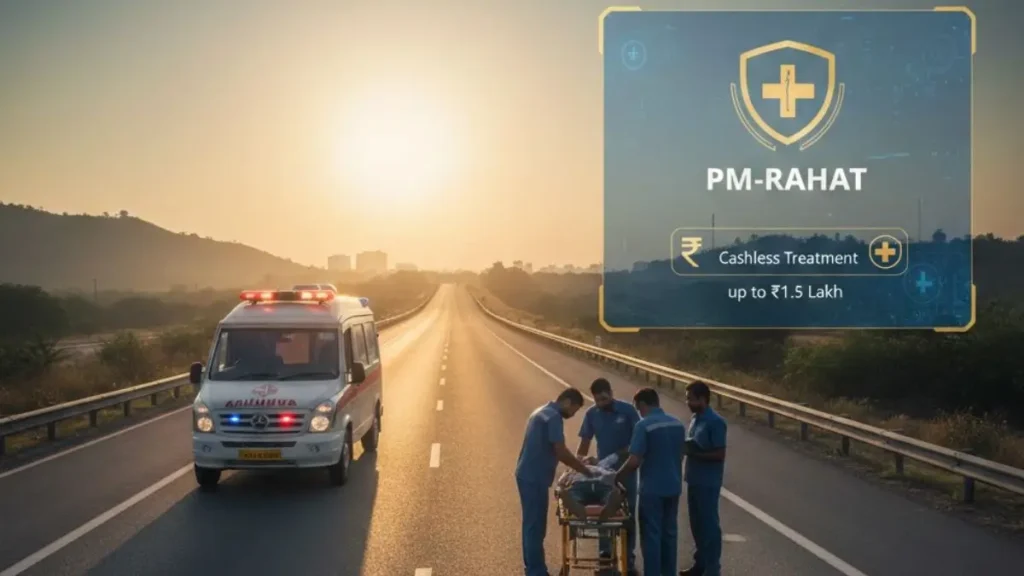
PM RAHAT Scheme provides cashless emergency treatment up to ₹1.5 lakh for road accident victims in India. Learn eligibility, benefits, and application process.
PM RAHAT Scheme Launched for Road Accident Victims – Ensuring Lifesaving Care Without Financial Burden
In a significant governance push, the Government of India has recently inaugurated the PM RAHAT Scheme (Pradhan Mantri Road Accident Victim Hospitalization and Assured Treatment) to provide cashless emergency medical treatment to victims of road accidents. This announcement was made by Prime Minister Narendra Modi from the newly inaugurated Seva Teerth complex in New Delhi — a transformational step that highlights the country’s focus on strengthening emergency health care and social security infrastructure for citizens.
🏥 What Is the PM RAHAT Scheme?
The PM RAHAT Scheme is a government initiative aimed at supporting road accident victims by ensuring immediate and assured medical care without any financial constraints. Under the scheme, every eligible victim is entitled to cashless treatment up to ₹1.5 lakh for seven days from the date of a road accident. The initiative integrates emergency response systems with digital health infrastructure to provide timely hospitalization — especially during the critical “Golden Hour” after an accident.
The scheme operates through a technology‑driven framework involving:
- The Emergency Response Support System (ERSS) 112 helpline,
- The Electronic Detailed Accident Report (eDAR) platform of the Ministry of Road Transport & Highways,
- The TMS 2.0 platform of the National Health Authority.
This digital integration enables seamless reporting, police authentication, treatment initiation, hospital admission, and claims processing — all under one consolidated system with minimal paperwork.
📞 Who Can Get Benefits and How?
Under PM RAHAT, road accident victims — and even bystanders or “Good Samaritans” — can benefit from the cashless treatment facility. Upon dialing 112, the caller can request ambulance support, identify nearby designated hospitals, and receive accelerated medical attention. Hospitals are reimbursed through the Motor Vehicle Accident Fund (MVAF), and in cases where the offending vehicle is insured, contributions from general insurance companies are used. In uninsured or hit‑and‑run cases, the Government of India provides budgetary support for reimbursements.
😷 Treatment Coverage and Duration
Under the scheme:
- Cashless treatment up to ₹1.5 lakh per victim is guaranteed.
- Treatment coverage is for seven days from the accident date.
- Stabilization care is provided for up to 24 hours in non‑critical cases and 48 hours in life‑threatening cases.
- Claims approved by State Health Authorities are processed within 10 days to ensure uninterrupted hospital care.
This initiative removes the economic barrier to emergency health care and ensures that victims are not denied lifesaving treatment due to lack of funds — a major concern in a country that witnesses a large number of road accidents annually.

🧠 Why This News Is Important for Government Exam Aspirants
💡 Public Policy and Social Security Focus
The launch of the PM RAHAT Scheme marks an important policy milestone in India’s governance landscape. This is not just a health sector initiative — it’s a social security measure that aligns with the Indian government’s broader goals of humane and inclusive public policy. By eliminating out‑of‑pocket expenses for critical care after road accidents, the scheme directly addresses one of the biggest challenges in India’s public health ecosystem: affordability and accessibility of emergency care.
🧑⚖️ Relevance to Emergency Response and Governance
For aspirants preparing for competitive exams like Civil Services (IAS/IPS), State PSCs, Defence Services, Railways, and Health Administration posts, understanding PM RAHAT is crucial because it demonstrates how public policy can be designed to support equity, efficiency, and citizen welfare. The integration of emergency response systems (ERSS 112) with digital platforms (eDAR and TMS 2.0) showcases how technology accelerates public service delivery — a key theme in modern governance.
📊 Strategic Importance
Road safety and emergency health care are major components of the National Health Policy and transportation governance frameworks. Exam questions often focus on:
- Government schemes aimed at reducing fatalities,
- Digital integration in public service delivery,
- Measures to strengthen emergency infrastructure.
The PM RAHAT scheme touches all these topics and therefore is highly relevant for current affairs sections of competitive exams.
📚 Historical Context: Emergency Healthcare and Road Safety in India
🛣 Road Accidents: A Persistent Challenge
India has long grappled with high rates of road traffic accidents. Historically, one of the major reasons for fatalities was inability to receive immediate medical care due to poor emergency response systems and lack of financial resources among victims’ families. Studies and health reports have emphasized that nearly 50% of road accident deaths could be prevented if victims received timely medical care within the first hour — a period referred to as the Golden Hour.
🚑 Evolution of Emergency Response Initiatives
Prior to PM RAHAT, India launched several policies to strengthen emergency care:
- Emergency Response Support System (ERSS 112) to streamline police and medical response.
- Health sector reforms focusing on trauma care units and ambulance networks.
- Various insurance schemes like Pradhan Mantri Suraksha Bima Yojana (PMSBY) offering financial protection against accidental death or disability.
However, affordability and prompt treatment after accidents remained key gaps — which PM RAHAT directly aims to bridge with its cashless treatment model.
🧠 Towards Safe and Inclusive Emergency Care
The introduction of digital platforms like eDAR and TMS 2.0 reflects India’s broader commitment to integrated digital governance, where real‑time data and automated systems reduce delays and increase accountability. PM RAHAT thus builds on years of incremental policy reforms to create a cohesive emergency treatment ecosystem.
📊 Key Takeaways from “PM RAHAT Scheme for Accident Victims”
| S. No. | Key Takeaway |
|---|---|
| 1 | PM RAHAT (Pradhan Mantri Road Accident Victim Hospitalization and Assured Treatment) was launched to provide cashless emergency treatment to road accident victims. |
| 2 | The scheme guarantees cashless treatment up to ₹1.5 lakh per victim for seven days from the accident date. |
| 3 | It is integrated with the ERSS 112 helpline and digital platforms like eDAR and TMS 2.0 for coordinated care and claims processing. |
| 4 | Hospitals are reimbursed through the Motor Vehicle Accident Fund; insured cases use insurer contributions, and uninsured/hit‑and‑run cases are funded by the Government. |
| 5 | The scheme aims to strengthen India’s emergency healthcare and road safety ecosystem, reducing fatalities caused by delayed treatment. |
FAQs: Frequently Asked Questions
1. What is the PM RAHAT Scheme?
The PM RAHAT Scheme (Pradhan Mantri Road Accident Victim Hospitalization and Assured Treatment) is a government initiative that provides cashless emergency medical treatment to road accident victims, ensuring financial barriers do not delay critical care.
2. Who can avail the benefits of PM RAHAT?
All road accident victims, including bystanders or “Good Samaritans” who assist victims, are eligible for cashless treatment under PM RAHAT.
3. How much financial assistance is provided under the scheme?
The scheme provides up to ₹1.5 lakh per victim for seven days from the date of the accident.
4. How is the scheme implemented digitally?
The scheme integrates multiple platforms:
- ERSS 112 for emergency helpline support,
- eDAR (Electronic Detailed Accident Report) for police verification,
- TMS 2.0 for claims processing by hospitals.
5. Who bears the cost of treatment in uninsured or hit-and-run cases?
In cases where the vehicle is uninsured or the accident involves a hit-and-run, the Government of India provides budgetary support for reimbursements through the Motor Vehicle Accident Fund (MVAF).
6. Why is PM RAHAT important for emergency care in India?
The scheme ensures timely treatment during the “Golden Hour”, reduces fatalities caused by delayed care, and strengthens India’s emergency response ecosystem.
7. How can a person request help under PM RAHAT?
Victims or bystanders can call 112, which connects them to ambulance services and nearby hospitals participating in the PM RAHAT Scheme.
Some Important Current Affairs Links

