
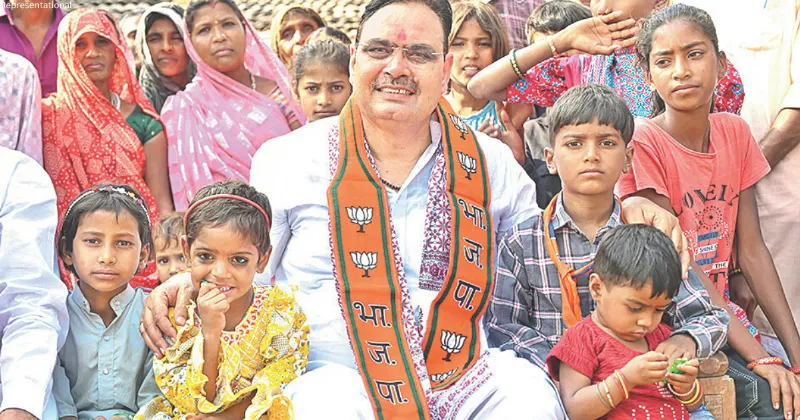
Pandit Deendayal Upadhyay Scheme aims to transform 5,000 Rajasthan villages into poverty-free zones with ₹300 crore funding, direct cash benefits, and SHG support.
“Rajasthan Launches Pandit Deendayal Upadhyay Poverty‑Free Village Scheme”
Heading: Introduction to the Scheme
On July 4, 2025, the Rajasthan government unveiled the Pandit Deendayal Upadhyay Poverty‑Free Village Scheme, a groundbreaking rural development initiative. With a budget allocation of ₹300 crore, this scheme targets 5,000 villages in its first phase. Its primary aim is to lift economically vulnerable families currently below the poverty line (BPL) into self-sustaining livelihoods
Eligibility & Identification Process
Approximately 30,631 BPL households across 5,002 villages were identified using the 2002 BPL census and updated surveys. The government has also received over 61,000 fresh applications from families seeking assistance. The process includes physical surveys, portal-based data verification, and ongoing bank-account authentication
Financial Assistance for Livelihoods
Each identified BPL family may receive up to ₹1 lakh, which can be utilized to start micro-enterprises or income-generation activities. Additionally, self-help groups led by women are eligible for ₹15,000 working capital—fostering women’s participation in rural economies
Recognition for Self-Reliant Families
Families who have successfully emerged from poverty will receive an incentive of ₹21,000, disbursed via DBT (Direct Benefit Transfer) to verified bank accounts. Their achievement will be acknowledged with an ‘Atmanirbhar Parivar Card‘—a token of self-reliance
Village-Level Action Plans & Scheme Linkages
For every selected village, a bespoke “Poverty-Free Village Action Plan” is being crafted. These plans aim to integrate beneficiaries with existing state initiatives—covering skill development, financial inclusion, and healthcare—to ensure sustainable poverty alleviation
Incentives for High Performance
Districts performing well in implementing the scheme will be rewarded quarterly: ₹50 lakh for 1st place, ₹35 lakh for 2nd, and ₹25 lakh for 3rd—driving healthy competition among administrative units
Phase Two Expansion
A second phase, covering another 5,002 villages, has begun. So far, 22,872 families have been surveyed in these areas, with data collection ongoing
B) Why this News is Important
Heading: Enhancing Rural Livelihoods & BPL Upliftment
This scheme directly tackles rural poverty by providing financial aid, promoting skill-building, and offering job opportunities to BPL families—an essential focus area for government exam aspirants across sectors like banking, civil services, and defence.
Heading: Empowering Women and SHG Mobilization
By allocating ₹15,000 per self-help group family, especially for women, the scheme aligns with government priorities on women’s empowerment and grassroots financial inclusion—key topics for teaching, banking, and administrative exam syllabuses.
Heading: Administrative Governance & Incentive Structures
The introduction of performance incentives for districts promotes administrative efficiency, transparency, and accountability. Knowledge of this model aids candidates preparing for roles in public administration, police services, and civil structures.
Heading: Strategic Use of DBT and Data-Driven Planning
The emphasis on DBT, bank verification, and village-specific action plans symbolizes a policy shift toward tech-enabled welfare. This highlights modern governance methods pertinent to UPSC, PSC, and RRB exam patterns.
Heading: Legacy of Pandit Deendayal Upadhyay & Antyodaya Philosophy
The scheme reflects the socio-economic ideology of Pandit Deendayal Upadhyay—integral humanism and Antyodaya. Examining this ideological linkage enriches understanding for those preparing for PSCS, IAS, and other civil service roles.
C) Historical Context
Heading: Roots in Antyodaya Philosophy
Pandit Deendayal Upadhyay (1916–1968), a philosopher and political thinker, launched the ideology of Integral Humanism and focused on the upliftment of India’s poorest through Antyodaya (“rise of the last person”)
Heading: Evolution of Rural Welfare Schemes
India’s journey from early self-help group missions like SGSY (1999) through NRLM (2011) to the Deen Dayal Upadhyaya Antyodaya Yojana (2014) set the stage for today’s state-level adaptation on a village-wide scale
Heading: State-Level Implementation in Rajasthan
Rajasthan’s launch of this scheme connects with ongoing efforts like the Pandit Deendayal Upadhyay Antyodaya Sambal Pakhwada, aimed at accelerating the last-mile delivery of welfare schemes and building on the momentum of previous poverty alleviation drives
D) Key Takeaways from this News
| S. No | Key Takeaway |
|---|---|
| 1 | Scheme Launch: ₹300 crore allocated for phase‑1 of the Pandit Deendayal Upadhyay Poverty‑Free Village Scheme covering 5,000 villages |
| 2 | Beneficiary Reach: 30,631 BPL families identified; 61,000+ additional applications received |
| 3 | Financial Support: Up to ₹1 lakh for entrepreneurial activities; ₹15,000 for women SHG members |
| 4 | Incentives: ₹21,000 reward via DBT and ‘Atmanirbhar Parivar Card’ for families crossing poverty line |
| 5 | Implementation Strategy: Village action plans, integration with other schemes, phased rollout, and performance-linked district incentives |
📌 Frequently Asked Questions (FAQs)
1. What is the Pandit Deendayal Upadhyay Poverty-Free Village Scheme?
It is a Rajasthan government initiative launched in July 2025 to eliminate poverty from 5,000 villages in its first phase through financial assistance and livelihood support.
2. How much budget is allocated for the scheme?
The Rajasthan government has allocated ₹300 crore for the first phase of the scheme.
3. Who are the beneficiaries of this scheme?
Families listed as Below Poverty Line (BPL) in official surveys and verified via physical and portal-based assessments are eligible.
4. What kind of support is provided under this scheme?
Each family can get up to ₹1 lakh for self-employment, while women-led SHG families receive ₹15,000 as working capital.
5. What is the Atmanirbhar Parivar Card?
It is a recognition card awarded to families who successfully exit poverty and become self-reliant, along with a ₹21,000 cash incentive.
6. Are there incentives for government officials or districts?
Yes, the top three performing districts each quarter receive ₹50 lakh, ₹35 lakh, and ₹25 lakh respectively as performance rewards.
7. How many new applications have been received apart from the identified BPL families?
Over 61,000 fresh applications have been received under the scheme.
8. What methodology is used for identifying eligible families?
Eligibility is determined through the 2002 BPL list, updated physical verification, and digital portal submissions.
9. What is the vision behind this scheme?
The scheme is rooted in Pandit Deendayal Upadhyay’s Antyodaya philosophy, aiming to uplift the poorest families through self-reliance.
10. What is the progress of phase two?
Phase two has begun with 22,872 families already surveyed across the next 5,002 villages.
Some Important Current Affairs Links

