
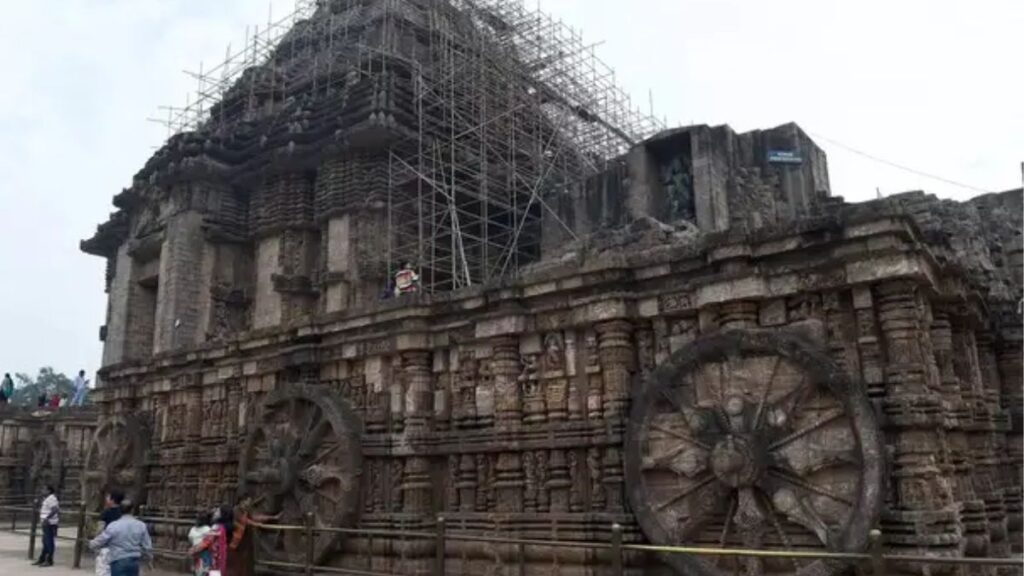
Konark Sun Temple restoration project by ASI explained with scientific conservation methods, Jagamohan sand analysis, UNESCO heritage significance, and exam-oriented insights for UPSC and government exams.
ASI Conservation and Restoration Initiative at Konark Sun Temple
The Archaeological Survey of India (ASI) has recently accelerated its restoration and scientific conservation project at the Konark Sun Temple, one of India’s most iconic UNESCO World Heritage Sites located in Odisha. The project primarily focuses on the Jagamohan (assembly hall) of the 13th-century temple, which has remained structurally supported by sand filled inside during the colonial period in the early 1900s.
According to official updates, ASI has begun core drilling operations in the temple structure to assess the stability of its thick stone walls and the condition of the sand-filled interior. This marks a significant phase in one of India’s most complex heritage conservation efforts, combining archaeology, structural engineering, and modern scientific analysis.
The restoration process aims to carefully evaluate whether the sand—inserted over a century ago to prevent collapse—can be safely removed without damaging the structure. The temple, built by King Narasimhadeva I of the Eastern Ganga dynasty, represents a monumental architectural design in the form of Surya’s chariot.
🧪 Scientific Assessment and Engineering Approach
The ASI has adopted a highly cautious and scientific method for this project. Experts have initiated controlled drilling techniques using diamond-core equipment to avoid vibrations and structural damage. These samples are being sent to reputed institutions like IIT Madras and other scientific bodies for detailed analysis.
Preliminary findings indicate that the sand inside the structure is finely packed and has settled significantly over time, suggesting that it has been supporting the structure for more than 120 years. Structural analysis of the temple walls shows a thickness of several meters, indicating strong foundational stability.
Officials have clarified that the restoration process will proceed only after multi-disciplinary expert evaluations, ensuring that heritage preservation and safety remain top priorities.
🏺 Heritage Value of Konark Sun Temple
The Konark Sun Temple, built in the 13th century, is one of the finest examples of ancient Indian temple architecture. Designed as a massive stone chariot of the Sun God Surya, the temple features:
- 24 intricately carved wheels symbolizing time cycles
- Seven horses representing the days of the week
- Rich sculptures depicting cultural, spiritual, and social life
Declared a UNESCO World Heritage Site in 1984, the temple reflects India’s advanced engineering and artistic heritage. However, due to structural deterioration over centuries, parts of the temple have required continuous conservation efforts by ASI.

📌 Why This News is Important
🏛️ Significance for Heritage Conservation and Governance
This restoration project is highly significant for India’s cultural preservation framework. The Konark Sun Temple is not only an architectural marvel but also a symbol of India’s historical identity. Any intervention in such a monument requires extreme precision and scientific validation.
For students preparing for UPSC, SSC, Railway, Banking, Defence, and State PSC exams, this news is important because it highlights:
- Role of the Archaeological Survey of India in heritage conservation
- Use of modern technology in archaeology and restoration
- Importance of UNESCO World Heritage Sites in India
- Government policies related to cultural preservation under AMASR Act
🧑🔬 Scientific and Engineering Relevance
The use of core drilling, structural analysis, and interdisciplinary research shows how modern science is applied in heritage conservation. It reflects India’s growing integration of engineering, archaeology, and technology-driven restoration methods.
🌍 Cultural and Tourism Impact
The Konark Sun Temple is a major tourist destination in Odisha. Successful restoration will enhance tourism, strengthen cultural diplomacy, and preserve India’s global heritage image.
📚 Historical Context
🏛️ Origin and Construction of Konark Sun Temple
The Konark Sun Temple was constructed in the mid-13th century (around 1250 CE) during the reign of King Narasimhadeva I of the Eastern Ganga dynasty. It was dedicated to the Sun God Surya and designed as a colossal stone chariot.
🏚️ Structural Damage and Colonial Intervention
Over centuries, parts of the temple suffered structural collapse. By the early 1900s, the main assembly hall (Jagamohan) was filled with sand by British engineers to prevent further collapse. This sand has remained inside for over a century.
🏗️ Modern Conservation Efforts
Since independence, the Archaeological Survey of India (ASI) has been continuously working on stabilizing and preserving the monument under the provisions of the Ancient Monuments and Archaeological Sites and Remains (AMASR) Act, 1958.
Recent scientific interventions aim to reassess earlier conservation methods using modern technology.
📊 Key Takeaways from ASI Konark Sun Temple Restoration Project
| S.No. | Key Takeaway |
|---|---|
| 1 | ASI has started a scientific restoration project at Konark Sun Temple focusing on the sand-filled Jagamohan structure. |
| 2 | Core drilling is being used to assess structural strength and internal conditions of the temple walls. |
| 3 | Sand inside the temple was originally filled during the British era in the early 1900s to prevent collapse. |
| 4 | Samples from the site are being tested in scientific institutions like IIT Madras for structural analysis. |
| 5 | The project combines archaeology, engineering, and heritage conservation to preserve a UNESCO World Heritage Site. |
Frequently Asked Questions (FAQs)
1. What is the Konark Sun Temple known for?
The Konark Sun Temple in Odisha is a UNESCO World Heritage Site known for its unique chariot-shaped architecture dedicated to the Sun God Surya, built in the 13th century by King Narasimhadeva I.
2. Why has ASI started restoration work at Konark Sun Temple?
ASI has initiated restoration to scientifically assess and preserve the structural stability of the Jagamohan (assembly hall), which has been sand-filled since the British era to prevent collapse.
3. What method is being used in the restoration project?
The Archaeological Survey of India is using core drilling and scientific structural analysis to examine internal conditions without damaging the monument.
4. Why was sand filled inside the temple earlier?
During the early 1900s, British engineers filled the Jagamohan with sand to prevent structural collapse and stabilize the temple.
5. Which institutions are involved in the analysis of samples?
Scientific institutions such as IIT Madras and other research bodies are involved in analyzing samples collected from the temple structure.
6. What makes Konark Sun Temple important for exams?
It is important for exams due to its relevance in Indian heritage, UNESCO World Heritage Sites, ASI functions, and cultural conservation policies under government schemes.
Some Important Current Affairs Links

