
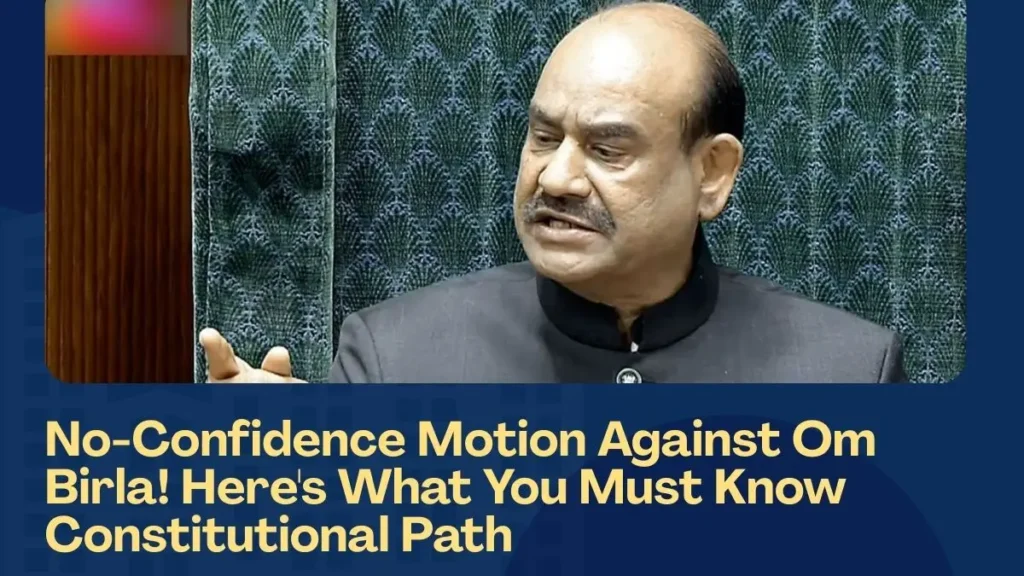
No confidence motion against Om Birla explained in simple terms for government exam preparation, covering constitutional provisions, procedure, and key facts for competitive exams.
No-Confidence Motion Against Lok Sabha Speaker Om Birla: A Constitutional Development
Recently, a major parliamentary development has taken centre stage in Indian politics. The Opposition parties in the Lok Sabha formally submitted a no-confidence motion against the Lok Sabha Speaker, Om Birla, on February 10, 2026. The notice was submitted to the Secretary-General of the Lok Sabha under the Rules of Procedure of the House and has sparked widespread debate across political corridors.
This move came amid escalating tensions between the ruling National Democratic Alliance (NDA) and the INDIA bloc (the Opposition alliance), especially after repeated disruptions during the Budget Session of Parliament and disagreements over the conduct of parliamentary debates. The motion is now set to be examined and processed as per constitutional provisions and parliamentary rules.
Allegations Driving the Motion
The opposition has accused the Speaker of “blatantly partisan conduct” and abuse of his constitutional office, alleging that he has not upheld the expected neutrality required of his position. The notice was reportedly signed by 118 Members of Parliament from several opposition parties, though not all coalition members participated (notably, the Trinamool Congress did not sign).
One significant triggering point was the disruption of parliamentary proceedings during a debate, including objections over a speech by the Leader of the Opposition and refusal to allow certain references, which resulted in prolonged adjournments and allegations of biased rulings.
Parliamentary Response and Next Steps
Although the no-confidence notice contained some procedural errors (such as incorrect dates) which could have led to its outright rejection, Speaker Om Birla directed the Secretariat to rectify those flaws rather than dismiss the motion. The revised notice will now be reviewed and scheduled for discussion in the second phase of the Budget Session, likely beginning March 9, 2026.
While this motion does not threaten the stability of the central government, it represents a rare and significant constitutional challenge centred on parliamentary accountability and decorum.

Why This News Is Important (For Government Exams)
This development is crucial for students preparing for competitive exams because it covers key aspects of the Indian constitutional and parliamentary system, which frequently appear in both prelims and mains of exams like UPSC Civil Services, State PSCs, SSC CGL/CHSL, Banking PO/Clerk, RBI, Railways, and Teaching eligibility tests.
Understanding Constitutional Provisions
The motion invokes Article 94(c) of the Indian Constitution, which empowers the Lok Sabha to remove its Speaker by a resolution passed by a majority of its members. Understanding the detailed procedure for the removal of the Speaker or Deputy Speaker is vital for polity sections of exams, as this is one of the few occasions such constitutional provisions are being practically applied.
Parliamentary Procedures and Rule Books
Competitive exams often test candidates on the Rules of Procedure and Conduct of Business in Lok Sabha. This instance offers a real-world application of how no-confidence motions against a presiding officer are submitted, examined, and processed.
Political Dynamics and Governance
The event highlights the political dynamics between the Opposition and the ruling party, illustrating how parliamentary tools are employed not only against governments but also against key constitutional positions like the Speaker. Questions on this could appear in general awareness and current affairs mains essays.
Exam Focus on Institutional Accountability
The motion emphasises the principle of institutional checks and balances — a core concept in governance. Many competitive exams ask about the importance of neutrality in constitutional offices and how constitutional mechanisms uphold democratic values.
By integrating constitutional questions with current affairs, students can develop deeper insights needed for both objective and subjective answers in exams.
Historical Context: Removal of Lok Sabha Speaker — A Rare Constitutional Tool
The position of Lok Sabha Speaker is one of the highest constitutional offices in Parliament, expected to be unbiased and neutral while presiding over Lok Sabha proceedings.
Constitutional Basis
Under Article 94(c) of the Indian Constitution, the Speaker (and Deputy Speaker) can be removed by a resolution passed by a majority of all members of Lok Sabha. This is in line with the principle that the Speaker should command the confidence of the House.
Procedure Under Rules
The Rules of Procedure and Conduct of Business in Lok Sabha require at least a 14-day notice period before such a resolution can be taken up for discussion. After the notice is admitted, the motion is listed for discussion on a specified date and requires an effective majority for adoption.
Past Instances
Historically, motions against Speakers are very rare. Instances from 1954 (G.V. Mavalankar), 1966 (Hukam Singh), and 1987 (Balram Jakhar) saw such motions but none resulted in removal. Thus, the present motion against Om Birla is noteworthy as a rare application of constitutional removal procedure.
Key Takeaways from No-Confidence Motion Against Lok Sabha Speaker Om Birla
| # | Key Takeaway |
|---|---|
| 1 | The Opposition submitted a no-confidence motion against Lok Sabha Speaker Om Birla on Feb 10, 2026, citing alleged partisan conduct. |
| 2 | The notice was signed by 118 MPs from opposition parties, though not all INDIA bloc members supported it. |
| 3 | Procedural errors in the notice were flagged, but the Speaker allowed rectification rather than outright rejection. |
| 4 | The motion will be scheduled for discussion in the second phase of the Budget Session, likely starting March 9, 2026. |
| 5 | This motion invokes Article 94(c) of the Constitution, highlighting constitutional provisions for removal of the Speaker. |
FAQs on No-Confidence Motion Against Om Birla
1. What is a no-confidence motion against the Lok Sabha Speaker?
A no-confidence motion against the Speaker is a constitutional procedure through which Members of Parliament can propose the removal of the Speaker if they believe the Speaker has lost the confidence of the House. It is different from a no-confidence motion against the government.
2. Which constitutional article deals with the removal of the Speaker?
The removal of the Speaker is governed by Article 94(c) of the Constitution of India, which allows the Lok Sabha to remove the Speaker by passing a resolution with a majority of all the then members of the House.
3. How much notice is required before moving such a motion?
A minimum 14-day written notice must be given before the motion can be taken up for discussion in the House, as per parliamentary rules.
4. Who presides over the House when the Speaker’s removal motion is discussed?
When a motion for removal of the Speaker is under consideration, the Speaker does not preside. Instead, the Deputy Speaker or another designated member presides over the proceedings.
5. Is this motion the same as a no-confidence motion against the government?
No. A motion against the Speaker concerns parliamentary procedure and the conduct of the presiding officer. A no-confidence motion against the government tests whether the ruling government has majority support.
6. Why is this event important for competitive exams?
This event highlights constitutional provisions, parliamentary procedures, and the principle of neutrality of constitutional offices — topics frequently asked in UPSC, State PSCs, SSC, banking, railways, and defence exams.
7. Has any Lok Sabha Speaker been removed in Indian history?
Historically, such motions have been rare, and no Lok Sabha Speaker has been removed through a no-confidence resolution so far.
Some Important Current Affairs Links

