

NITI Aayog homestay report highlights the role of homestays in rural development, sustainable tourism, and women empowerment. Learn about policy pathways, challenges, and digital solutions for India’s homestay sector.
NITI Aayog Releases Report on “Rethinking Homestays: Navigating Policy Pathways”
Introduction
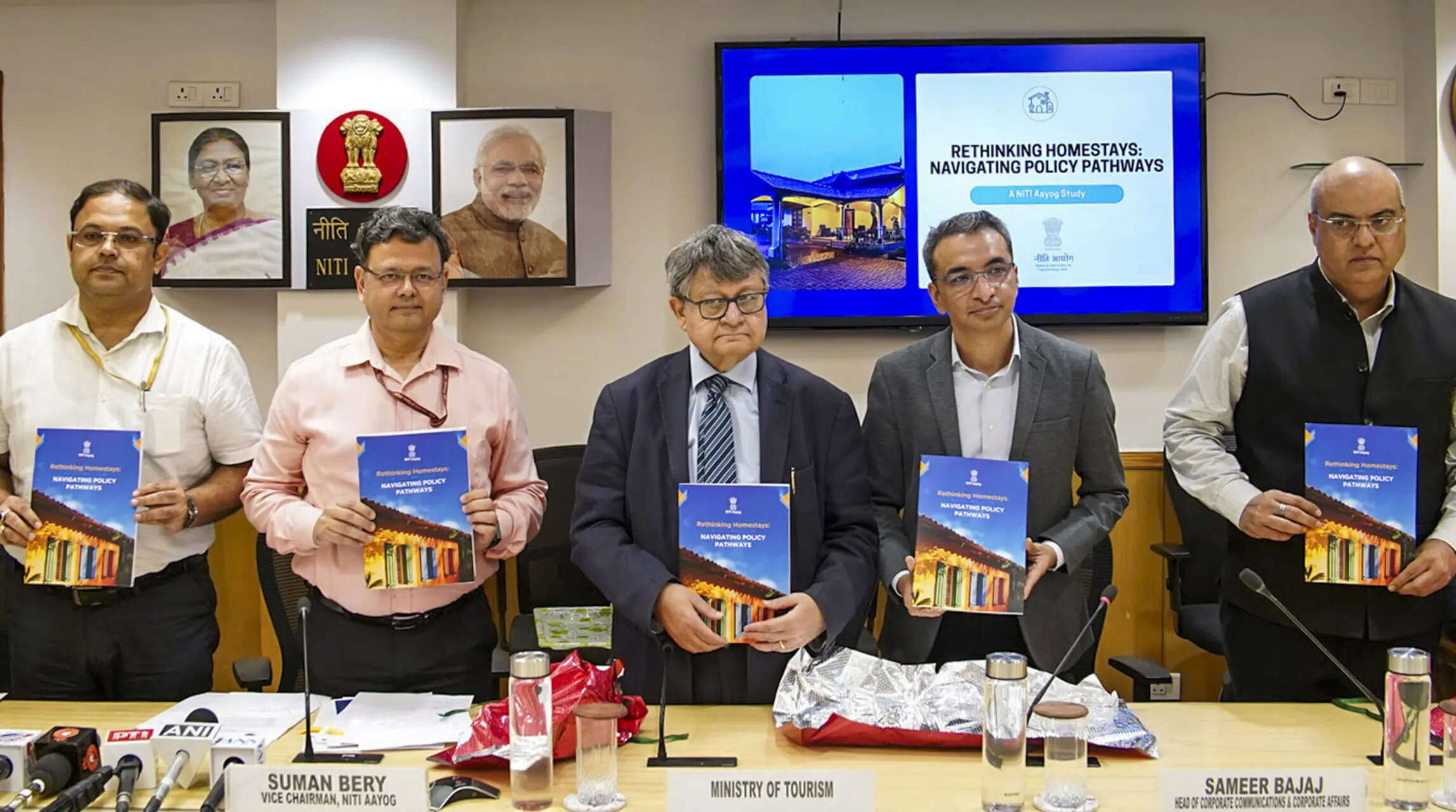
The NITI Aayog has recently released a comprehensive report titled “Rethinking Homestays: Navigating Policy Pathways”. This report highlights the growing importance of homestays in India’s tourism and rural economy. With the rise of experiential tourism, homestays have become a vital part of India’s hospitality sector, offering authentic cultural experiences to both domestic and international travelers. The report provides an in-depth analysis of policy frameworks, challenges, and strategies to make the homestay sector more sustainable and inclusive.
Homestays as a Catalyst for Rural Development
Homestays have emerged as a key driver of rural development in India. Unlike conventional hotels, homestays allow tourists to stay with local families, thereby ensuring that tourism-related income directly benefits rural households. This helps create employment opportunities, promotes entrepreneurship among locals, and encourages women’s participation in the workforce. The NITI Aayog report emphasizes that with proper regulation, financial support, and policy innovation, homestays can significantly reduce rural-urban migration by generating sustainable livelihoods within villages.
The Role of Policy in Expanding the Homestay Sector
The report underlines that fragmented regulations across states pose a major challenge to the growth of the homestay ecosystem. While some states have developed clear frameworks for licensing, taxation, and quality assurance, others lack streamlined guidelines. NITI Aayog has suggested the adoption of a uniform national policy framework that balances regulation with flexibility, making it easier for small and medium entrepreneurs to operate. This would not only attract more investment but also standardize safety and service quality across the country.
Promoting Sustainable and Inclusive Tourism
Sustainability remains a central theme in the report. Homestays encourage responsible tourism by minimizing environmental impact and promoting cultural heritage. By involving local communities in tourism activities, homestays help preserve traditional art, crafts, and cuisines. Moreover, the model is inclusive, as it opens opportunities for marginalized groups, including tribal populations and women-led households, to actively engage in the tourism economy. NITI Aayog has stressed that this sector could play a pivotal role in achieving India’s Sustainable Development Goals (SDGs).
Digital Transformation and Market Access
Another crucial aspect highlighted is the role of digital platforms in boosting homestay visibility and bookings. Online travel platforms and government-backed tourism portals can provide homestay owners with better market access, customer trust, and fair pricing. Training programs in digital literacy, hospitality management, and language skills would further empower rural homestay operators. The report also emphasizes the need for public-private partnerships to improve infrastructure such as roads, sanitation, and internet connectivity, which are essential for the growth of rural tourism.
Why This News Is Important
Relevance for Competitive Exams
For students preparing for government exams like UPSC, SSC, State PCS, banking, railways, defence, and teaching positions, this news is highly relevant. The report reflects the government’s focus on rural development, sustainable tourism, and economic inclusivity—all critical topics under current affairs, economy, and social development sections of exams. Candidates may encounter direct or analytical questions on the importance of homestays, their contribution to rural livelihoods, or the role of NITI Aayog in policymaking.
Policy and Economic Significance
The emphasis on creating a national-level framework for homestays is an important step toward economic diversification. For aspirants, understanding how tourism policy contributes to rural employment, women empowerment, and cultural preservation is crucial. Since examiners often test candidates on government initiatives aligned with the Sustainable Development Goals (SDGs), this report provides a perfect case study. It shows how India is attempting to bridge the gap between urban and rural economies through innovative tourism policies.
Historical Context
The concept of homestays in India has evolved over the past two decades, driven by both domestic and international demand for authentic cultural experiences. States like Kerala, Himachal Pradesh, and Sikkim were among the first to promote homestays as part of eco-tourism strategies. Over time, homestays gained traction in rural and tribal belts, offering alternative livelihoods to farming communities. The Ministry of Tourism has also introduced schemes to support homestay operators, such as skill development and financial aid programs.
Globally, countries like Nepal, Thailand, and Bhutan have successfully integrated homestays into their national tourism models, offering valuable lessons for India. The NITI Aayog report builds on these experiences and seeks to provide a roadmap for India to formalize and expand this sector, ensuring it remains both competitive and community-driven.
Key Takeaways from Rethinking Homestays
| S.No | Key Takeaway |
|---|---|
| 1 | NITI Aayog released the report “Rethinking Homestays: Navigating Policy Pathways” focusing on strengthening India’s homestay ecosystem. |
| 2 | Homestays can boost rural development by generating local employment, promoting entrepreneurship, and empowering women. |
| 3 | The report recommends a uniform national policy framework to streamline regulations and improve quality standards. |
| 4 | Emphasis on sustainability, cultural preservation, and inclusivity aligns with India’s SDGs. |
| 5 | Digital platforms, skill development, and infrastructure improvement are key enablers for the growth of the homestay sector. |
Frequently Asked Questions (FAQs)
1. What is the title of the recent report released by NITI Aayog on tourism?
The title of the report is “Rethinking Homestays: Navigating Policy Pathways”.
2. Why are homestays important for India’s rural economy?
Homestays provide employment opportunities, promote entrepreneurship, empower women, and help reduce rural-urban migration by generating local livelihoods.
3. Which government body released the report on homestays?
The report was released by NITI Aayog, India’s premier policy think tank.
4. What challenges do homestays in India currently face?
The sector faces fragmented regulations across states, lack of standardization in quality, limited access to digital platforms, and poor infrastructure in rural areas.
5. How can homestays contribute to sustainable development?
Homestays promote responsible tourism by preserving local culture, reducing environmental impact, and including marginalized communities in the tourism economy.
6. Which states were among the first to adopt the homestay model in India?
States like Kerala, Himachal Pradesh, and Sikkim pioneered the homestay model as part of eco-tourism initiatives.
7. How can digital platforms support homestays?
Digital platforms provide visibility, fair pricing, secure bookings, and customer trust, thereby helping local hosts compete with larger hotels.
8. What role does NITI Aayog suggest for policy in the homestay sector?
It recommends a uniform national policy framework to streamline licensing, taxation, and quality assurance across states.
9. How does the homestay model empower women?
Many homestays are women-led enterprises, giving them financial independence and active participation in the tourism economy.
10. Can homestays help India achieve Sustainable Development Goals (SDGs)?
Yes, homestays contribute to SDGs by reducing poverty, promoting gender equality, encouraging sustainable tourism, and preserving cultural heritage.
Some Important Current Affairs Links

