
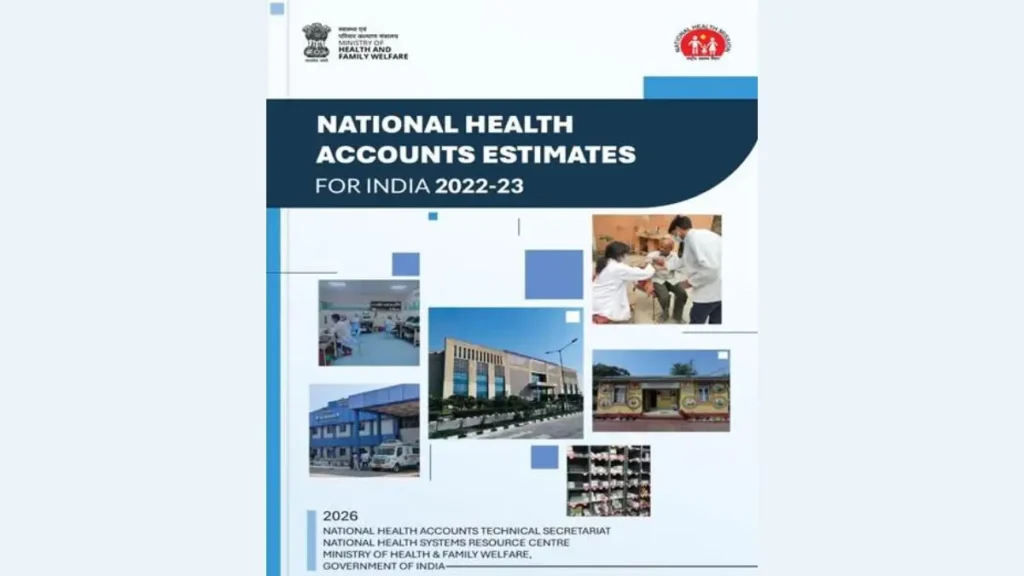
National Health Accounts India 2022–23 report highlights rising government health expenditure, declining out-of-pocket expenditure, and healthcare financing trends under SHA-2011 framework for policy and exams.
National Health Accounts 2022–23 Highlights India’s Health Spending Trends
🏥 Government Releases NHA 2022–23 Report on Health Expenditure
The Union Ministry of Health and Family Welfare has released the National Health Accounts (NHA) Estimates for India 2022–23, which provide a comprehensive overview of health expenditure patterns across the country. The report is prepared by the National Health Systems Resource Centre (NHSRC) using the globally accepted System of Health Accounts (SHA-2011) framework.
The NHA 2022–23 marks the 10th edition of this important report, tracking how funds flow through India’s health system from government, private sector, households, insurance providers, and external agencies.
📈 Government Health Spending Shows Strong Growth
According to the report, Government Health Expenditure (GHE) has shown a significant increase over the past decade. It has risen from ₹1.30 lakh crore in 2013–14 to ₹3.85 lakh crore in 2022–23, reflecting nearly a threefold rise.
In terms of GDP contribution, GHE increased from 1.15% to 1.43%, indicating higher prioritisation of healthcare in public spending. Government spending on primary healthcare has also more than doubled, strengthening India’s preventive healthcare infrastructure.
💳 Decline in Out-of-Pocket Expenditure (OOPE)
One of the most important findings of the report is the decline in Out-of-Pocket Expenditure (OOPE), which represents the money directly spent by households on healthcare services.
OOPE has reduced from 64.2% in 2013–14 to 43.4% in 2022–23, showing improved financial protection for citizens. This decline is largely due to government schemes like Ayushman Bharat, National Health Mission, and expanded insurance coverage.
🏥 Rising Role of Social Security and Insurance
The report also highlights that Social Security Expenditure (SSE) on health has increased from 6% to 9.9% during the same period. This reflects the growing role of government-backed insurance and welfare schemes in reducing healthcare costs for vulnerable populations.
📌 Overall Health Expenditure Growth
India’s Total Health Expenditure (THE) now stands at 3.37% of GDP, indicating a gradual but steady increase in investment in the healthcare sector. This includes spending from both public and private sources.

🎯 Why this News is Important
🧾 Strengthening Healthcare Policy Understanding
The NHA 2022–23 report is crucial for understanding how India finances its healthcare system. It provides data-driven insights that help policymakers design better health schemes and allocate resources effectively. For civil service aspirants, this report is highly relevant for GS Paper 2 (Health & Social Justice).
💡 Relevance for Government Exam Aspirants
This report is frequently asked in UPSC, State PSC, Banking, Railways, and Defence exams because it covers important topics like public health expenditure, government schemes, and socio-economic development.
It also highlights India’s progress toward Universal Health Coverage (UHC), a key policy goal.
🌍 Indicator of Social Development
The decline in out-of-pocket expenditure and rise in government spending reflect improving access to affordable healthcare. This is an important indicator of India’s progress in social development and poverty reduction.
📚 Historical Context
🏛️ Evolution of National Health Accounts in India
The National Health Accounts (NHA) system in India is based on the WHO’s System of Health Accounts (SHA-2011) framework. It was institutionalised in India in 2014 under the National Health Systems Resource Centre (NHSRC).
📊 First NHA Reports and Progress
India has now released 10 NHA reports, covering data from 2013–14 to 2022–23. Over time, these reports have shown a consistent rise in government health spending and gradual improvement in healthcare accessibility.
🏥 Policy Background
India’s focus on increasing public health expenditure aligns with the National Health Policy 2017, which aims to raise health spending to 2.5% of GDP and improve healthcare access across rural and urban regions.
📌 Key Takeaways from National Health Accounts 2022–23
| S. No. | Key Takeaway |
|---|---|
| 1 | Government Health Expenditure increased nearly threefold from ₹1.30 lakh crore (2013–14) to ₹3.85 lakh crore (2022–23). |
| 2 | GHE as a percentage of GDP rose from 1.15% to 1.43%, showing higher government focus on healthcare. |
| 3 | Out-of-Pocket Expenditure (OOPE) declined significantly from 64.2% to 43.4%. |
| 4 | Social Security Expenditure on health increased from 6% to 9.9%. |
| 5 | India’s Total Health Expenditure stands at 3.37% of GDP, indicating gradual growth in healthcare investment. |
FAQs: National Health Accounts 2022–23 (India)
1. What are National Health Accounts (NHA)?
National Health Accounts (NHA) are systematic records of all financial resources spent on healthcare in India, covering government, private sector, insurance, and household expenditure.
2. Which organisation prepares the NHA report in India?
The National Health Accounts Estimates are prepared by the National Health Systems Resource Centre (NHSRC) under the Union Ministry of Health and Family Welfare.
3. What framework is used in NHA 2022–23?
The report follows the System of Health Accounts (SHA-2011) framework developed by the World Health Organization (WHO).
4. Why is Out-of-Pocket Expenditure (OOPE) important?
OOPE shows how much individuals directly spend on healthcare. A high OOPE indicates financial burden on households, while a decline suggests better health insurance and government support.
5. What does the rise in Government Health Expenditure indicate?
An increase in Government Health Expenditure reflects stronger public investment in healthcare infrastructure, services, and welfare schemes.
6. How does NHA help in policy-making?
It helps policymakers analyse spending patterns, improve healthcare funding efficiency, and move towards Universal Health Coverage (UHC).
7. Which major schemes contributed to reduced OOPE in India?
Schemes like Ayushman Bharat, PM-JAY, and National Health Mission have contributed significantly to reducing OOPE.
Some Important Current Affairs Links

