

Behdeinkhlam Festival Meghalaya 2025 – Explore the sacred festival celebrated by the Pnar tribe in Jaintia Hills, its spiritual significance, and exam-relevant insights for aspirants.
“Behdeinkhlam Festival Meghalaya 2025: Tradition, Rituals, and Community Revival”
Cultural and Spiritual Essence of the Festival
Behdeinkhlam, celebrated by the Pnar (Jaintia) tribe in Meghalaya, is a four-day religious festival held in mid‑July after the sowing season. Its name, meaning “driving away plague,” reflects the community’s ancient ritual aimed at cleansing society of diseases and evil spirits The festival takes place in Jowai, West Jaintia Hills, centered on the sacred muddy pool, Aitnar.
Religious Rites, Symbolism & Rituals
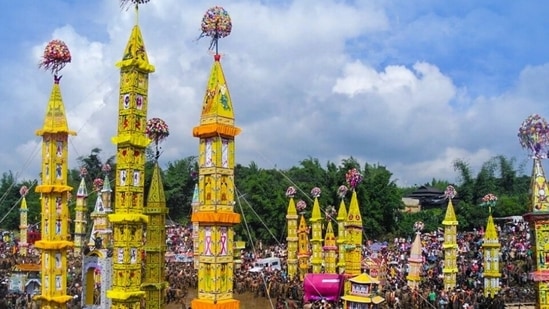
Villagers perform elaborate rites led by traditional priests, called Dolois, to purify the community Young men beat the rooftops of homes with bamboo poles in a symbolic act of expelling evil Central to the event are the wooden logs (Khnong or Dein Khlam) and tall bamboo structures (Rots), intricately decorated by local youth to highlight social themes. These are carried amid processions and immersed at Aitnar on the final day
Moments of Collective Joy and Message
On the last day, thousands gather around the muddy pool to dance to traditional drumming and piping . A dramatic tug-of-war-like game, Dad‑Lawakor, involving a wooden ball, parallels a football match and was contested this year between Upper and Lower Valley groups, believed to ensure a good harvest
Modern Relevance and Social Messaging
The 2025 festival integrated contemporary concerns through artistic designs on the “Rots,” spotlighting issues such as pollution from coke factories and ecological destruction of the Myntdu river Other themes referenced digital dependence and even saluted Operation Sindoor by the Indian Army, showcasing a blend of ancient ritual with modern awareness
Administrative Recognition & Public Celebration
High-ranking officials—including Meghalaya Governor and Chief Minister, along with ministers—attended the festivities and extended their greetings, highlighting the event’s cultural importance The RBI also declared a special bank holiday on July 14 in Meghalaya during the festival
📌 Why this News is Important
Exam-Relevant Cultural Study
For UPSC, PSC, SSC, Banking, Railways, and Defence exams, understanding regional festivals such as Behdeinkhlam provides deep insights into Indian tribal traditions, belief systems, and community structures.
Contemporary Relevance in Governance
By weaving modern issues—environmental protection, health, technology, national security—into its rituals, the festival illustrates how traditional forms can act as platforms for public messaging and social awareness.
Enhancement of Static and Current Affairs GK
This festival is a static GK topic under “Art & Culture” and also embodies current affairs elements. Noting administrative participation and bank holiday adds to answer depth.
Regional Significance in Northeast India
Recognising state-specific cultural markers is vital as many civil service and state-level exams include niche regional culture questions.
🕰 Historical Context
Ancient Roots & Meaning
Behdeinkhlam has origins in Pnar cosmology and agrarian life. The name comes from “behdein” (drive away) and “khlam” (plague) and symbolizes expelling disease, particularly cholera
Niamtre Faith and Ritual Custodians
The festival is rooted in the indigenous Niamtre religion and led by Dolois, Pators, and Langdohs who perform cleansing rituals—Cher iung blai—to purify the clan and land
Evolution of Celebrations
From solemn rites to community-wide festivities, Behdeinkhlam has grown into a vibrant cultural event featuring rots, Khnong processions, community games like Dad‑Lawakor, and modern social themes alongside ancestral traditions.
📊 Key Takeaways from “Behdeinkhlam Festival Meghalaya 2025”
| S.No | Key Takeaway |
|---|---|
| 1 | Behdeinkhlam means “driving away plague” and is a four-day Pnar festival held post‑sowing season. |
| 2 | Main rituals include roof-beating with bamboo, procession of wooden logs (Khnong), immersion at Aitnar. |
| 3 | Youth construct decorative bamboo “Rots,” now used to address environmental, digital, and national themes. |
| 4 | The traditional game “Dad‑Lawakor” symbolizes a football-like contest and harvest blessings. |
| 5 | Government officials attend, and banks observe holiday status in Meghalaya, showing administrative recognition. |
✅ Frequently Asked Questions (FAQs)
Q1: What does “Behdeinkhlam” mean?
“Behdien” means driving away, and “khlam” refers to plague or disease, thus Behdeinkhlam is the act of “driving away plague” from the community
Q2: Who organizes and celebrates this festival?
It is celebrated by the Pnar (Jaintia) tribe in Meghalaya, primarily those following the Niamtre faith
Q3: When and where is Behdeinkhlam celebrated?
Held annually in mid-July after the sowing season, the main festivities take place in Jowai, West Jaintia Hills, at the sacred Aitnar pond
Q4: What are the main rituals of the festival?
Key rituals include:
- Rots: 10–40 ft decorated bamboo structures symbolizing social themes
- Khnong/Dein Khlam: Polished wooden logs carried to Aitnar for immersion
- Beating rooftops: Young men use bamboo poles to drive away evil
- Dad‑Lawakor: Football-like wooden ball game predicting harvest success
Q5: What is the festival’s significance beyond rituals?
It symbolizes communal unity, social messaging (e.g., environmental awareness, anti-terrorism, digital sobriety), and acts as a prayer for community well-being, disease control, and agricultural prosperity
Q6: Can women participate in dances and rituals?
Women do not take part in ritual dances; instead, they offer food to ancestral spirits
Q7: Are political or administrative leaders involved?
Yes. Dignitaries including the Governor, Chief Minister, Deputy Chief Minister, and other state officials often attend and extend greetings
Some Important Current Affairs Links

