
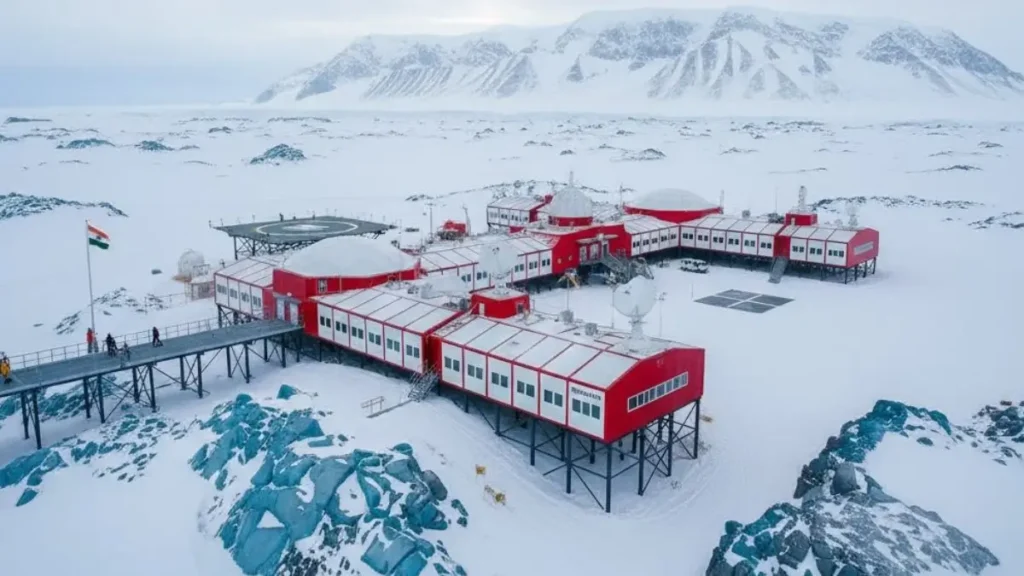
Maitri II Antarctic station 2032: India plans a new state-of-the-art Antarctic research station in Schirmacher Oasis, enhancing polar science and environmental research capabilities.
India Plans New Antarctic Research Station “Maitri II” — Operational by 2032
India has announced a major expansion of its polar research infrastructure with plans to construct a new Antarctic research station called Maitri II. This futuristic scientific base will be located in East Antarctica near the existing Maitri station and is expected to be completed and operational by 2032.
The Indian Ministry of Earth Sciences has approved ₹29.2 crore for pre-investment activities, including architectural design work and preparation of a detailed project report (DPR), marking the first crucial steps in this ambitious endeavour.
Strategic Location and Purpose of Maitri II
The new station will be built in the Schirmacher Oasis, a relatively ice-free region of East Antarctica near the existing Maitri station. This location has strategic research advantages due to easier access and established scientific infrastructure.
Maitri II is envisioned as a state-of-the-art, all-weather scientific facility, capable of supporting comprehensive research in various fields, including:
- Earth Sciences
- Glaciology
- Atmospheric Studies
- Environmental Monitoring
- Biological Research
The upgraded station will be better equipped for long-term and multidisciplinary scientific missions, significantly enhancing India’s contribution to global polar science.
Advanced Facilities and Research Capabilities
According to official plans:
- The station will include modern laboratories for ice-core processing and biological studies.
- There will be dedicated facilities for continuous atmospheric observation.
- The logistical backbone will support year-round operations, even during extreme weather conditions.
The facility is expected to house up to 90 researchers and support personnel, making it one of India’s most significant scientific outposts in Antarctica.
Project Timeline and Implementation Challenges
The original plan aimed for Maitri II to be functional by 2029, but the timeline has been extended to 2032 due to logistical hurdles and the complex nature of polar construction.
Key preparatory work, such as environmental assessments and site surveys, is currently underway. The project will rely on prefabricated structures transported to the continent for assembly — a common approach for polar stations due to harsh weather.
India’s Growing Role in Polar Research
Once completed, Maitri II will become India’s fourth Antarctica station after:
- Maitri (1989)
- Bharati (2012)
- Dakshin Gangotri (India’s first base, now retired)
India’s presence in Antarctica reflects the nation’s commitment to international scientific cooperation, environmental monitoring, and strategic research under the Antarctic Treaty System — a global framework for peaceful scientific activity and environmental protection.

Why This News Is Important for Exam Aspirants
Relevance to Government Exam Syllabus
This news is significant for students preparing for government exams (UPSC, PSCs, Railways, Defence, Banking, Teaching, and others) because it links to key themes in the General Studies syllabus:
- Geography & Environment: Antarctica’s climate systems, ecosystems, and global environmental significance.
- Science & Technology: India’s scientific research capabilities and strategic technological investments.
- International Relations and Treaties: India’s role in the Antarctic Treaty System.
- Government Policies & Initiatives: Funding, infrastructure planning, and environmental compliance.
Why It Matters in the Current Context
Understanding India’s expanding scientific footprint in Antarctica also helps students grasp broader global issues such as:
- Climate change research
- Global data sharing on environmental science
- Peaceful international use of polar regions
These topics are increasingly featured in exam questions due to their relevance to global governance and environmental sustainability.
Historical Context: India’s Antarctic Research Journey
India’s journey in Antarctic exploration began in 1981-82, when its first scientific expedition reached Antarctica, marking a major milestone for polar science participation.
- Dakshin Gangotri: India’s first Antarctic research station, established in 1983, became operational but was later abandoned as it got buried under ice.
- Maitri Station: Commissioned in 1989, this station became India’s primary research outpost for continental studies and is still functional.
- Bharati Station: Established in 2012, it is one of India’s most technologically advanced research facilities, focusing on oceanography and earth sciences.
With Maitri II, India is set to reinforce its scientific legacy in Antarctica, expanding capabilities and research infrastructure for decades to come.
Key Takeaways from “India Plans New Antarctic Research Station Maitri II”
| S. No. | Key Takeaway |
|---|---|
| 1 | India plans a new Antarctic research station called Maitri II, expected to be operational by 2032. |
| 2 | The Ministry of Earth Sciences has approved initial funding and pre-investment activities for the project. |
| 3 | Maitri II will be a state-of-the-art research facility supporting multidisciplinary scientific studies. |
| 4 | The station will enhance India’s ability to conduct year-round research in climate, glaciology, biology, and atmospheric sciences. |
| 5 | Once completed, it will join India’s existing Antarctic bases — Maitri and Bharati — reinforcing India’s global scientific footprint. |
FAQs: Frequently Asked Questions
1. What is Maitri II?
Maitri II is India’s planned new Antarctic research station, set to be operational by 2032. It will be located near the existing Maitri station in East Antarctica.
2. Why is India building Maitri II?
The station aims to strengthen India’s scientific research capabilities in Antarctica, supporting studies in glaciology, atmospheric science, environmental monitoring, and biology.
3. Where will Maitri II be located?
Maitri II will be built in the Schirmacher Oasis region of East Antarctica, a relatively ice-free area near the current Maitri station.
4. How many researchers will Maitri II accommodate?
The station is expected to house up to 90 researchers and support staff, facilitating year-round scientific research.
5. What is the estimated cost of Maitri II’s pre-investment activities?
The Indian Ministry of Earth Sciences has approved ₹29.2 crore for pre-investment activities, including architectural design and the detailed project report.
6. What are India’s other Antarctic stations?
India currently operates Maitri (1989) and Bharati (2012). Dakshin Gangotri was India’s first station, now retired.
7. What is the significance of Maitri II for exams?
Maitri II is important for government exams like UPSC, PSCs, banking, railways, and defence, covering Geography, Science & Technology, Environmental Studies, and International Relations.
8. When did India first establish its Antarctic research program?
India began its Antarctic expeditions in 1981–82, and Dakshin Gangotri was commissioned in 1983.
9. Which ministry is responsible for Maitri II?
The Ministry of Earth Sciences is the nodal agency responsible for planning and executing the Maitri II project.
10. What global framework governs research in Antarctica?
Research in Antarctica is governed by the Antarctic Treaty System, which promotes peaceful scientific activities and environmental protection.
Some Important Current Affairs Links

