
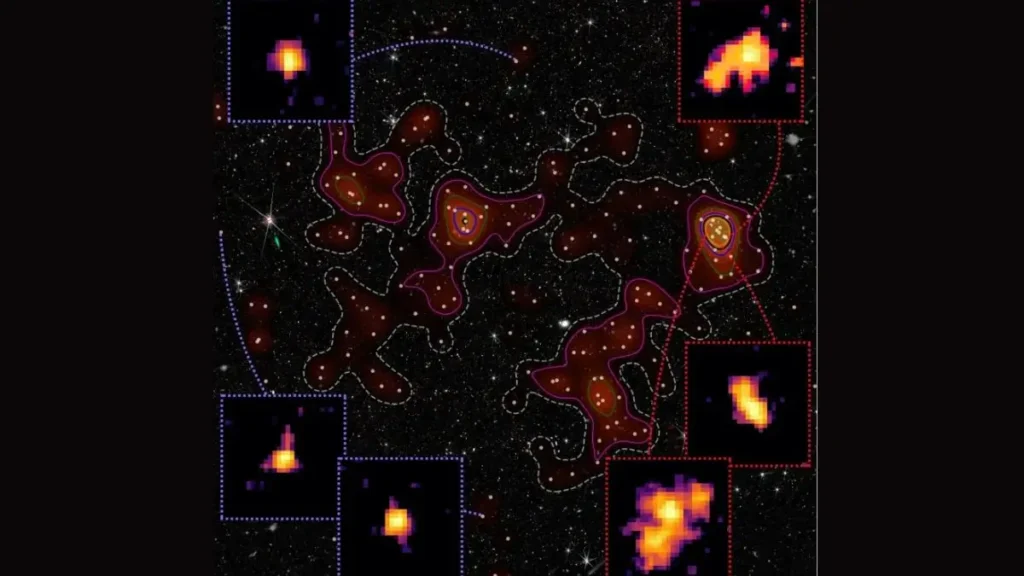
Loktak protocluster discovery 2026 highlights how an Indian scientist led the discovery of an ancient galaxy cluster located 12.6 billion light-years away using the James Webb Space Telescope.
Indian Scientist Leads Discovery of Ancient Loktak Protocluster
Discovery of the Loktak Protocluster
A major scientific breakthrough has brought global attention to Indian astronomy after an Indian astrophysicist led the discovery of an ancient galaxy structure known as the “Loktak Protocluster.” The discovery has become an important topic in current affairs because it highlights India’s growing contribution to global space science and astronomy research. The protocluster has been named after Loktak Lake in Manipur, connecting India’s cultural and natural heritage with one of the oldest known structures in the universe.
The discovery was led by Dr. Ronaldo Laishram, a scientist from Manipur currently associated with the National Astronomical Observatory of Japan (NAOJ). An international team of researchers worked together to identify this massive structure located nearly 12.6 billion light-years away from Earth. The findings were published in the reputed scientific journal “The Astrophysical Journal Letters.”
What is a Protocluster?
A protocluster is an early-stage galaxy cluster that later develops into a large cluster of galaxies through gravitational attraction. Scientists often describe it as a “city of galaxies” under construction. Galaxy clusters are among the largest structures in the universe and contain hundreds or even thousands of galaxies bound together by gravity.
The Loktak Protocluster existed when the universe was only around 1.2 billion years old, making it one of the earliest massive structures ever identified. This discovery challenges earlier scientific assumptions that such giant structures formed much later in cosmic history.
Why the Name “Loktak”?
The structure was named after Loktak Lake in Manipur, the largest freshwater lake in Northeast India. Loktak Lake is famous for its floating islands called “phumdis,” which are masses of vegetation and organic matter floating on water. Scientists found that the newly discovered galaxy concentrations resembled these interconnected floating masses.
According to Dr. Ronaldo Laishram, the protocluster contains four connected galaxy concentrations, similar to the way phumdis remain interconnected within Loktak Lake. The naming also serves as a tribute to the scientist’s home state and highlights the cultural identity of Northeast India on a global scientific platform.
Role of Advanced Telescopes in the Discovery
The discovery became possible through observations made using advanced astronomical instruments, including the Subaru Telescope in Hawaii and NASA’s James Webb Space Telescope (JWST). The James Webb Space Telescope has transformed modern astronomy because of its ability to observe extremely distant and ancient cosmic objects.
The detailed observations showed that galaxies within the Loktak Protocluster were evolving differently from galaxies located in less crowded areas of space. Scientists observed that galaxies inside dense regions appeared physically larger and more developed. These findings are helping astronomers understand how galaxies evolved during the early stages of the universe.
Importance of the Discovery in Astronomy
The Loktak Protocluster discovery is considered highly important because it provides clues about the formation of the universe after the Big Bang. It gives scientists an opportunity to study how galaxy clusters began forming in the early universe. The findings may also improve scientific understanding of cosmic evolution, dark matter distribution, and gravitational interactions between galaxies.
This achievement also highlights India’s increasing role in international scientific collaborations. Indian scientists are now contributing significantly to frontier areas such as astrophysics, space exploration, and cosmology. The discovery has therefore become an important topic for competitive examinations, especially for students preparing for UPSC, SSC, banking, railways, defence, and state civil services examinations.

Why this News is Important
Importance for Science and Technology
The discovery of the Loktak Protocluster is important because it provides evidence that massive cosmic structures existed much earlier than scientists previously believed. Earlier theories suggested that large galaxy clusters formed gradually over billions of years. However, this newly discovered structure indicates that the universe developed complex systems very rapidly after the Big Bang.
The research also demonstrates the importance of modern astronomical technology. Instruments such as the James Webb Space Telescope are allowing scientists to observe ancient regions of space with unprecedented detail. This discovery will contribute to future studies related to galaxy formation and cosmic evolution.
Importance for India
The achievement has become a proud moment for India because an Indian scientist from Manipur led the international research team. It highlights the growing participation of Indian researchers in advanced scientific discoveries. The naming of the protocluster after Loktak Lake has also brought global recognition to Northeast India and its cultural heritage.
The discovery promotes awareness about India’s scientific talent and strengthens the country’s image in the global research community. It may inspire more students to pursue careers in astronomy, astrophysics, and space science.
Importance for Competitive Exams
For government exam aspirants, this topic is important under Science and Technology current affairs. Questions may be asked about the James Webb Space Telescope, galaxy clusters, protoclusters, Loktak Lake, or the scientist associated with the discovery. Students preparing for UPSC, PSCs, SSC, defence, railways, and teaching examinations should carefully revise these concepts.
Historical Context
Evolution of Astronomy and Galaxy Research
The study of galaxies and cosmic structures has advanced significantly since the twentieth century. Scientists discovered that galaxies are not randomly distributed but exist in groups and clusters connected through gravity. Over time, astronomers developed theories explaining how these structures formed after the Big Bang.
The launch of advanced telescopes revolutionized space research. The Hubble Space Telescope expanded knowledge about distant galaxies, while the James Webb Space Telescope has enabled scientists to observe even older regions of the universe. These technological advancements have helped researchers identify structures formed during the early stages of cosmic history.
India’s Contribution to Space Science
India has steadily increased its contribution to astronomy and space research through institutions such as ISRO and collaborations with global observatories. Indian scientists have participated in important international projects related to astrophysics, cosmology, and planetary science. The Loktak Protocluster discovery continues this tradition of scientific contribution and highlights the role of Indian researchers in global astronomy.
Key Takeaways from This News
| S.No. | Key Takeaway |
|---|---|
| 1 | Indian astrophysicist Dr. Ronaldo Laishram led the discovery of the Loktak Protocluster. |
| 2 | The Loktak Protocluster is located about 12.6 billion light-years away from Earth. |
| 3 | The structure was named after Loktak Lake in Manipur, famous for its floating phumdis. |
| 4 | The discovery was made using the Subaru Telescope and James Webb Space Telescope. |
| 5 | The discovery suggests massive galaxy structures formed earlier than previously believed. |
FAQs on Loktak Protocluster Discovery
1. What is the Loktak Protocluster?
The Loktak Protocluster is an ancient group of galaxies discovered nearly 12.6 billion light-years away from Earth. It is considered one of the earliest known large cosmic structures in the universe.
2. Who led the discovery of the Loktak Protocluster?
The discovery was led by Indian astrophysicist Dr. Ronaldo Laishram from Manipur, who is associated with the National Astronomical Observatory of Japan (NAOJ).
3. Why is the protocluster named “Loktak”?
The protocluster was named after Loktak Lake in Manipur because the interconnected galaxy formations resembled the floating phumdis found in the lake.
4. What is a protocluster?
A protocluster is an early-stage cluster of galaxies that eventually develops into a massive galaxy cluster through gravitational attraction.
5. Which telescopes were used in this discovery?
Scientists used the Subaru Telescope in Hawaii and NASA’s James Webb Space Telescope (JWST) to observe the protocluster.
6. Why is this discovery important?
The discovery is important because it suggests that large galaxy structures formed much earlier in the universe than previously believed.
7. How old was the universe when the Loktak Protocluster existed?
The universe was approximately 1.2 billion years old when the Loktak Protocluster existed.
8. What is the James Webb Space Telescope?
The James Webb Space Telescope is an advanced space observatory launched by NASA to study distant galaxies, stars, and the origins of the universe.
9. Where is Loktak Lake located?
Loktak Lake is located in the state of Manipur in Northeast India. It is the largest freshwater lake in the region.
10. Why is this topic important for competitive exams?
This topic is important for Science and Technology current affairs in exams such as UPSC, SSC, Banking, Railways, Defence, and State PSC examinations.
Some Important Current Affairs Links

