
Jamun origin India study reveals that Syzygium cumini originated in India, challenging earlier Australia-Southeast Asia theories based on fossil evidence from the Eocene epoch.
Jamun’s Evolutionary Origin Rewritten by Scientific Study
🌍 Introduction: Major Discovery in Plant Evolution
A groundbreaking scientific study has revealed that the origin of Jamun (Syzygium cumini) can be traced back to India, challenging the long-held belief that the fruit originated in Australia or Southeast Asia. The research, conducted by leading institutions such as the Birbal Sahni Institute of Palaeosciences (BSIP) under the Department of Science and Technology (DST), has reshaped global understanding of plant evolution and biogeography.
🧬 Fossil Evidence Rewrites Evolutionary Timeline
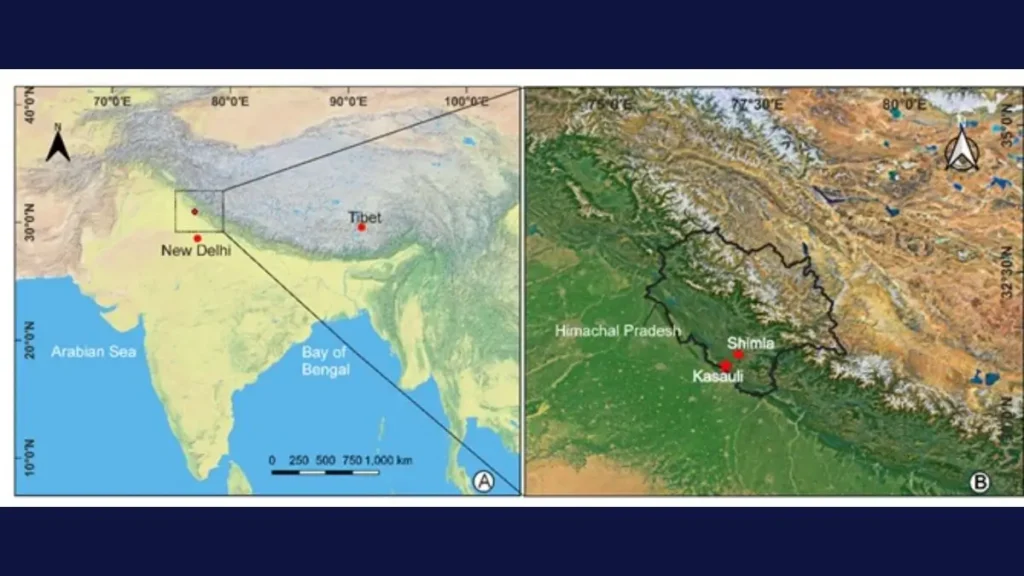
The study found strong fossil evidence suggesting that the Syzygium genus existed in the Indian subcontinent as early as the Eocene epoch (~55 million years ago). Earlier theories placed its origin around 51 million years ago in Australia or Southeast Asia. However, new fossil discoveries from Himachal Pradesh’s Kasauli Formation (around 20 million years old) have significantly altered this timeline.
🇮🇳 India as the Centre of Diversification
Researchers concluded that India was not just a transit region but a primary centre of origin and diversification for Jamun. From India, the species is believed to have spread to Southeast Asia and Australia over millions of years, reversing earlier migration assumptions.
🔬 Scientific Methodology Used
The study combined multiple scientific approaches including fossil leaf analysis, morphological comparison, and molecular phylogenetics. This interdisciplinary method helped validate the presence of Syzygium in India far earlier than previously estimated.
🌱 Importance of the Discovery
This discovery highlights India’s critical role in global plant biodiversity evolution. It also provides valuable insights into ancient climate patterns and ecological transitions that shaped modern-day flora distribution.

📌 Why this News is Important
🎯 Scientific and Exam Relevance
This discovery is highly significant for students preparing for UPSC, SSC, Railways, Banking, and State PSC exams because it connects science, geography, environment, and current affairs in a single topic. Questions related to biodiversity, evolution, and fossil studies are frequently asked in competitive examinations.
🌏 India in Global Biodiversity Research
The study strengthens India’s position as a major contributor to global paleobotanical research. It also highlights the importance of institutions like BSIP and DST in advancing scientific knowledge.
🌱 Environmental and Ecological Importance
Understanding plant evolution helps scientists predict future climate change impacts and biodiversity shifts. This makes the study relevant for environmental policies and conservation strategies.
📚 Link with Static GK
The topic also connects with static general knowledge such as:
- Origin of plant species
- Gondwana land theory
- Fossil studies in India
- Indian biodiversity hotspots
🧠 Exam Utility
Such discoveries often appear in:
- UPSC Prelims (Environment & Science section)
- SSC General Awareness
- Railway NTPC & Group D exams
- State PCS exams
🏺 Historical Context
The genus Syzygium, which includes Jamun, has long been studied for its medicinal and nutritional importance. Earlier scientific theories suggested that its origin lay in Australia or Southeast Asia, based on limited fossil records and molecular studies.
However, India has always been recognized as a biodiversity-rich region, historically part of the ancient Gondwana landmass, which played a crucial role in plant evolution. Over time, fossil discoveries across Indian states like Himachal Pradesh and Kerala have provided evidence of ancient flora presence.
The recent study builds upon earlier paleobotanical research conducted by Indian and international scientists. It integrates fossil records dating back over 50 million years, offering a revised understanding of how plant species migrated and diversified across continents.
This shift in understanding reflects how modern science continuously revises historical ecological narratives using advanced research tools.
📊 Key Takeaways from Jamun Origin Study
| S.No. | Key Takeaway |
|---|---|
| 1 | Jamun (Syzygium cumini) origin traced back to India, not Australia or Southeast Asia |
| 2 | Fossil evidence shows presence in India as early as ~55 million years ago |
| 3 | Kasauli Formation fossils in Himachal Pradesh played a key role in the discovery |
| 4 | India identified as a major centre of diversification for Syzygium genus |
| 5 | Study reshapes global understanding of plant evolution and biogeography |
Frequently Asked Questions (FAQs)
Q1. What is the main finding of the Jamun origin study?
The study reveals that Jamun (Syzygium cumini) originated in India, challenging earlier beliefs that it came from Australia or Southeast Asia.
Q2. Which institution conducted the study on Jamun origin?
The research was carried out by the Birbal Sahni Institute of Palaeosciences (BSIP) under the Department of Science and Technology (DST), India.
Q3. How old is the fossil evidence related to Jamun?
Fossil evidence suggests the presence of the Syzygium genus in India as far back as the Eocene epoch (~55 million years ago).
Q4. Why is this discovery important for geography and environment exams?
It helps in understanding plant evolution, fossil records, biodiversity distribution, and India’s role in global ecological history, which are key exam topics.
Q5. What does this study change in global scientific understanding?
It revises the earlier theory and establishes India as a major centre of origin and diversification for the Syzygium genus.
Some Important Current Affairs Links

