
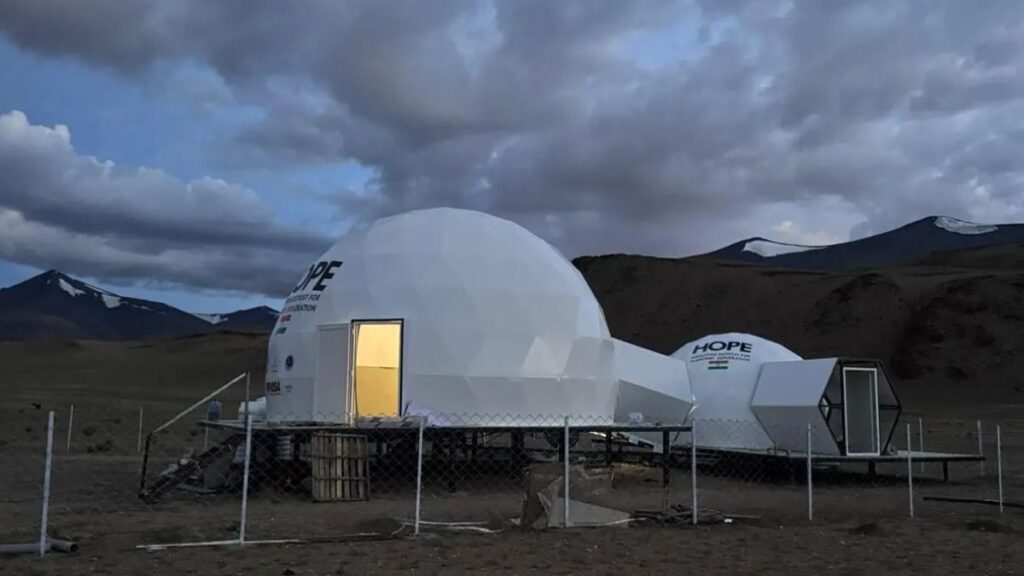
ISRO launches HOPE mission in Ladakh to simulate astronaut life for Gaganyaan 2025. Learn about India’s analog habitat, mission goals, participants, and its significance for space missions.
ISRO’s HOPE Mission in Ladakh: Simulating Astronaut Life for Gaganyaan and Beyond
Introduction to the HOPE Mission
On August 1, 2025, the Indian Space Research Organisation (ISRO) launched a groundbreaking 10-day high-altitude isolation experiment in Ladakh’s Tso Kar Valley, named the HOPE (Himalayan Outpost for Planetary Exploration). Conducted at 14,000 feet, the mission simulates Mars- and Moon-like conditions to evaluate human performance in extreme environments as part of preparations for India’s Gaganyaan human spaceflight programme and future interplanetary missions.
Location and Infrastructure
Situated in a cold desert terrain with rocky, lunar-like features, low oxygen environment, and sub-zero night temperatures, HOPE presents one of the most realistic space analogues on Earth. The facility was developed by Bengaluru-based Protoplanet and inaugurated by ISRO Chairman Dr V Narayanan just a day before the mission began.
Crew Selection and Preparation
From 135 applicants, two individuals were chosen: Rahul Mogalapalli, a PhD candidate from Purdue University, and Yaman Akot, a planetary science graduate from the University of Aberdeen. Selection criteria emphasized medical fitness, psychological resilience, and prior experience in confined-environment simulations. Both participants underwent a 15-day acclimatisation programme in lower altitudes before initiating the mission.
Mission Objectives and Research Focus
The HOPE mission focuses on three key areas:
- Physical Health Monitoring— Comprehensive sampling (blood, urine, stool) to examine genomic, proteomic, and metabolomic responses.
- Mental Health and Performance— Evaluation of mood, sleep patterns, cognitive ability, and team dynamics under isolation.
- Operational Readiness— Practicing daily routines akin to those on the ISS, including exercise schedules and communication with Mission Control.
Global Context and Comparison
ISRO’s HOPE facility sets itself apart by combining cold desert, high-altitude, and lunar-like terrain in one location—unlike other analog missions such as the U.S.’s Mars Desert Research Station, Canada’s Flashline Mars Arctic Station, Hawaii’s HI‑SEAS, Russia’s SIRIUS, or ESA’s CAVES training program. IAS
Strategic Significance for India’s Space Ambitions
The HOPE mission offers critical human performance data, enabling ISRO to test life-support systems, assess astronaut adaptability, and refine operational protocols—without relying on international facilities. This initiative firmly positions India among the select few nations capable of homegrown planetary surface simulations.
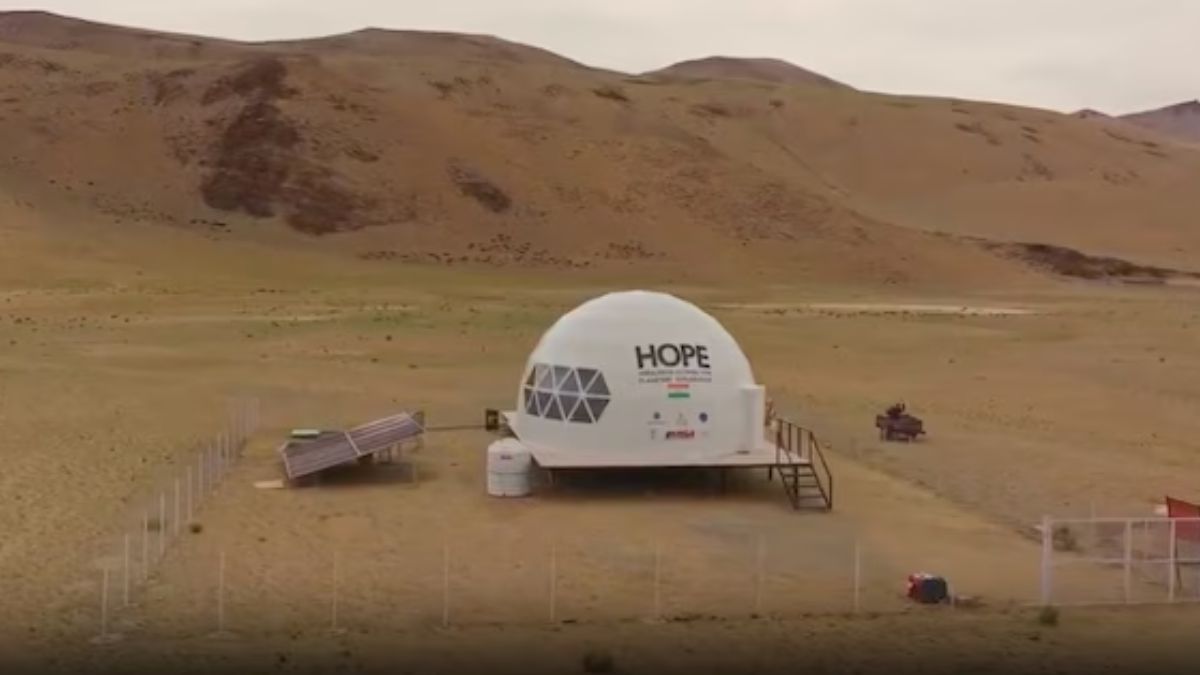 "ISRO HOPE Mission in Ladakh")
B) Why This News Is Important
Bridging Earthly Simulation with Space Ambitions
ISRO’s HOPE mission marks India’s transition from conceptual exploration to practical human spaceflight preparedness. By replicating the harsh environmental conditions of the Moon and Mars, the mission equips researchers with valuable insights into physical and psychological stressors faced by astronauts—crucial for the success of the upcoming Gaganyaan programme and beyond.
Self-Reliance and Strategic Autonomy
HOPE exemplifies India’s evolving space ecosystem, reflecting the government’s push towards public–private collaboration. Developed with Bengaluru‑based Protoplanet and national research institutes, this homegrown facility reduces reliance on external analogues, enhancing India’s self-sufficiency in space exploration infrastructure.
Foundation for Future Missions
As a live laboratory, HOPE enables ISRO to validate protocols, health monitoring systems, and operational procedures under controlled but challenging conditions. This serves as a rehearsal for longer-duration missions, including Gaganyaan’s crewed flight and eventual lunar and interplanetary missions, flagging a leap toward achieving India’s 2040 lunar landing ambition.
C) Historical Context
Analog Missions in Ladakh: A Stepped Strategy
India’s analog mission journey began with the Ladakh Human Analogue Mission (LHAM) commenced in November 2024, overseen by ISRO’s Human Space Flight Centre, AAKA Space Studio, University of Ladakh, and IIT Bombay. LHAM focused on astronaut endurance, lighting systems, and habitat design using an inflatable module (Hab‑1).
A follow-up was the Anugami Isolation Study in July 2025, involving Gaganyatri astronaut Group Captain Angad Pratap, further refining psychological and operational protocols.
HOPE: Evolving Complexity and Collaboration
Building upon these missions, the HOPE analogue mission elevates the scale and sophistication—incorporating interdisciplinary scientific research, private industry involvement, and more complex environmental simulation models. It represents the current and most advanced step in preparing for human spaceflight.
D) Key Takeaways from HOPE Mission
| Serial No. | Key Takeaway |
|---|---|
| 1 | HOPE (Himalayan Outpost for Planetary Exploration) is a 10-day analog mission launched on August 1, 2025, at 14,000 ft in Ladakh to simulate space-like conditions. |
| 2 | The facility, built by Protoplanet and inaugurated by ISRO Chairman Dr V Narayanan, simulates lunar/Mars terrain, low oxygen, and freezing temperatures. |
| 3 | Two crew members—Rahul Mogalapalli (Purdue) and Yaman Akot (Aberdeen)—were selected based on fitness, resilience, and prior simulation experience. |
| 4 | Mission objectives include health monitoring (genomic, proteomic, metabolomic), mental performance evaluation, and testing operational routines. |
| 5 | HOPE marks India’s entry into elite global analog missions, supporting Gaganyaan and future Moon/Mars projects with homegrown simulation infrastructure. |
FAQs: Frequently Asked Questions
Q1. What is ISRO’s HOPE mission and where is it located?
The HOPE (Himalayan Outpost for Planetary Exploration) mission is an analog space simulation experiment launched by ISRO in Ladakh’s Tso Kar Valley at an altitude of 14,000 feet. It replicates lunar and Martian environmental conditions.
Q2. Why is Ladakh chosen for space simulation?
Ladakh’s high altitude, low oxygen levels, rocky terrain, and extreme temperatures make it an ideal terrestrial analogue for extraterrestrial environments like Mars or the Moon.
Q3. Who are the participants in the HOPE mission?
The mission involves two analog astronauts: Rahul Mogalapalli, a PhD student at Purdue University, and Yaman Akot, a planetary science graduate from the University of Aberdeen.
Q4. How is this mission relevant to Gaganyaan?
HOPE helps simulate conditions astronauts will face in space, allowing ISRO to study health, psychology, and operational efficiency for crewed missions like Gaganyaan.
Q5. What is unique about India’s HOPE mission compared to global analog missions?
Unlike other space analogues, HOPE combines lunar-like terrain with cold desert and high-altitude isolation—all in a single Indian location, enhancing indigenous space research capacity.
Q6. How long will the HOPE mission last?
The current HOPE analog mission is scheduled for 10 days, involving continuous simulation of astronaut-like life.
Q7. What kind of research is being conducted during this mission?
ISRO is studying genomics, proteomics, sleep, mood, decision-making, operational readiness, and other vital astronaut health and performance markers.
Q8. Which private company collaborated with ISRO in developing the HOPE facility?
Bengaluru-based Protoplanet collaborated in setting up the HOPE facility in Ladakh.
Q9. Is this India’s first analog mission?
No, India conducted prior missions like LHAM (Ladakh Human Analogue Mission) in 2024 and Anugami Isolation Study in 2025. HOPE is the most advanced so far.
Q10. How is this mission useful for exams like UPSC, SSC, and Defence Services?
It showcases India’s advancements in space technology, indigenous research capabilities, and strategic planning—highly relevant for science & tech and current affairs sections in competitive exams.
Some Important Current Affairs Links

