
ISRO 175 tonne semi cryogenic engine hot test marks a major advancement in India’s space programme. Learn its significance, features, exam relevance, key facts, MCQs, and important current affairs for UPSC, SSC, Banking, Railways, Defence, PSC, and other government exams.
Introduction
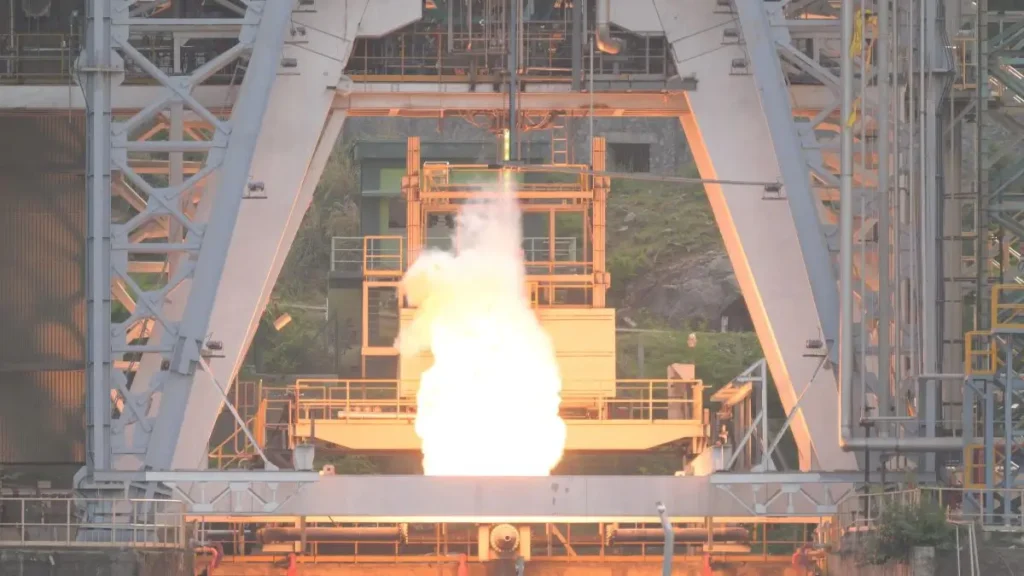
The Indian Space Research Organisation (ISRO) has achieved another significant milestone by successfully conducting a hot test of its Semi-Cryogenic Engine Power Head Test Article (PHTA) at a thrust level of 175 tonnes. The successful test marks a major step toward developing India’s next-generation rocket propulsion system, which will support heavier satellites, deep-space exploration, and future human spaceflight missions. The test was carried out at the ISRO Propulsion Complex (IPRC), Mahendragiri, Tamil Nadu, demonstrating the country’s growing self-reliance in advanced space technologies.
What is the Semi-Cryogenic Engine?
A semi-cryogenic engine is an advanced rocket propulsion system that uses Liquid Oxygen (LOX) as the oxidizer and refined kerosene (Isrosene) as fuel. Unlike fully cryogenic engines that use liquid hydrogen, semi-cryogenic engines generate higher thrust while remaining more economical and easier to handle.
These engines are particularly suitable for the booster stage of heavy-lift launch vehicles because they offer greater efficiency, improved payload capacity, and enhanced reliability.
Details of the Successful Hot Test
ISRO successfully tested the Power Head Test Article (PHTA) at 175 tonnes of thrust, equivalent to nearly 88% of the engine’s targeted operational capacity. The PHTA contains all critical engine systems except the thrust chamber.
This was the eighth hot test in the ongoing development programme. Earlier tests had been conducted at 94 tonnes (47%) and 120 tonnes (60%) thrust levels. During the latest test, the engine demonstrated stable combustion, successful operation of the turbopumps, and outlet pressures of 400 and 500 bar, confirming the robustness of the propulsion system.
Importance of the Achievement
The successful test provides confidence for conducting the next phase of testing at the engine’s full 200-tonne thrust capability. Achieving this milestone is essential before integrating the engine into future launch vehicles.
The indigenous development of this engine reduces India’s dependence on foreign technologies and strengthens the country’s capability to design powerful launch systems for commercial and strategic missions.
Benefits for India’s Space Programme
The semi-cryogenic engine is expected to significantly enhance the performance of future launch vehicles, including upgraded versions of the LVM3. Increased thrust will allow India to launch heavier communication satellites, Earth observation satellites, interplanetary missions, and human spaceflight missions more efficiently.
The engine will also improve fuel efficiency and reduce launch costs, making Indian launch services more competitive in the global commercial launch market.
Role in Future Space Missions
The new propulsion system will play an important role in upcoming missions involving:
- Heavy communication satellites
- Deep-space exploration
- Planetary missions
- Space station-related programmes
- Human spaceflight under Gaganyaan
- Future reusable launch vehicles
The technology also aligns with India’s long-term vision of becoming a leading global space power.
Indigenous Technology Development
The successful test reflects India’s increasing technological self-reliance under the “Atmanirbhar Bharat” initiative. Developing indigenous propulsion technology reduces dependence on imported systems and strengthens national strategic capabilities.
The programme also provides valuable experience in advanced engine design, turbomachinery, combustion systems, and high-pressure testing.
Significance for Competitive Examinations
This development is highly relevant for UPSC, State PSC, SSC, Banking, Railways, Defence, Police, and Teaching examinations. Questions may be asked about:
- Semi-cryogenic engines
- ISRO propulsion technologies
- ISRO Propulsion Complex, Mahendragiri
- LVM3 launch vehicle
- Cryogenic vs Semi-cryogenic engines
- India’s indigenous space technologies
- Recent ISRO achievements

B) Why this News is Important
Strengthening India’s Space Capability
The successful 175-tonne semi-cryogenic engine hot test represents a major technological advancement for India’s space programme. It demonstrates ISRO’s capability to design and develop complex propulsion systems without relying on foreign technology. This achievement enhances India’s strategic autonomy in space technology and strengthens its global reputation.
Relevance for Government Examinations
Space technology is an important topic in UPSC, State PSCs, SSC, CDS, NDA, Banking, Railways, CAPF, and various teaching examinations. Questions related to ISRO missions, propulsion systems, launch vehicles, and indigenous technology frequently appear in current affairs and science sections.
Understanding the difference between cryogenic and semi-cryogenic engines, the location of ISRO testing facilities, and the importance of heavy-lift launch vehicles is essential for aspirants.
Contribution to India’s Economy
Advanced propulsion systems improve India’s ability to launch commercial satellites at competitive prices. This can generate significant foreign exchange earnings through commercial launch services while strengthening India’s growing space economy.
Strategic Importance
A powerful indigenous launch capability supports communication, weather forecasting, navigation, defence surveillance, disaster management, and scientific exploration. These technologies contribute directly to national security and technological leadership.
C) Historical Context
Evolution of India’s Rocket Engine Programme
India’s space programme began in the 1960s under the leadership of Dr. Vikram Sarabhai. Initially dependent on foreign technology, ISRO gradually developed indigenous solid, liquid, and cryogenic propulsion systems.
The development of cryogenic technology became a national priority after international technology restrictions delayed India’s access to advanced rocket engines.
To further improve launch capabilities, ISRO initiated the Semi-Cryogenic Engine Development Programme for producing approximately 2000 kN thrust engines using Liquid Oxygen and kerosene. The first major breakthrough came with successful PHTA hot tests beginning in 2025, followed by progressively higher thrust demonstrations. The latest 175-tonne hot test represents another major milestone toward achieving full operational capability.
D) Key Takeaways from ISRO’s 175-Tonne Semi-Cryogenic Engine Hot Test
| S. No. | Key Takeaway |
|---|---|
| 1 | ISRO successfully conducted a hot test of the Semi-Cryogenic Engine Power Head Test Article at 175 tonnes thrust. |
| 2 | The test was carried out at the ISRO Propulsion Complex (IPRC), Mahendragiri, Tamil Nadu. |
| 3 | The successful test achieved about 88% of the engine’s target 200-tonne thrust level. |
| 4 | The engine uses Liquid Oxygen (LOX) and refined kerosene (Isrosene), offering higher efficiency and payload capability. |
| 5 | The achievement strengthens India’s future launch vehicles, deep-space missions, human spaceflight programme, and indigenous space technology capabilities. |
Frequently Asked Questions (FAQs)
1. What is the recent achievement of ISRO?
ISRO successfully conducted a 175-tonne hot test of its Semi-Cryogenic Engine Power Head Test Article (PHTA), marking a major milestone in the development of India’s next-generation launch vehicle technology.
2. What is a semi-cryogenic engine?
A semi-cryogenic engine is a rocket engine that uses Liquid Oxygen (LOX) as the oxidizer and refined kerosene (Isrosene/RP-1 class fuel) as the fuel. It produces high thrust and is more economical than fully cryogenic engines.
3. Where was the hot test conducted?
The hot test was conducted at the ISRO Propulsion Complex (IPRC), Mahendragiri, Tamil Nadu.
4. What is the significance of the 175-tonne hot test?
The test demonstrated nearly 88% of the engine’s designed thrust capacity, bringing ISRO closer to qualifying the engine for operational use in future launch vehicles.
5. What is the target thrust of ISRO’s semi-cryogenic engine?
The engine is being developed to generate approximately 200 tonnes (around 2000 kN) of thrust.
6. Which fuels are used in a semi-cryogenic engine?
It uses Liquid Oxygen (LOX) as the oxidizer and refined kerosene (Isrosene) as the fuel.
7. How is a semi-cryogenic engine different from a cryogenic engine?
A semi-cryogenic engine uses LOX and kerosene, whereas a cryogenic engine uses Liquid Hydrogen (LH2) and Liquid Oxygen (LOX). Semi-cryogenic engines provide higher thrust and are easier to handle.
8. Why is this development important for India?
The successful test enhances India’s indigenous rocket technology, reduces dependence on foreign propulsion systems, and strengthens future heavy-lift and deep-space missions.
9. Which future missions will benefit from this engine?
The engine is expected to support:
- Heavy satellite launches
- Human spaceflight (Gaganyaan)
- Deep-space exploration
- Lunar and planetary missions
- Future reusable launch vehicles
10. Why is this topic important for competitive examinations?
Questions on ISRO, propulsion systems, cryogenic technology, launch vehicles, recent scientific achievements, and India’s space programme are frequently asked in UPSC, State PSC, SSC, Banking, Railways, Defence, Police, and Teaching examinations.
11. What does PHTA stand for?
PHTA stands for Power Head Test Article, which includes all major engine systems except the thrust chamber and is used to validate engine performance.
12. What are the advantages of a semi-cryogenic engine?
Greater reusability potential
Higher thrust
Better fuel efficiency
Increased payload capacity
Lower launch costs
Improved reliability
Some Important Current Affairs Links

