
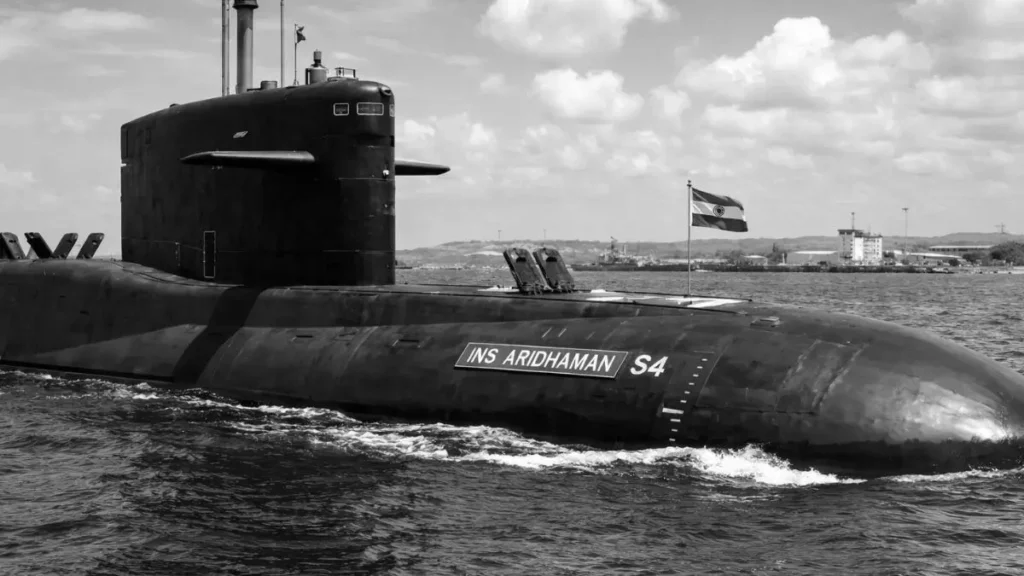
INS Aridaman, India’s third nuclear-powered ballistic missile submarine, enhances second-strike capability, completes the nuclear triad, and strengthens maritime security.
Indian Navy’s INS Aridaman: Features, Role & Strategic Importance — Comprehensive Analysis
Introduction: What Is INS Aridaman?
The Indian Navy has inducted its third indigenously built nuclear‑powered ballistic missile submarine (SSBN) — INS Aridaman — marking a significant milestone in India’s defence and strategic capabilities. This submarine belongs to the Arihant‑class of SSBNs developed under the Advanced Technology Vessel (ATV) project, aimed at strengthening the country’s sea‑based nuclear deterrence.
Advanced Capabilities and Features
INS Aridaman, with an estimated displacement of around 7,000 tonnes, is believed to be larger and more potent than its predecessors (INS Arihant and INS Arighaat). It is equipped with more vertical launch system tubes, enabling it to carry double the missile load of earlier SSBNs. It can deploy a range of submarine‑launched ballistic missiles (SLBMs) such as the K‑15 Sagarika (range ~700–750 km) and K‑4 SLBMs (range ~3,500 km).
Powering Aridaman is a nuclear reactor system, allowing it to stay submerged for extended durations — months at a time — without surfacing, giving it unmatched stealth and endurance compared to conventional submarines.
Enhancing India’s Second‑Strike Capability
Under India’s nuclear doctrine of No First Use (NFU), having a secure second‑strike capability is critical. SSBNs like INS Aridaman ensure that India can retaliate even after absorbing a first nuclear strike. Being hard to detect in the depths of the ocean, they form the most survivable leg of the nation’s nuclear deterrent, reinforcing the credibility of India’s strategic posture.
Strengthening the Nuclear Triad
A nuclear triad consists of nuclear weapons launch platforms on land, air, and sea. With INS Aridaman now operational, India joins a select group of nations — including the United States, Russia, China, and France — possessing complete triad capabilities. Sea‑based deterrence adds strategic depth, making India’s nuclear force less vulnerable to preemptive strikes.
Boosting Indigenous Defence Manufacturing
INS Aridaman is a product of India’s push for self‑reliance in defence technology. Built at the Ship Building Centre, Visakhapatnam, it embodies the Aatmanirbhar Bharat initiative by combining advanced nuclear propulsion and indigenous submarine construction techniques. This not only cuts dependence on foreign systems but also enhances India’s technological prowess in high‑end defence manufacturing.
Strategic Impact on Regional Security
The commissioning of INS Aridaman comes at a time of evolving security dynamics in the Indo‑Pacific region. With increased maritime competition and expanding naval presence by other powers, India’s expanded SSBN fleet strengthens its capacity to safeguard vital sea lanes, assert strategic deterrence, and project power. These submarines also serve as a potent tool in India’s wider maritime diplomacy and security strategy.
Conclusion
The induction of INS Aridaman marks one of modern India’s most crucial strategic defence advancements. It not only enhances India’s nuclear deterrence but also reinforces maritime security, bolsters indigenous defence capabilities, and positions India as a formidable underwater power within the global strategic landscape.

Why This News Is Important for Government Exam Aspirants
Strategic Importance in Defense
The commissioning of the INS Aridaman is a landmark development in India’s strategic defence initiatives. It is India’s third indigenously built nuclear‑powered ballistic missile submarine (SSBN), boosting the country’s sea‑based nuclear deterrence by strengthening its second‑strike capability — a key pillar of India’s nuclear doctrine under the No First Use policy.
Relevance in Syllabus Topics
For competitive exams like UPSC Civil Services (IAS/IPS), SSC CGL, CAPF, CDS, and defence services exams, this topic fits directly under GS Paper III — Internal Security, Defence Technology, and Strategic Deterrence. Understanding nuclear triad technology, naval modernisation, and indigenous defence production is crucial for both prelims and mains answers.
Geo‑Political Implications
INS Aridaman enhances India’s deterrence in the Indo‑Pacific region, where tensions with strategic competitors remain high. Questions related to maritime security and geopolitical balance often appear in current affairs sections of competitive exams.
Technological and Indigenous Development
The submarine exemplifies India’s strides in indigenous defence manufacturing under the Make in India and Aatmanirbhar Bharat initiatives — themes commonly probed in government exams.
Important for Essay and Interview
Candidates preparing for descriptive papers or interviews may be asked about India’s nuclear deterrence strategy, strategic assets, or the importance of sea‑based deterrent platforms, and this news provides a timely context to craft well‑informed responses.
Historical Context: India’s Sea‑Based Nuclear Deterrence Journey
Origins of India’s Nuclear Submarine Program
India’s journey in developing a nuclear‑powered submarine began over three decades ago with the Advanced Technology Vessel (ATV) project, which aimed to build indigenous SSBNs capable of delivering nuclear warheads from underwater platforms.
First Milestone — INS Arihant
The first breakthrough came with INS Arihant, launched in 2009 and commissioned in 2016. Arihant was India’s first home‑built SSBN and marked the country’s entry into the exclusive club of nations with sea‑based nuclear deterrence.
Building the Fleet — INS Arighaat
India continued its trajectory by inducting the second SSBN, INS Arighaat, in 2024, enhancing missile capacity and operational capabilities. Each successive submarine incorporated technological improvements over its predecessor.
Strategic Deterrence Doctrine
India’s nuclear doctrine, officially articulated in the late 1990s, emphasises credible minimum deterrence and a No First Use policy. Developing a sea‑based deterrent was a strategic priority, since submarines are less vulnerable to a first strike compared to land or air launch platforms.
Maritime Strategy in Contemporary Context
As India emerged as a key player in the Indo‑Pacific security framework, naval capability became central to strategic planning. The commissioning of INS Aridaman represents the culmination of decades of sustained research, indigenous shipbuilding, and strategic doctrine evolution.
Key Takeaways from INS Aridaman Commissioning
| S. No. | Key Takeaway |
|---|---|
| 1 | INS Aridaman is India’s third indigenously built nuclear‑powered ballistic missile submarine (SSBN). |
| 2 | It significantly enhances India’s sea‑based nuclear deterrence and second‑strike capability. |
| 3 | The submarine strengthens India’s nuclear triad, joining land, air, and sea nuclear delivery systems. |
| 4 | It can carry SLBMs such as K‑15 and K‑4 missiles with long strike ranges. |
| 5 | INS Aridaman reflects India’s push for indigenous defence technology and maritime strategic power. |
FAQs: Frequently Asked Questions
1. What is INS Aridaman?
INS Aridaman is India’s third indigenously built nuclear-powered ballistic missile submarine (SSBN), developed under the Advanced Technology Vessel (ATV) project to enhance sea-based nuclear deterrence.
2. Which missiles can INS Aridaman carry?
It can carry submarine-launched ballistic missiles (SLBMs) such as K-15 Sagarika (~700–750 km range) and K-4 SLBMs (~3,500 km range).
3. What is the strategic importance of INS Aridaman?
It strengthens India’s second-strike capability, completes the nuclear triad, enhances maritime security, and ensures India’s survivable sea-based nuclear deterrent.
4. How does INS Aridaman improve India’s defence capabilities?
Being nuclear-powered, it can remain submerged for months, provides stealth, increases missile load, and boosts indigenous defence manufacturing capabilities.
5. Where was INS Aridaman built?
It was constructed at the Ship Building Centre, Visakhapatnam, under India’s push for self-reliant defence technology (Aatmanirbhar Bharat initiative).
6. Why is sea-based deterrence crucial for India?
Submarines like INS Aridaman are hard to detect and less vulnerable to a first strike, making them a key component of India’s nuclear doctrine under No First Use (NFU).
7. How does INS Aridaman enhance India’s nuclear triad?
With nuclear weapons delivery systems on land, air, and now sea, India achieves credible minimum deterrence and strategic stability.
Some Important Current Affairs Links

