
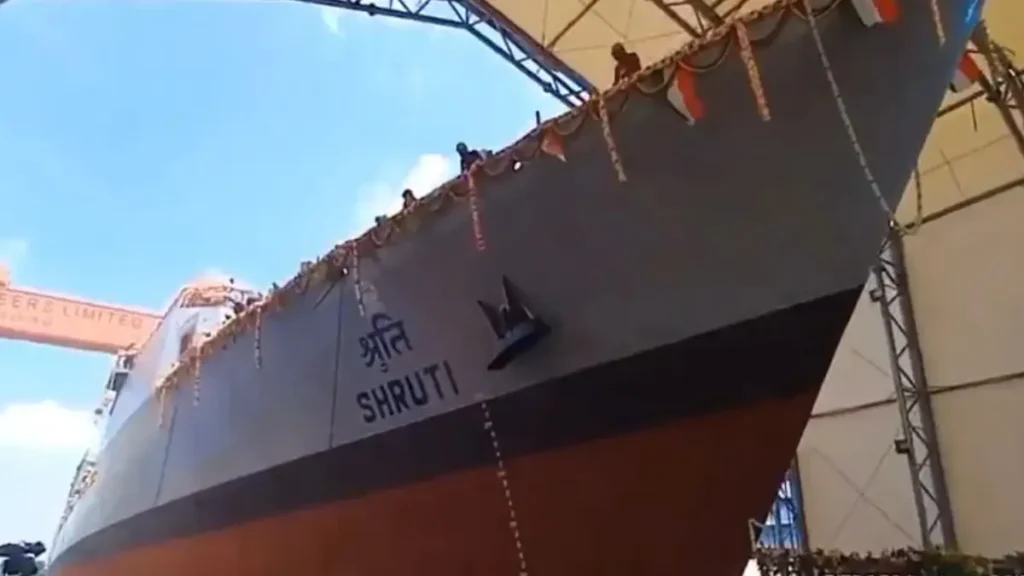
Indian Navy Shruti NGOPV launch at GRSE Kolkata marks a major step in indigenous defence shipbuilding, maritime security and Aatmanirbhar Bharat.
Indian Navy Launches Next-Generation Offshore Patrol Vessel Shruti
The Indian Navy achieved another milestone in indigenous warship construction with the launch of Shruti, a Next-Generation Offshore Patrol Vessel (NGOPV), at Garden Reach Shipbuilders & Engineers (GRSE) in Kolkata on August 11, 2026. The launch is significant for India’s maritime security strategy and its continuing efforts to strengthen domestic defence manufacturing. Shruti is part of a larger programme involving 11 NGOPVs being constructed for the Indian Navy.
Shruti Built Under India’s Indigenous Shipbuilding Programme
The NGOPV programme reflects India’s emphasis on designing and manufacturing major naval platforms within the country. Under the contract concluded in March 2023, seven vessels are being constructed by Goa Shipyard Limited (GSL), while four vessels are being constructed by GRSE in Kolkata. The vessels have an approximate displacement of 3,000 tonnes and are intended for a range of maritime security missions.
GRSE Kolkata’s Role in the NGOPV Programme
GRSE is one of India’s major defence shipyards and is undertaking four vessels under the NGOPV project. The first and second GRSE vessels, identified as Yard 3037 and Yard 3038, had their keel-laying ceremony in November 2024. Subsequent construction work progressed on the remaining vessels, demonstrating the shipyard’s continuing role in expanding India’s indigenous naval manufacturing capacity.
Key Maritime Security Missions of NGOPVs
The NGOPVs have been planned as versatile platforms capable of undertaking several important maritime duties. Their roles include coastal defence and surveillance, search-and-rescue operations, protection of offshore assets and anti-piracy missions. These functions are particularly important for a country such as India, which has extensive coastlines, offshore infrastructure and strategic interests across the Indian Ocean Region.
Importance of Coastal Surveillance and Anti-Piracy Operations
Modern offshore patrol vessels help naval forces maintain a persistent presence at sea. They can contribute to monitoring maritime traffic, responding to suspicious activities, assisting vessels in distress and protecting strategically important offshore installations. Their role in anti-piracy operations is also important because secure sea lanes are essential for international trade and India’s economic interests.
Shruti and India’s Maritime Security Strategy
The launch of Shruti comes amid India’s broader efforts to enhance maritime domain awareness and strengthen its naval presence. Offshore patrol vessels provide the Navy with platforms suited to prolonged surveillance and routine maritime security missions. Their operational flexibility allows larger and more heavily armed warships to remain available for higher-end combat and strategic missions.
Aatmanirbhar Bharat and Defence Manufacturing
The NGOPV programme is closely linked with the Aatmanirbhar Bharat initiative in defence. Indigenous construction reduces dependence on foreign suppliers and strengthens the domestic defence industrial ecosystem. The Ministry of Defence has specifically described the NGOPV programme as part of India’s pursuit of indigenous shipbuilding and the objectives of Aatmanirbhar Bharat and Make in India.
Significance for Indian Defence Shipyards
Projects such as NGOPVs provide Indian shipyards with opportunities to develop expertise in naval design, construction, systems integration and project management. They also create demand for equipment and components supplied by domestic defence companies. Consequently, such programmes can contribute to the development of a broader defence manufacturing ecosystem.
Why Shruti Is Important for Government Exams
For government-exam aspirants, the launch of Shruti is relevant to questions on defence current affairs, Indian Navy, indigenous defence production, maritime security and Aatmanirbhar Bharat. Candidates should remember the vessel’s name, launch location, shipyard, type of vessel, approximate displacement and the major objectives of the NGOPV programme.
Important Facts to Remember
The most important facts are that Shruti is a Next-Generation Offshore Patrol Vessel, it was launched at GRSE in Kolkata, and the NGOPV programme consists of 11 vessels. Of these, seven are being built by Goa Shipyard Limited and four by GRSE. The vessels are designed for coastal defence and surveillance, search and rescue, protection of offshore assets and anti-piracy operations.
Conclusion
The launch of Shruti represents another step in the modernization of the Indian Navy and India’s drive towards self-reliance in defence production. By expanding its fleet of indigenous offshore patrol vessels, India is strengthening its ability to undertake maritime surveillance, protect offshore interests and respond to security challenges at sea. The development is therefore important not only from a defence perspective but also as a key example of India’s growing domestic shipbuilding capabilities.
Why This News Is Important
Strengthening India’s Maritime Security
The launch of Shruti is important because offshore patrol vessels provide the Indian Navy with platforms designed for sustained maritime surveillance and security operations. India’s geographical position in the Indian Ocean makes the protection of sea lanes, coastal areas and offshore infrastructure an important national-security priority.
Supporting Indigenous Defence Production
The NGOPV programme demonstrates India’s increasing dependence on domestic shipbuilding capabilities. The construction of these vessels by GRSE and Goa Shipyard Limited supports the government’s Aatmanirbhar Bharat and Make in India objectives. The Ministry of Defence has identified indigenous shipbuilding as an important part of strengthening India’s defence capabilities.
Expanding Naval Operational Capability
The vessels are intended for coastal defence and surveillance, search and rescue, offshore asset protection and anti-piracy missions. These diverse responsibilities make NGOPVs valuable for routine maritime-security duties and allow specialized naval assets to be deployed more efficiently.
Important Defence Current Affairs Topic
For candidates preparing for UPSC, State PCS, SSC, banking, railways, defence examinations and police recruitment examinations, Shruti can form the basis of questions involving the Indian Navy, GRSE, offshore patrol vessels, maritime security and indigenous defence manufacturing.
Promoting the Domestic Defence Industry
The project also has wider economic significance. Large indigenous shipbuilding programmes strengthen Indian shipyards and generate opportunities for domestic manufacturers of naval equipment and systems. This contributes to the development of India’s defence-industrial ecosystem and supports the long-term objective of reducing dependence on imported defence equipment.
Historical Context: Background of India’s Offshore Patrol Vessel Programme
Evolution of Maritime Patrol Capability
Offshore patrol vessels have become an important component of modern maritime-security forces. Unlike highly specialized frontline warships, patrol vessels are generally designed to perform extended surveillance, law-enforcement support, search-and-rescue and maritime-security tasks. For India, such platforms are particularly relevant because of its long coastline and extensive maritime interests.
India’s Indigenous Naval Shipbuilding
India has progressively expanded its ability to design and construct warships domestically. Public-sector shipyards such as GRSE, Goa Shipyard Limited, Mazagon Dock Shipbuilders Limited and Cochin Shipyard Limited have played major roles in this development. Indigenous construction has increasingly become a central component of India’s naval modernization strategy.
Launch of the NGOPV Programme
The Ministry of Defence concluded contracts in March 2023 for the indigenous design and construction of 11 NGOPVs. Seven vessels were allocated to Goa Shipyard Limited and four to GRSE. The programme envisages vessels of approximately 3,000 tonnes for coastal defence and surveillance, search and rescue, protection of offshore assets and anti-piracy missions.
Keel Laying at GRSE
The keel-laying ceremony for the first two GRSE NGOPVs, Yard 3037 and Yard 3038, took place on November 5, 2024. This marked an early construction milestone in the GRSE portion of the programme. Subsequent vessels were also taken forward at the Kolkata shipyard.
Shruti as a Milestone in the Programme
The launch of Shruti in August 2026 demonstrates the transition of the NGOPV programme from initial construction stages toward the launch and eventual induction of additional vessels. It highlights the continuing expansion of India’s indigenous naval production capabilities.
Key Takeaways from Indian Navy’s Shruti NGOPV Launch
| S. No. | Key Takeaway |
|---|---|
| 1 | Shruti is a Next-Generation Offshore Patrol Vessel (NGOPV) launched for the Indian Navy. |
| 2 | Shruti was launched at Garden Reach Shipbuilders & Engineers (GRSE), Kolkata. |
| 3 | The NGOPV programme covers 11 vessels, with seven assigned to Goa Shipyard Limited and four to GRSE. |
| 4 | NGOPVs are intended for coastal defence and surveillance, search and rescue, offshore asset protection and anti-piracy missions. |
| 5 | The programme supports Aatmanirbhar Bharat, Make in India and indigenous defence shipbuilding. |
FAQs
1. What is Shruti launched by the Indian Navy?
Shruti is a Next-Generation Offshore Patrol Vessel (NGOPV) being constructed for the Indian Navy. It is designed primarily for maritime security, surveillance and other coastal and offshore operations.
2. Where was the Indian Navy’s Shruti NGOPV launched?
Shruti was launched at Garden Reach Shipbuilders & Engineers (GRSE) in Kolkata, West Bengal.
3. What does NGOPV stand for?
NGOPV stands for Next-Generation Offshore Patrol Vessel.
4. How many NGOPVs are being constructed under the programme?
The programme covers 11 Next-Generation Offshore Patrol Vessels for the Indian Navy.
5. Which shipyards are constructing the NGOPVs?
The 11 vessels are being constructed by Goa Shipyard Limited (GSL) and Garden Reach Shipbuilders & Engineers (GRSE). Seven vessels are allocated to GSL and four to GRSE.
6. What are the major roles of NGOPVs?
The major roles include coastal defence and surveillance, search and rescue, protection of offshore assets and anti-piracy operations.
7. What is the approximate displacement of the NGOPVs?
The NGOPVs under the programme have an approximate displacement of 3,000 tonnes.
8. When was the contract for the NGOPV programme concluded?
The contract for the indigenous construction of 11 NGOPVs was concluded in March 2023.
9. What is the significance of GRSE in Indian defence?
GRSE is one of India’s major defence shipyards and has played an important role in indigenous naval shipbuilding. It is headquartered in Kolkata, West Bengal.
10. How is the NGOPV programme related to Aatmanirbhar Bharat?
The programme promotes indigenous defence manufacturing and shipbuilding, reducing dependence on foreign sources and supporting the objectives of Aatmanirbhar Bharat and Make in India.
Some Important Current Affairs Links

