
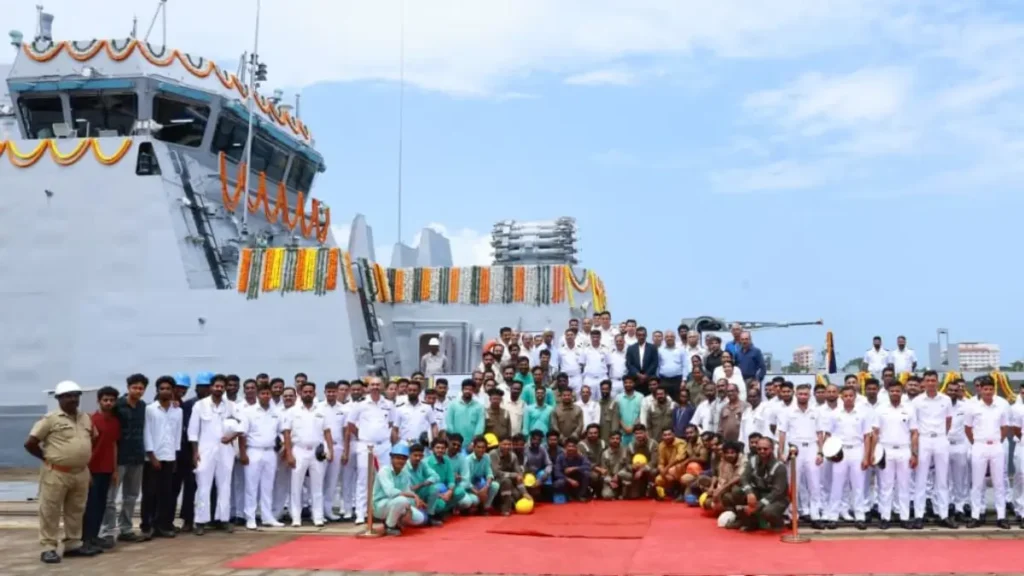
Indian Navy Mangrol ASW craft strengthens India’s anti-submarine warfare capability. Know Mangrol’s role, CSL construction, programme details and exam-important facts.
A Major Boost to India’s Maritime Defence
The Indian Navy has received Mangrol, the third Anti-Submarine Warfare Shallow Water Craft (ASW SWC) built by Cochin Shipyard Limited (CSL), Kochi. The delivery marks another important step in strengthening India’s ability to detect and counter submarine threats in shallow coastal waters.
Mangrol is part of a programme under which eight Anti-Submarine Warfare Shallow Water Crafts are being built by CSL for the Indian Navy. The vessel has been designed and constructed in India, reflecting the country’s growing capability in indigenous naval shipbuilding and defence manufacturing.
Strengthening Anti-Submarine Warfare Capability
Anti-submarine warfare is an important component of modern naval operations. Submarines can operate covertly and pose significant challenges to maritime security, especially in strategically important coastal regions.
The induction of Mangrol is expected to improve the Indian Navy’s capacity to detect, track and engage underwater threats in shallow-water areas. ASW SWCs are specifically designed for operations in coastal waters, where the detection of submarines can be more complex due to underwater conditions and environmental factors.
These vessels are also expected to contribute to India’s wider maritime security architecture by supporting coastal surveillance and other naval operations.
Indigenous Shipbuilding Gains Momentum
The delivery of Mangrol highlights the importance of indigenous defence production in India’s national security strategy. Cochin Shipyard Limited, a major public sector shipbuilding company, has played an important role in building naval platforms for the country.
The ASW SWC programme supports India’s broader objective of strengthening self-reliance in defence manufacturing. Indigenous warship construction can help develop domestic industrial capabilities, encourage technological expertise and reduce dependence on foreign suppliers.
For competitive examination aspirants, the development is important in the context of Make in India, Aatmanirbhar Bharat, maritime security and defence modernisation.
Mangrol as Part of a Larger Naval Programme
Mangrol is the third of eight ASW Shallow Water Crafts being constructed by CSL. The programme aims to provide the Indian Navy with specialised vessels capable of operating effectively in shallow coastal zones.
The expansion of the Navy’s anti-submarine capability is particularly significant because India has a long coastline and strategic maritime interests in the Indian Ocean Region. A modern and technologically capable fleet is therefore essential for protecting maritime approaches and responding to underwater threats.
The delivery of Mangrol represents another step in the continuing modernisation of the Indian Navy and the development of India’s indigenous defence ecosystem.
Why This News is Important
Importance for Defence Preparedness
The delivery of Mangrol is important because it strengthens India’s anti-submarine warfare capability. Submarines are among the most significant underwater threats faced by modern navies because of their ability to operate with a high degree of stealth.
Shallow coastal waters present different operational challenges compared with deep oceans. Specialised ASW platforms can improve the Navy’s ability to monitor and respond to underwater activity near coastal regions. The addition of Mangrol therefore contributes to India’s broader maritime defence preparedness.
Significance for Aatmanirbhar Bharat
The news is also important because Mangrol has been built indigenously by Cochin Shipyard Limited. Indigenous defence production is a major policy priority for India as the country seeks to strengthen domestic manufacturing capabilities and reduce dependence on imports.
The project demonstrates the growing role of Indian shipyards and domestic defence industries in producing complex military platforms.
Relevance for Competitive Examinations
For students preparing for UPSC, State PCS, defence examinations, banking examinations and other government recruitment tests, the development is relevant to several areas of current affairs. Important themes include the Indian Navy, anti-submarine warfare, defence modernisation, indigenous shipbuilding, maritime security and the Make in India initiative.
Students should remember the name Mangrol, its role as an Anti-Submarine Warfare Shallow Water Craft, its position as the third of eight vessels in the CSL programme, and its builder, Cochin Shipyard Limited, Kochi.
Historical Context: India’s Development of Anti-Submarine Warfare Platforms
Growing Importance of Underwater Security
India’s maritime security requirements have expanded with the increasing strategic importance of the Indian Ocean Region. Protecting sea lanes, coastal areas and naval assets requires effective surveillance above and below the water.
Anti-submarine warfare has therefore become an important area of naval modernisation. ASW operations involve the detection, tracking and engagement of hostile submarines through specialised platforms and underwater detection systems.
Development of the ASW Shallow Water Craft Programme
The ASW Shallow Water Craft programme was initiated to provide the Indian Navy with specialised vessels for operations in shallow coastal waters. The programme includes multiple indigenous shipbuilding projects involving Indian shipyards.
Cochin Shipyard Limited is constructing eight such vessels for the Indian Navy. Mangrol is the third vessel in this particular series. Earlier deliveries in the programme include Mahe and Malwan. The delivery of these vessels reflects continuing progress in India’s indigenous naval shipbuilding programme.
Broader Push for Naval Self-Reliance
India has increasingly focused on constructing warships and naval platforms within the country. Public and private shipbuilding capabilities have become important components of the wider defence manufacturing ecosystem.
The ASW SWC programme is therefore significant not only from a military perspective but also from an industrial perspective. It represents the growing connection between defence preparedness, technological capability and domestic manufacturing.
Key Takeaways from Indian Navy Receives Mangrol
| S. No. | Key Takeaway |
|---|---|
| 1 | Mangrol was received by the Indian Navy as the third Anti-Submarine Warfare Shallow Water Craft built under CSL’s eight-vessel programme. |
| 2 | Mangrol has been designed and constructed by Cochin Shipyard Limited, Kochi. |
| 3 | The vessel is intended to strengthen anti-submarine warfare capability, particularly in shallow coastal waters. |
| 4 | The programme supports India’s objectives of defence modernisation, Make in India and Aatmanirbhar Bharat. |
| 5 | The development is important for exam topics related to Indian defence, maritime security, indigenous shipbuilding and current affairs. |
Frequently Asked Questions (FAQs)
1. What is Mangrol?
Mangrol is an Anti-Submarine Warfare Shallow Water Craft (ASW SWC) inducted into the Indian Navy to strengthen its capability to detect and counter underwater threats in shallow coastal waters.
2. Which organisation built Mangrol?
Mangrol was built by Cochin Shipyard Limited (CSL), Kochi, an important Indian shipbuilding organisation involved in naval and commercial ship construction.
3. Mangrol is the third vessel under which programme?
Mangrol is the third of eight Anti-Submarine Warfare Shallow Water Crafts being constructed by Cochin Shipyard Limited for the Indian Navy.
4. What is the primary role of an Anti-Submarine Warfare Shallow Water Craft?
Its primary role is to support anti-submarine warfare operations in shallow coastal waters, including detecting, tracking and responding to underwater threats.
5. Why are shallow-water anti-submarine vessels important for India?
Such vessels are important for monitoring India’s coastal and near-shore maritime areas, where conventional deep-sea anti-submarine platforms may face different operational conditions.
6. Which company is constructing the ASW Shallow Water Crafts?
Cochin Shipyard Limited (CSL) is constructing the eight-vessel ASW Shallow Water Craft series for the Indian Navy.
7. What does ASW stand for?
ASW stands for Anti-Submarine Warfare.
8. Which branch of the Indian Armed Forces operates Mangrol?
Mangrol is operated by the Indian Navy, which is responsible for India’s maritime military operations and naval security.
9. How is Mangrol relevant to Aatmanirbhar Bharat?
The vessel’s indigenous construction by an Indian shipyard contributes to India’s objective of increasing domestic defence manufacturing and reducing dependence on foreign sources.
10. What major examination topics are associated with this news?
This news can be linked with Indian Navy, defence modernisation, anti-submarine warfare, maritime security, indigenous defence production, Cochin Shipyard Limited, Make in India and Aatmanirbhar Bharat.
Some Important Current Affairs Links

