
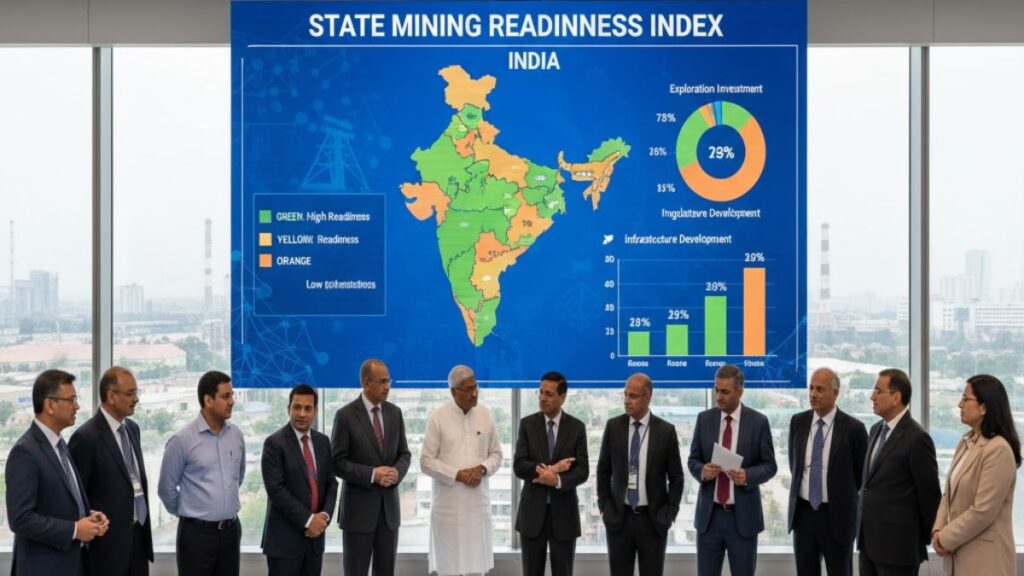
“India State Mining Readiness Index (SMRI) 2025 launched to benchmark states on mining governance, sustainable practices, and investment readiness, promoting transparency and sectoral reforms.”
India Launches First-Ever State Mining Readiness Index: A Step Towards Sustainable Mining Reforms
Introduction
On October 16, 2025, the Ministry of Mines, Government of India, unveiled the inaugural State Mining Readiness Index (SMRI). This initiative aligns with the Union Budget 2025–26’s commitment to enhancing transparency, efficiency, and sustainability in India’s mining sector, particularly focusing on non-coal minerals.
What Is the State Mining Readiness Index (SMRI)?
The SMRI is a comprehensive benchmarking framework designed to assess and rank Indian states based on their preparedness and performance in the mining sector. It evaluates states across four key indicators:
- Auction Performance: Effectiveness and transparency in mineral block auctions.
- Early Mine Operationalization: Speed and efficiency in converting auctioned blocks into operational mines.
- Exploration Thrust: Investment and initiatives for geological exploration and discovery of new resources.
- Sustainable Mining Practices: Adoption of environmentally sound and socially responsible mining models.
These criteria collectively aim to foster a competitive yet cooperative environment among states, encouraging reforms and attracting private investment into the mining sector.
State Rankings and Categories
To provide a fair comparison, states have been categorized based on their mineral endowment and resource potential:
- Category A (High Mineral Endowment): Madhya Pradesh, Rajasthan, and Gujarat.
- Category B (Moderate Mineral Endowment): Goa, Uttar Pradesh, and Assam.
- Category C (Low Mineral Endowment): Punjab, Uttarakhand, and Tripura.
This classification ensures that states are evaluated relative to their resource capacities, promoting equitable development across regions.
Objectives of the SMRI
The primary objectives of the SMRI are:
- Benchmarking State Performance: Assessing and comparing states’ efficiency and effectiveness in managing mining activities.
- Identifying Policy Gaps: Highlighting areas where states can improve in terms of governance and operational practices.
- Promoting Sustainable Practices: Encouraging the adoption of environmentally responsible and socially inclusive mining methods.
- Attracting Investment: Creating a conducive environment for private sector participation through transparent and efficient processes.
By achieving these objectives, the SMRI aims to transform India’s mining sector into a model of sustainable and inclusive growth.

Why This News Is Important
Enhancing Governance in the Mining Sector
The introduction of the SMRI marks a significant step towards improving governance in India’s mining industry. By providing a clear framework for assessment, it enables states to identify strengths and areas for improvement, leading to more effective policy implementation and oversight.
Fulfilling Union Budget Commitments
The launch of the SMRI fulfills a key promise made in the Union Budget 2025–26, demonstrating the government’s commitment to reforming the mining sector. This alignment ensures that the initiative is backed by policy support and resources.
Promoting Sustainable Development
With a focus on sustainable mining practices, the SMRI encourages states to adopt environmentally friendly and socially responsible methods. This approach aligns with global trends towards sustainability and positions India as a leader in responsible mining.
Stimulating Economic Growth
By improving efficiency and transparency, the SMRI aims to attract private investment into the mining sector. Increased investment can lead to job creation, infrastructure development, and overall economic growth, particularly in resource-rich regions.
Facilitating Inter-State Learning
The SMRI fosters a competitive yet cooperative environment among states, encouraging the sharing of best practices and experiences. This inter-state learning can lead to the adoption of innovative solutions and improvements in mining governance across the country.
Historical Context
India’s mining sector has long been a critical component of its economy, contributing significantly to employment and industrial growth. However, challenges such as inefficiency, lack of transparency, and environmental degradation have hindered its potential. Previous attempts at reform have been piecemeal, lacking a comprehensive framework to assess and guide state-level performance.
The Union Budget 2025–26 recognized these issues and proposed the development of the SMRI as a tool to benchmark and improve state mining governance. The index draws inspiration from global best practices in governance and sustainability, aiming to create a robust and accountable mining sector in India.
Key Takeaways from “India Launches First-Ever State Mining Readiness Index”
| S.No | Key Takeaway |
|---|---|
| 1 | The SMRI evaluates states on auction performance, early mine operationalization, exploration efforts, and sustainable practices. |
| 2 | States are categorized into three groups (A, B, C) based on mineral endowment, ensuring fair comparisons. |
| 3 | Madhya Pradesh, Rajasthan, and Gujarat lead in Category A; Goa, Uttar Pradesh, and Assam in Category B; Punjab, Uttarakhand, and Tripura in Category C. |
| 4 | The index aims to attract private investment by promoting transparency and efficiency in the mining sector. |
| 5 | The SMRI encourages states to adopt sustainable mining practices, aligning with global environmental standards. |
FAQs: Frequently Asked Questions
1. What is the State Mining Readiness Index (SMRI)?
The SMRI is India’s first comprehensive benchmarking framework launched by the Ministry of Mines to evaluate and rank states based on their preparedness and performance in the mining sector. It focuses on auction performance, mine operationalization, exploration efforts, and sustainable mining practices.
2. When was the SMRI launched?
The SMRI was officially launched on October 16, 2025, by the Ministry of Mines.
3. Why is the SMRI important for India’s mining sector?
The SMRI improves governance, promotes transparency, attracts private investment, encourages sustainable mining, and helps states identify areas for policy and operational improvement.
4. How are states categorized in the SMRI?
States are categorized into three groups based on their mineral endowment:
- Category A: High mineral endowment (e.g., Madhya Pradesh, Rajasthan, Gujarat)
- Category B: Moderate mineral endowment (e.g., Goa, Uttar Pradesh, Assam)
- Category C: Low mineral endowment (e.g., Punjab, Uttarakhand, Tripura)
5. What are the objectives of the SMRI?
The objectives include benchmarking state performance, identifying policy gaps, promoting sustainable mining, attracting investment, and fostering inter-state learning for better governance.
6. Which sectors or exams does this news relate to?
The SMRI news is important for exams related to civil services (IAS, PCS), public administration, banking, and environmental governance, as it reflects government policy reforms and economic priorities.
7. Which indicators are used in the SMRI evaluation?
The SMRI evaluates states based on four indicators:
- Auction performance
- Early mine operationalization
- Exploration thrust
- Sustainable mining practices
8. How does the SMRI promote sustainable development?
By encouraging environmentally responsible and socially inclusive mining practices, the SMRI ensures mining operations minimize environmental impact and contribute positively to local communities.
9. How does the SMRI attract investment?
The index promotes transparency and efficiency in state mining governance, making states more attractive to private investors and encouraging economic growth in mineral-rich regions.
10. What is the historical context of SMRI?
India’s mining sector faced inefficiencies, lack of transparency, and environmental challenges. The SMRI was introduced to address these issues, following recommendations in the Union Budget 2025–26.
Some Important Current Affairs Links

