
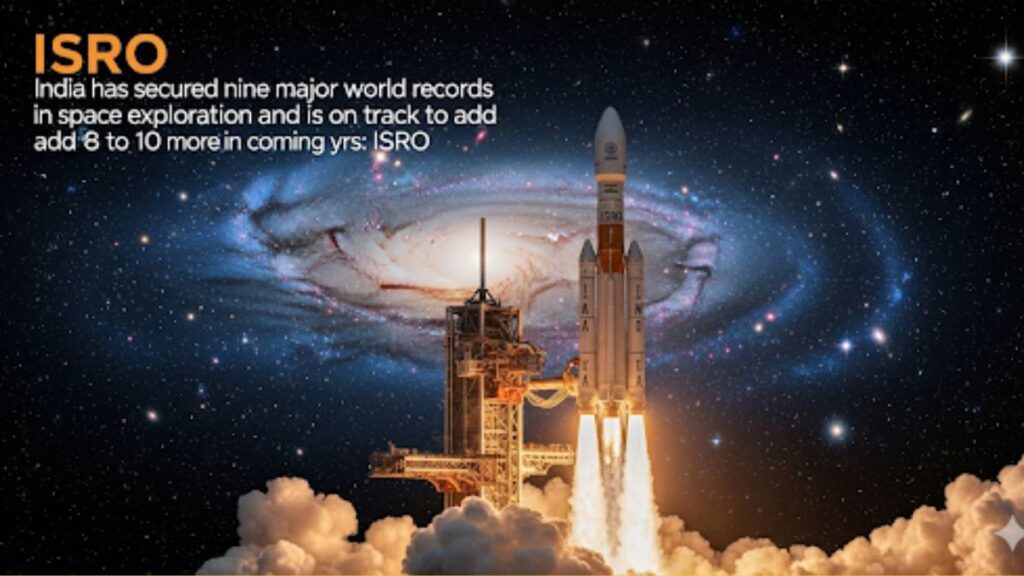
India space world records achieved by ISRO include nine milestones in Mars Orbiter, Chandrayaan missions, and cryogenic technology, boosting India’s global space leadership.
India Secures Nine World Records in Space Exploration: A Quantum Leap by ISRO
India’s space programme, via the Indian Space Research Organisation (ISRO), has recently claimed nine world records in space exploration, according to statements by ISRO Chairman V. Narayanan. The achievements underscore India’s rising global stature in space science and technology and its ability to deliver high impact missions with cost-efficient innovation. ISRO has also set its sights on 8–10 more record-setting milestones in the coming years, including an ambitious goal of a human Moon landing by 2040.
Landmark Achievements That Shaped India’s Celestial Credentials
ISRO’s journey to these nine records is built on several key missions over the past two decades:
- Mars Orbiter Mission (2014): India became the first country in the world to reach Mars on its first attempt, marking a major milestone for its space agency.
- PSLV-C37 (2017): ISRO broke a world record by launching 104 satellites in a single mission, displaying its prowess in satellite deployment and mission planning.
- Chandrayaan-2 (2019): The mission deployed one of the most advanced orbiter cameras around the Moon, enhancing lunar imaging and mapping capabilities.
- Chandrayaan-3 (2023): India became the first nation to land near the lunar south pole, a region of high scientific interest due to its permanently shadowed craters which may hold water ice.
Breakthroughs in Cryogenic Technology
A cornerstone of ISRO’s recent advances has been in cryogenic engine development, which is crucial for building heavier launch vehicles and enabling deep space missions:
- The development from 2014 to 2017 included three world records related to cryogenic engine technology.
- One specific achievement was the fastest maiden flight of LVM3 with a cryogenic stage — completed in just 28 months, compared to 37–108 months typically taken elsewhere.
Scale, Capabilities and Impact of ISRO’s Operations
Beyond specific missions, ISRO’s strength lies in scale, efficiency, and impact:
- To date, over 4,000 rockets have been launched.
- India has successfully placed around 133 satellites into orbit.
- The space programme contributes significantly not just to scientific discovery but to national security, disaster management, communications, and economic development. Also, the growth of a space entrepreneurship ecosystem has been noted.
Looking Forward: New Milestones and the Moon by 2040
ISRO’s roadmap for the next few years includes:
- Targeting 8-10 additional world records across launches, vehicle technology, and satellite applications.
- Expanding its missions to the Moon, Mars, and deeper space science.
- Pioneering a crewed lunar landing by 2040, which would place India among a very few nations capable of this feat.

Why This News Is Important
Strategic Technological Edge
For students preparing for government exams, this news is crucial because it highlights India’s rapidly advancing capabilities in space technology — particularly precision in launches, satellite deployment, deep space exploration, and cryogenic propulsion. These are topics likely to be asked in Science & Technology, General Awareness, and Current Affairs sections in exams like UPSC, SSC, banking & defence tests.
National Prestige & Global Standing
India securing nine world records in space establishes its position among the global leaders in space exploration. This enhances prestige, encourages international cooperation, and strengthens India’s soft power. Understanding such geopolitical implications is important for civil services – both for “international relations” segments and “national development”.
Implications for Future Policies & Careers
The commitment to human moon landing by 2040 signals long-term planning and budget allocations toward space sciences. For students, this means more government jobs, research opportunities, and policies favoring STEM education. Knowledge of such direction is helpful not only in multiple choice questions but also in essay and interview stages.
Historical Context
Early Years of ISRO and Foundational Missions
ISRO was established in 1969, building on the legacy of early pioneers like Vikram Sarabhai. Over decades, India progressed from sounding rockets and small satellites to ambitious projects like the Aryabhata satellite (1975), SLV, ASLV, PSLV, and GSLV series, gradually improving lift capacity and technology both in solid, liquid, and eventually cryogenic engines.
Cryogenic Technology Struggles and Successes
For many years, developing reliable cryogenic engines — critical for large payloads and deep space missions — was a major hurdle for India. International constraints, technical complexity, and cost issues delayed progress. However, by the 2010s, indigenous cryogenic engines matured, culminating in the achievements mentioned (e.g. the maiden LVM3 launch). These advances have been key to enabling heavier satellites and ambitious explorations.
Milestones in Martian and Lunar Missions
- Mars Orbiter Mission (MOM) in 2014 marked India’s first interplanetary mission and received acclaim for doing so on a modest budget.
- Chandrayaan-1 & 2 broke ground in Moon exploration; Chandrayaan-1 confirmed the presence of water molecules on the Moon.
- Chandrayaan-3, noted for its successful landing near the lunar south pole, added critical data about lunar geography and resources.
Each of these boosted India’s scientific capabilities and credibility in space research.
Key Takeaways from India’s Space Records
| Serial No. | Key Takeaway |
|---|---|
| 1 | India currently holds nine world records in space missions under ISRO’s leadership. |
| 2 | Major achievements include: Mars Orbiter Mission (2014), PSLV-C37 launching 104 satellites (2017), Chandrayaan-2’s high quality orbiter camera (2019), and Chandrayaan-3’s historic south pole lunar landing (2023). |
| 3 | ISRO has made significant breakthroughs in cryogenic engine technology, notably achieving a 28-month timeframe for the first flight of LVM3 with the cryogenic stage, much faster than many other countries. |
| 4 | The scale of operations is vast: over 4,000 rocket launches and approx 133 satellites placed in orbit, reflecting both quantity and diversity of missions. |
| 5 | Looking ahead, India is targeting 8-10 new world records and is aiming for a crewed Moon landing by 2040, indicating long-term strategic planning in the space sector. |
FAQs: Frequently Asked Questions
1. What are the nine world records achieved by India in space exploration?
India’s nine world records include Mars Orbiter Mission’s success on the first attempt, PSLV‑C37 launching 104 satellites, Chandrayaan‑2’s advanced lunar orbiter camera, Chandrayaan‑3’s south pole landing, and achievements in cryogenic engine development, among others.
2. Which mission made India the first country to reach Mars on its first attempt?
The Mars Orbiter Mission (Mangalyaan) in 2014 achieved this milestone.
3. What is the significance of Chandrayaan‑3’s south pole landing?
Chandrayaan‑3 is the first mission to land near the Moon’s south pole, a scientifically important region with potential water ice deposits.
4. When is India planning its first crewed Moon landing?
ISRO aims to achieve a human Moon landing by 2040.
5. What are the major technological breakthroughs achieved by ISRO recently?
ISRO has made breakthroughs in cryogenic engine technology, satellite deployment efficiency, and deep-space exploration capabilities, reducing mission timelines significantly.
6. How many satellites has ISRO placed in orbit till now?
Approximately 133 satellites have been placed into orbit by ISRO.
7. Why is India’s space program important for government exams?
It is relevant for Science & Technology, Current Affairs, International Relations, and National Development topics, frequently appearing in UPSC, SSC, banking, defence, and other competitive exams.
Some Important Current Affairs Links

