
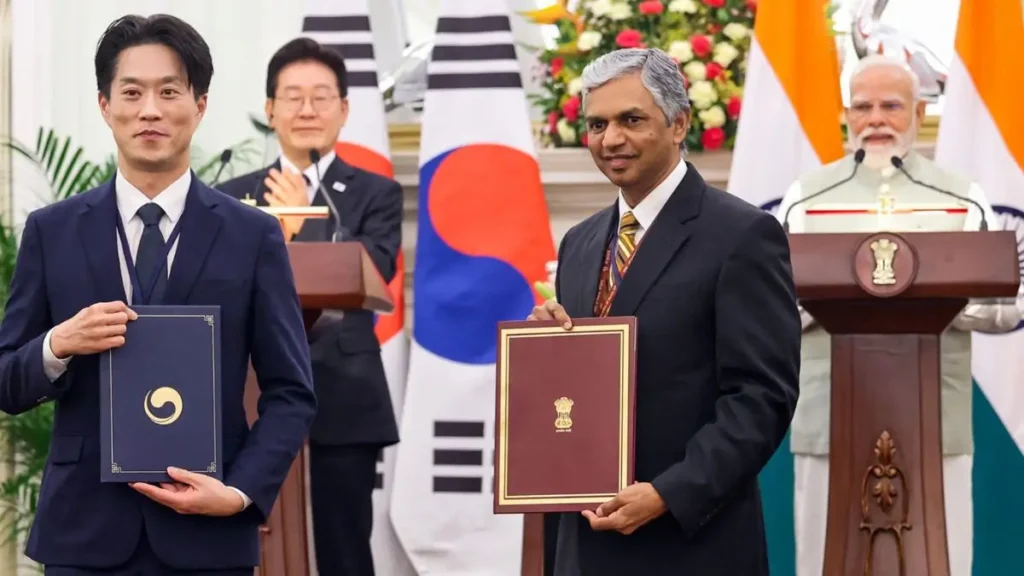
India South Korea talks 2026 highlight 25 key outcomes including $50 billion trade target, Digital Bridge initiative, and defence cooperation, strengthening Indo-Pacific strategic partnership for UPSC and government exams.
India–South Korea Announce 25 Key Outcomes After High-Level Talks in New Delhi
🏛️ High-Level Bilateral Talks and Strategic Visit
India and South Korea strengthened their Special Strategic Partnership during a high-level meeting held in New Delhi on 20 April 2026. The talks were attended by Indian Prime Minister Narendra Modi and South Korean President Lee Jae Myung. The discussions marked a significant milestone in bilateral relations, leading to the announcement of 25 key outcomes aimed at enhancing cooperation in trade, technology, defence, and global governance.
💼 Economic Cooperation and Trade Expansion
One of the most important outcomes was the agreement to expand bilateral trade significantly. Both countries set a target to increase trade from approximately $27 billion to $50 billion by 2030. To achieve this goal, India and South Korea agreed to upgrade the Comprehensive Economic Partnership Agreement (CEPA) to make trade more balanced and efficient.
🧠 Technology, AI, and Digital Partnership
The talks placed strong emphasis on emerging technologies. Both nations agreed to expand cooperation in Artificial Intelligence (AI), semiconductors, digital infrastructure, and innovation ecosystems. A key initiative, the India–Korea Digital Bridge, was launched to deepen collaboration in high-tech sectors and strengthen supply chain resilience.
⚓ Defence, Shipbuilding and Maritime Cooperation
Defence and maritime cooperation also emerged as a major pillar of the partnership. The two sides agreed to enhance collaboration in shipbuilding, naval logistics, and defence manufacturing, including joint development and technology sharing in strategic defence systems.
🌱 Climate, Energy and Sustainable Development
India and South Korea committed to strengthening cooperation in clean energy, green technologies, and sustainable development projects. Both nations aim to work together on energy transition strategies and climate-friendly industrial growth.
🤝 Institutional Mechanisms and Future Framework
To ensure long-term collaboration, both countries agreed to establish new institutional frameworks such as the Industrial Cooperation Committee, Economic Security Dialogue, and Financial Cooperation Platforms. These mechanisms will help coordinate policies and promote investment flows.

⭐ Why This News is Important
📘 Strategic Importance for India–South Korea Relations
This development is highly significant as it marks a major upgrade in India–South Korea relations from a trade-focused partnership to a comprehensive futuristic strategic alliance. The agreement strengthens cooperation in critical sectors such as defence, technology, and supply chains, which are crucial for national security and economic stability.
📊 Relevance for Government Exams
For UPSC, SSC, Banking, Railways, and State PCS exams, this news is important because it highlights:
- India’s Act East Policy expansion
- Strengthening of Indo-Pacific cooperation
- Growth of technology diplomacy
- Strategic economic partnerships with developed economies
🌍 Global Geopolitical Impact
The partnership also plays a key role in balancing global power equations in the Indo-Pacific region. It enhances India’s position as a rising global economic and strategic power while deepening ties with technologically advanced nations like South Korea.
📚 Historical Context
India and South Korea established diplomatic relations in 1973, but their strategic partnership gained momentum after the signing of the CEPA agreement in 2010. Over the years, cooperation expanded into defence, trade, and technology sectors.
The relationship was upgraded to a Special Strategic Partnership in 2015, reflecting growing convergence in Indo-Pacific strategy. However, high-level engagement slowed in the following years. The 2026 summit marks a revival and expansion of bilateral ties with a futuristic vision.
📌 Key Takeaways from “India–South Korea High-Level Talks 2026”
| S.No | Key Takeaway |
|---|---|
| 1 | India and South Korea announced 25 key outcomes after high-level talks in New Delhi (2026). |
| 2 | Bilateral trade target set to rise from $27 billion to $50 billion by 2030. |
| 3 | Agreement to upgrade CEPA for improved trade balance and market access. |
| 4 | Launch of India–Korea Digital Bridge for AI and semiconductor cooperation. |
| 5 | Enhanced cooperation in defence, shipbuilding, clean energy, and maritime security. |
FAQs (Frequently Asked Questions)
Q1. What is the main outcome of India–South Korea High-Level Talks 2026?
The main outcome is the announcement of 25 key agreements covering trade, defence, technology, energy, and strategic cooperation between India and South Korea.
Q2. What trade target has been set between India and South Korea?
Both countries have set a target to increase bilateral trade from $27 billion to $50 billion by 2030.
Q3. Which new initiative was launched in the technology sector?
The India–Korea Digital Bridge was launched to boost cooperation in AI, semiconductors, and digital infrastructure.
Q4. Why are these talks important for defence cooperation?
The talks strengthen cooperation in naval systems, shipbuilding, defence manufacturing, and maritime security, improving India’s strategic capabilities.
Q5. How does this agreement support India’s foreign policy?
It strengthens India’s Act East Policy and Indo-Pacific strategy, enhancing ties with key technologically advanced nations.
Q6. When were India–South Korea diplomatic relations established?
India and South Korea established diplomatic relations in 1973, and later upgraded them to a Special Strategic Partnership in 2015.
Q7. Which sectors are highlighted in the 2026 agreements?
Key sectors include trade, defence, AI, semiconductors, green energy, maritime cooperation, and digital infrastructure.
Some Important Current Affairs Links

