
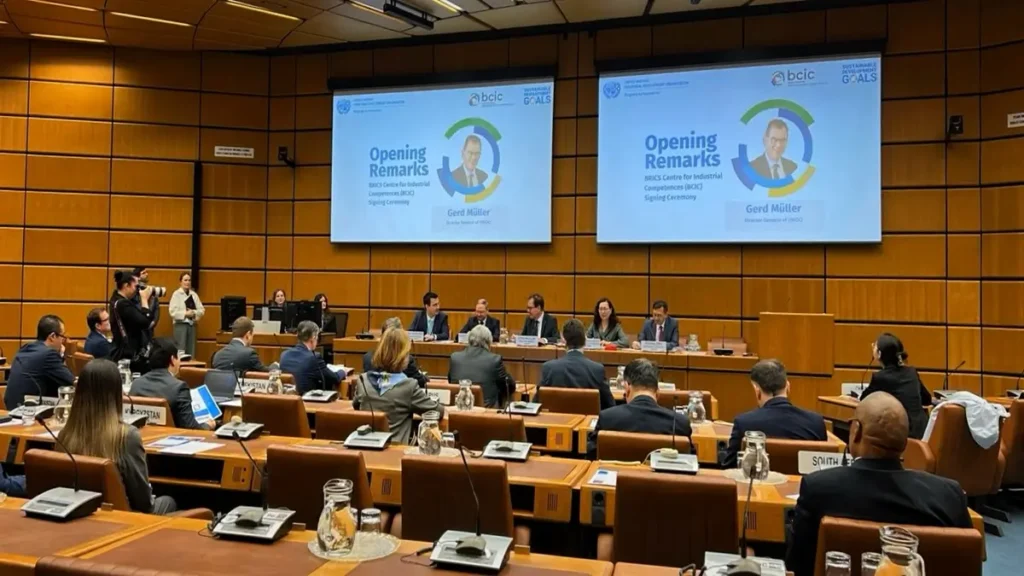
India joins BRICS industrial centre (BCIC) to enhance MSME capabilities, boost manufacturing, and strengthen international industrial cooperation under UNIDO partnership.
India Joins BRICS Centre for Industrial Competencies: Boosting Manufacturing and MSME Capabilities
India has officially joined the BRICS Centre for Industrial Competencies (BCIC) — a strategic move to strengthen industrial cooperation, enhance manufacturing capabilities, and support Micro, Small and Medium Enterprises (MSMEs) across emerging economies. The announcement was made during a high‑profile event organized by the Department for Promotion of Industry and Internal Trade (DPIIT) under the Ministry of Commerce & Industry at Vanijya Bhavan, New Delhi.
The BCIC operates as a one‑stop platform that provides integrated support services to manufacturing companies and MSMEs within the BRICS framework — originally consisting of Brazil, Russia, India, China, and South Africa — and now a broader grouping of emerging partners. India’s participation in the BCIC reflects its commitment to advanced industrial skills, Industry 4.0 technologies, and enhancing productivity across key sectors.
Strategic Partnership with UNIDO: A Catalyst for Industrial Growth
The BCIC is launched in collaboration with the United Nations Industrial Development Organization (UNIDO) — an international agency with decades of expertise in industrial development. This partnership enables the centre to offer technical support, training programs, and best practices for industrial modernization.
To formalize India’s entry into the BCIC framework, a Trust Fund Agreement was signed between DPIIT and UNIDO. The agreement, signed by Agrim Kaushal, Economic Adviser to DPIIT, and Dr. Cristiano Pasini, Director at UNIDO, lays down the financial and operational foundation for long‑term cooperation.
Role of the National Productivity Council
A key outcome of India’s participation is the designation of the National Productivity Council (NPC) as the India Centre for BRICS Industrial Competencies. Under the guidance of DPIIT and with technical support from UNIDO, NPC will:
- Lead India’s engagement with the BCIC,
- Promote capacity building and productivity enhancement,
- Facilitate adoption of advanced manufacturing practices — especially for MSMEs.
Senior officials from the Ministry of MSME, the Ministry of External Affairs, industry bodies such as the Federation of Indian Chambers of Commerce and Industry (FICCI), and representatives from UNIDO participated in the event, highlighting the importance of multi‑stakeholder cooperation.
Supporting India’s Manufacturing Ambitions
India’s participation in the BCIC comes at a time when the country is intensifying efforts to transform its manufacturing sector. Initiatives like the Make in India campaign and policies promoting advanced technology adoption and MSME competitiveness align closely with the objectives of the BCIC. By integrating with the BRICS industrial ecosystem, India will be better positioned to:
- Strengthen supply chains with emerging markets,
- Facilitate technology transfer and skill development,
- Enhance global competitiveness of Indian industries.
India joining the BCIC is a forward‑looking step that supports its broader economic and industrial goals, especially in a rapidly changing global manufacturing landscape.

Why This News Is Important for Competitive Exam Aspirants
Relevance to Government Exams
The news about India joining the BRICS Centre for Industrial Competencies is important for aspirants preparing for exams such as UPSC Civil Services (IAS, IPS), State PSC, Banking, SSC, Railways, Defence Services, and Teaching Exams because it covers topics related to:
- International cooperation
- Economic diplomacy
- Industrial policy and MSME development
- Multilateral organizations and partnerships — all of which are common syllabus areas in general studies and current affairs.
Economic and Strategic Importance
India’s participation in the BCIC highlights its efforts to strengthen manufacturing and MSME sectors — key pillars of the nation’s economic growth. Through this initiative, India aims to promote Industry 4.0 adoption, boost productivity, and expand global business linkages with key emerging economies. These themes are frequently asked in prelims and mains examinations under sections like Economy, International Relations, and Government Policies.
MSMEs and Industrial Modernization
For exams that include economics, industry, and entrepreneurship, this news provides insight into:
- How India collaborates with international bodies like the United Nations Industrial Development Organization (UNIDO),
- The role of institutional mechanisms — such as the National Productivity Council (NPC),
- How framework agreements and trust funds operate in multilateral contexts.
In summary, this development not only reflects India’s global economic engagements but also demonstrates the country’s focus on sustainable industrial growth — a recurring theme across competitive exams.
Historical Context
Background of BRICS and Industrial Cooperation
The term BRICS originally referred to the emerging economies of Brazil, Russia, India, and China, later expanded to include South Africa in 2010. BRICS was formed to create a counterbalance to Western economic dominance and promote cooperation among rapidly developing nations. Over time, BRICS has broadened its scope to include economic collaboration, trade, technology, and development initiatives.
UNIDO’s Role in Industrial Development
The United Nations Industrial Development Organization (UNIDO) has a long history of supporting industrialization and capacity building worldwide. Its partnership in launching the BRICS Centre for Industrial Competencies is rooted in past multilateral frameworks that aim to bridge technological gaps, encourage standardization, and promote sustainable industrial advancement.
India’s Industrial Policy Shift
Over recent decades, India has increasingly focused on enhancing its manufacturing sector. Policies such as Make in India, the Production Linked Incentive (PLI) schemes, and digital transformation efforts have created a foundation for greater integration with international industrial platforms like the BCIC.
The formation of the BCIC reflects a growing global emphasis on collaborative industrial competencies — combining traditional manufacturing with digital technologies to address the demands of modern economies.
Key Takeaways from India Joins BRICS Centre for Industrial Competencies
| S. No. | Key Takeaway |
|---|---|
| 1 | India has officially joined the BRICS Centre for Industrial Competencies (BCIC) to strengthen industrial cooperation. |
| 2 | The BCIC was launched in partnership with the United Nations Industrial Development Organization (UNIDO). |
| 3 | A Trust Fund Agreement was signed between the Department for Promotion of Industry and Internal Trade (DPIIT) and UNIDO. |
| 4 | The National Productivity Council (NPC) is designated as India’s centre for BCIC. |
| 5 | This initiative supports India’s manufacturing goals and MSME development under Industry 4.0 frameworks. |
FAQs: Frequently Asked Questions
1. What is the BRICS Centre for Industrial Competencies (BCIC)?
The BCIC is a multilateral platform created under the BRICS framework to promote industrial cooperation, support MSMEs, enhance manufacturing capabilities, and facilitate adoption of modern industrial practices like Industry 4.0.
2. Which countries are part of BRICS?
BRICS includes Brazil, Russia, India, China, and South Africa. The grouping focuses on collaboration in economic development, trade, and industrial advancement.
3. What is the role of UNIDO in BCIC?
The United Nations Industrial Development Organization (UNIDO) is a key partner that provides technical expertise, capacity building, and support for industrial modernization and skill development in member countries.
4. Which Indian body has been designated as the BCIC center?
The National Productivity Council (NPC) has been appointed as the India Centre for BCIC. It will implement programs, facilitate training, and promote productivity enhancement across industries and MSMEs.
5. How does India’s participation in BCIC benefit the economy?
India’s engagement strengthens global manufacturing linkages, encourages technology adoption, supports MSMEs, and boosts overall industrial competitiveness, aligning with initiatives like Make in India and PLI schemes.
6. Who signed the Trust Fund Agreement for India’s participation in BCIC?
The agreement was signed by Agrim Kaushal, Economic Adviser to DPIIT, and Dr. Cristiano Pasini, Director at UNIDO, formalizing India’s operational and financial participation.
7. Why is BCIC important for competitive exams?
This news covers topics like international cooperation, industrial policy, MSME development, and multilateral partnerships — all relevant for UPSC, SSC, banking, railways, defence, and teaching exams.
Some Important Current Affairs Links

