
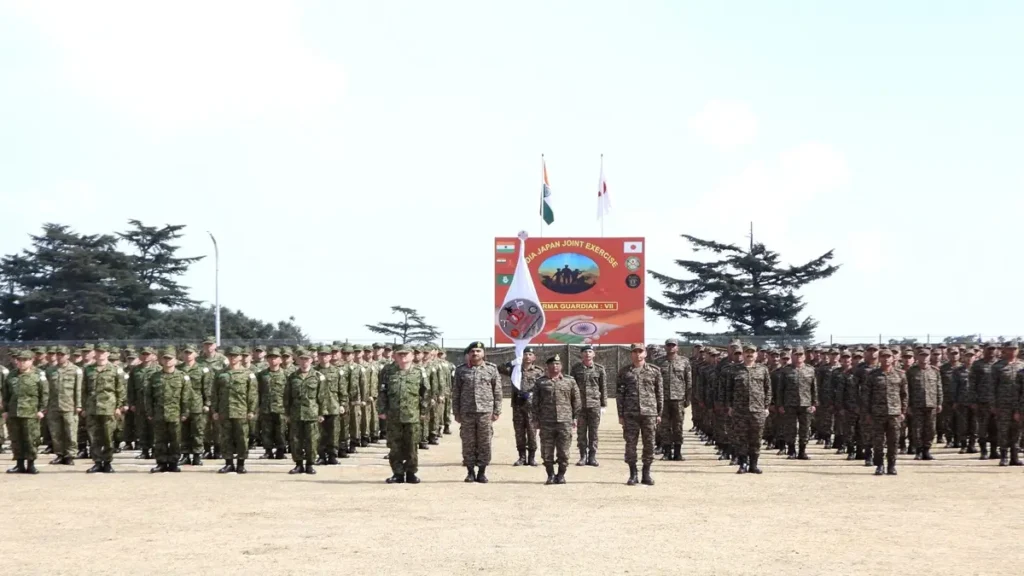
India Japan Military Exercise 2026 marks the 7th edition of Dharma Guardian in Uttarakhand, strengthening defence cooperation between the Indian Army and Japan Ground Self-Defense Force. Read key facts, FAQs, and exam-focused MCQs.
India-Japan Joint Military Exercise Dharma Guardian 2026 Begins in Uttarakhand
The 7th edition of the annual India–Japan Joint Military Exercise ‘Dharma Guardian’ has commenced at the Foreign Training Node, Chaubattia in Uttarakhand, marking another important chapter in defence cooperation between India and Japan.
📌 Overview of the Exercise
The exercise kicked off on 24 February 2026 and will continue until 9 March 2026, bringing together troops from both nations to train and operate under realistic scenarios that enhance their combat readiness.
This year’s edition sees 120 personnel deployed from each side. The Indian Army contingent is drawn from the Ladakh Scouts, known for expertise in mountain warfare and high–altitude operations, while the Japan Ground Self-Defense Force (JGSDF) is represented by troops from the 32nd Infantry Regiment.
🤝 Aims and Strategic Importance
The primary goal of Exercise Dharma Guardian is to strengthen bilateral military collaboration and enhance interoperability between the Indian Army and the JGSDF.
This structured training focuses on:
- Enhancing combined operational capabilities
- Improving joint planning and tactical execution
- Conducting operations in semi-urban combat environments
- Boosting readiness through modern military technologies
Such exercises build mutual understanding and shared tactical skills, which are essential in handling future security challenges in the Indo-Pacific region.
🧠 Key Training Activities
During the two-week exercise, troops will train in a variety of field tasks aimed at improving coordinated action, situational awareness, and rapid response.
These include:
- Establishment of Temporary Operating Bases
- Developing Intelligence, Surveillance, and Reconnaissance (ISR) grids
- Setting up Mobile Vehicle Check Posts
- Cordon & Search Operations
- Heliborne Operations
- House Intervention Drills
Such drills give realistic exposure to joint operational planning and execution, reinforcing combat readiness in diverse conditions.
🌐 Strategic Context of India-Japan Defence Cooperation
Exercise Dharma Guardian is held alternatively in India and Japan each year, underlining the deepening defence partnership between the two democracies. It stands as a key pillar in broader bilateral ties that also cover diplomacy, trade, and regional security cooperation.
This exercise is particularly important for building capabilities in semi-urban environments, often relevant in counter-terrorism and hybrid warfare scenarios.

🧾 Why This News Is Important
📘 Key Relevance to Government Exams
News about Exercise Dharma Guardian 2026 is highly relevant for students preparing for competitive exams such as UPSC, State PSCs, SSC, Banking, Railways, Defence, and Police Services because:
- It highlights India’s defence diplomacy and bilateral military cooperation with a key partner — Japan.
- Understanding such exercises reflects an aspirant’s awareness of India’s strategic relations in the Indo-Pacific region—an important topic in General Studies (GS) Paper II & III of UPSC and other exam syllabi.
- It showcases India’s emphasis on interoperability and joint operational readiness, crucial for future security and defence planning in a changing geopolitical landscape.
📘 Enhancing Strategic Awareness
For positions in defence services and police services, knowledge about joint military drills helps in understanding practical aspects of military operations, combined tactics, and India’s role in global security frameworks.
Such exercises also reflect India’s proactive approach in strengthening multilateral and bilateral military partnerships, which tie into broader topics of foreign policy, national security, and defence preparedness.
📜 Historical Context: Dharma Guardian Exercise
The India–Japan Joint Military Exercise ‘Dharma Guardian’ was first initiated in 2018 as an annual bilateral training activity between the Indian Army and the Japan Ground Self-Defense Force (JGSDF).
The exercise is designed to improve joint operational capabilities, tactical interoperability, and mutual understanding between the two armies, particularly in semi-urban environments, which are crucial for modern conflict scenarios.
Held alternately in India and Japan, earlier editions of Dharma Guardian have emphasized common military goals, strategic cooperation, and training in advanced field operations. Previous exercises involved drills such as joint planning, ISR grid development, cordon & search operations, and helicopter-borne missions.
The consistent conduct of Dharma Guardian reflects deepening defence ties and shared strategic interests, especially as India and Japan work together as part of democratic partners in the Indo-Pacific region’s security architecture.
🗒️ Key Takeaways from India-Japan Dharma Guardian 2026
| S.No | Key Takeaway |
|---|---|
| 1 | 7th edition of Exercise Dharma Guardian commenced in Uttarakhand starting 24 Feb – 9 Mar 2026. |
| 2 | The exercise is between the Indian Army and Japan Ground Self-Defense Force (JGSDF). |
| 3 | India’s contingent: Ladakh Scouts; Japan’s contingent: 32nd Infantry Regiment. |
| 4 | Aims to strengthen joint operational capability and interoperability in semi-urban environments. |
| 5 | Includes activities like ISR grids, Cordon & Search, and Heliborne Ops to enhance combat readiness. |
FAQs: India–Japan Joint Military Exercise Dharma Guardian 2026
1) What is Exercise Dharma Guardian?
Exercise Dharma Guardian is an annual bilateral military exercise conducted between the Indian Army and the Japan Ground Self-Defense Force (JGSDF). It aims to enhance interoperability, joint tactical planning, and combat readiness.
2) Where is Dharma Guardian 2026 being conducted?
The 2026 edition is being held at the Foreign Training Node in Chaubattia, Uttarakhand, India.
3) Which edition of the exercise is being conducted in 2026?
The 2026 exercise marks the 7th edition of Dharma Guardian.
4) Which Indian Army unit is participating in 2026?
The Indian contingent is drawn from the Ladakh Scouts, a regiment known for its expertise in high-altitude and mountain warfare.
5) Which Japanese unit is participating?
The Japanese contingent is represented by troops from the 32nd Infantry Regiment of the Japan Ground Self-Defense Force.
6) What is the main objective of the exercise?
The primary objective is to improve joint operational capability in semi-urban terrain and strengthen defence cooperation between India and Japan.
7) Since when has Dharma Guardian been conducted?
The exercise was first initiated in 2018 as part of expanding India–Japan defence ties.
8) How often is Dharma Guardian conducted?
It is conducted annually, alternately hosted by India and Japan.
9) Why is this exercise important for UPSC and State PSC exams?
It is relevant for topics such as India’s foreign policy, Indo-Pacific strategy, defence diplomacy, bilateral relations, and security cooperation—key areas in General Studies Papers II and III.
10) How does Dharma Guardian fit into India’s Indo-Pacific strategy?
It strengthens strategic coordination between two major democratic nations in the Indo-Pacific region, contributing to regional stability and maritime security cooperation.
Some Important Current Affairs Links

