
India Italy strategic partnership 2026: Explore key outcomes of PM Modi’s Italy visit including defence roadmap, IMEC corridor, trade targets, critical minerals cooperation, and strategic global agreements for UPSC and government exams.
India-Italy Special Strategic Partnership Explained: Key Outcomes from PM Modi’s Italy Visit
India and Italy Upgrade Bilateral Relations
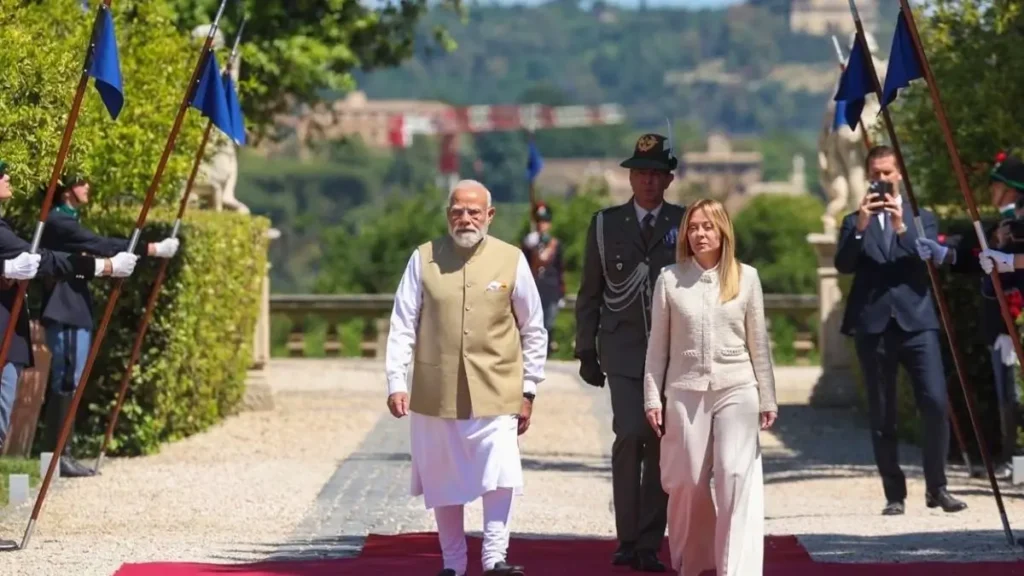
India and Italy have elevated their diplomatic ties to a “Special Strategic Partnership” during Prime Minister Narendra Modi’s official visit to Rome. The development marks a major step in India’s foreign policy outreach toward Europe and reflects growing cooperation in defence, trade, technology, energy, and global governance.
The announcement was made after high-level discussions between PM Modi and Italian Prime Minister Giorgia Meloni. Both leaders emphasized stronger cooperation in strategic sectors and agreed to expand bilateral engagement through long-term partnerships.
Focus on Defence and Security Cooperation
One of the most significant outcomes of the visit was the agreement on a Defence Industrial Roadmap. The roadmap aims to increase joint defence manufacturing, co-development of military technologies, and industrial cooperation in advanced defence systems.
India and Italy are also expected to cooperate in naval systems, aerospace technology, and supply chains related to defence equipment. The partnership reflects India’s larger goal of strengthening indigenous defence production under the “Make in India” initiative.
The two countries also discussed cooperation in tackling financial crimes, money laundering, and terror financing through collaboration between Italian and Indian enforcement agencies.
Trade, Investment and Economic Expansion
Economic cooperation emerged as another major pillar of the visit. India and Italy have set an ambitious target to increase bilateral trade to 20 billion euros by 2029.
Both countries agreed to encourage investments in sectors such as advanced manufacturing, renewable energy, transport infrastructure, logistics, agriculture, and artificial intelligence. Italian firms are also expected to increase investments in India’s industrial and technology sectors.
The leaders also supported the India-Middle East-Europe Economic Corridor (IMEC), which is expected to improve connectivity and trade between India and Europe.
Cooperation in Critical Minerals and Technology
India and Italy signed an MoU on critical minerals to secure supply chains for emerging technologies and strategic industries. This is important because critical minerals are essential for electric vehicles, semiconductors, renewable energy, and defence manufacturing.
The two nations also agreed to deepen cooperation in scientific research, climate studies, and innovation. Institutions from both countries will collaborate in weather science, environmental sustainability, and advanced research technologies.
Italy also announced efforts to strengthen innovation ecosystems and connect startups and research centres with Indian institutions.
Education, Healthcare and Cultural Exchanges
India and Italy agreed to enhance academic partnerships and student mobility through new higher education and research initiatives. Indian students may benefit from increased opportunities for study and collaboration in Italian universities and research institutions.
Healthcare cooperation was another important area of discussion. An agreement on the mobility of Indian nurses to Italy was finalized, which could create new employment opportunities for Indian healthcare professionals.
The two countries also announced that 2027 will be celebrated as the “Year of Culture and Tourism” to strengthen people-to-people ties and cultural exchange.
Maritime and Agricultural Collaboration
India and Italy signed agreements related to maritime transport, port modernization, and logistics infrastructure. These agreements are expected to strengthen maritime connectivity and improve trade efficiency between the two countries.
Both countries also agreed to cooperate in agriculture, sustainable farming practices, and marine exports. India’s seafood exports may receive a boost through partnerships with Italian trade organizations.
Strategic Importance of the Partnership
The India-Italy Special Strategic Partnership reflects a broader geopolitical shift in global diplomacy. Europe is increasingly looking toward India as a reliable economic and strategic partner amid global supply chain disruptions and rising geopolitical tensions.
For India, stronger ties with Italy improve its engagement with the European Union and enhance cooperation in areas such as technology, clean energy, defence manufacturing, and connectivity projects.

Why This News is Important
Importance for India’s Foreign Policy
The elevation of India-Italy ties to a Special Strategic Partnership is important because it strengthens India’s diplomatic and strategic presence in Europe. Italy is a major European economy and a member of important international groups such as the G7, NATO, and the European Union. Closer cooperation with Italy will help India improve its influence in European affairs and global governance.
The development also highlights India’s growing role as a global strategic partner in areas such as defence, technology, climate action, and economic cooperation.
Importance for Defence and Security
The Defence Industrial Roadmap announced during the visit is highly significant for India’s defence modernization goals. It supports India’s objective of promoting domestic defence manufacturing and reducing dependence on imports. Cooperation with Italy can help India access advanced defence technologies and industrial expertise.
The agreement on financial crime cooperation is equally important in strengthening international efforts against terrorism financing and money laundering.
Importance for Economy and Employment
The partnership is expected to boost trade, investment, infrastructure development, and employment opportunities. Agreements related to healthcare mobility may create jobs for Indian nurses and professionals abroad. Increased cooperation in education, science, and innovation can also benefit Indian students and researchers.
Importance for Competitive Exams
This topic is important for UPSC, SSC, Banking, Railway, Defence, and State PSC examinations because it covers international relations, foreign policy, economic diplomacy, defence cooperation, and global trade initiatives. Questions may be asked about the India-Italy partnership, IMEC corridor, bilateral agreements, or India’s relations with Europe.
Historical Context
Early Diplomatic Relations
India and Italy established diplomatic relations soon after India’s independence in 1947. Over the decades, the two countries developed cooperation in trade, culture, manufacturing, and education. Italy became one of India’s major European trade partners.
Strategic Partnership in Recent Years
Relations between the two countries improved significantly in recent years after periods of diplomatic tension linked to the Italian marines issue. In 2023, India and Italy upgraded their ties to a strategic partnership during PM Meloni’s visit to India.
Both countries later adopted the Italy-India Joint Strategic Action Plan 2025–2029 to deepen cooperation in defence, energy transition, innovation, connectivity, and trade.
Growing Strategic Convergence
India and Italy now share common interests in the Indo-Pacific region, clean energy transition, supply chain resilience, and global economic stability. The new “Special Strategic Partnership” reflects this expanding strategic convergence and indicates a more institutionalized long-term relationship between the two countries.
Key Takeaways from This News
| S.No. | Key Takeaway |
|---|---|
| 1 | India and Italy upgraded their bilateral ties to a “Special Strategic Partnership.” |
| 2 | A Defence Industrial Roadmap was launched to promote joint defence manufacturing and technology cooperation. |
| 3 | Both countries set a target to increase bilateral trade to 20 billion euros by 2029. |
| 4 | Agreements were signed in critical minerals, healthcare, education, maritime transport, agriculture, and climate research. |
| 5 | The partnership strengthens India’s strategic engagement with Europe and supports India’s economic and geopolitical interests. |
Frequently Asked Questions (FAQs)
1. What is the India-Italy Special Strategic Partnership?
The India-Italy Special Strategic Partnership is a high-level diplomatic framework that enhances cooperation between the two countries in defence, trade, technology, energy, education, and global governance.
2. Why is Italy important for India’s foreign policy?
Italy is a major European economy and G7 member. Strengthening ties with Italy helps India expand its influence in Europe and deepen engagement with the European Union.
3. What are the key defence outcomes of PM Modi’s Italy visit?
The major outcome is the Defence Industrial Roadmap, which focuses on joint defence manufacturing, technology sharing, and strengthening military-industrial cooperation.
4. What is the significance of the India-Middle East-Europe Economic Corridor (IMEC)?
IMEC aims to improve connectivity and trade between India, the Middle East, and Europe, enhancing supply chains and reducing logistics costs.
5. Which sectors will benefit from India-Italy cooperation?
Key sectors include defence, renewable energy, critical minerals, maritime transport, agriculture, artificial intelligence, healthcare, and education.
6. Will Indian professionals get opportunities in Italy under this partnership?
Yes, an agreement on mobility of Indian nurses and healthcare professionals is expected to create employment opportunities in Italy.
7. What is the importance of critical minerals cooperation?
Critical minerals are essential for EVs, semiconductors, renewable energy, and defence production, making this cooperation strategically important.
8. Why is this news important for UPSC and other exams?
It covers international relations, bilateral diplomacy, economic cooperation, defence agreements, and global connectivity initiatives like IMEC.
Some Important Current Affairs Links

