
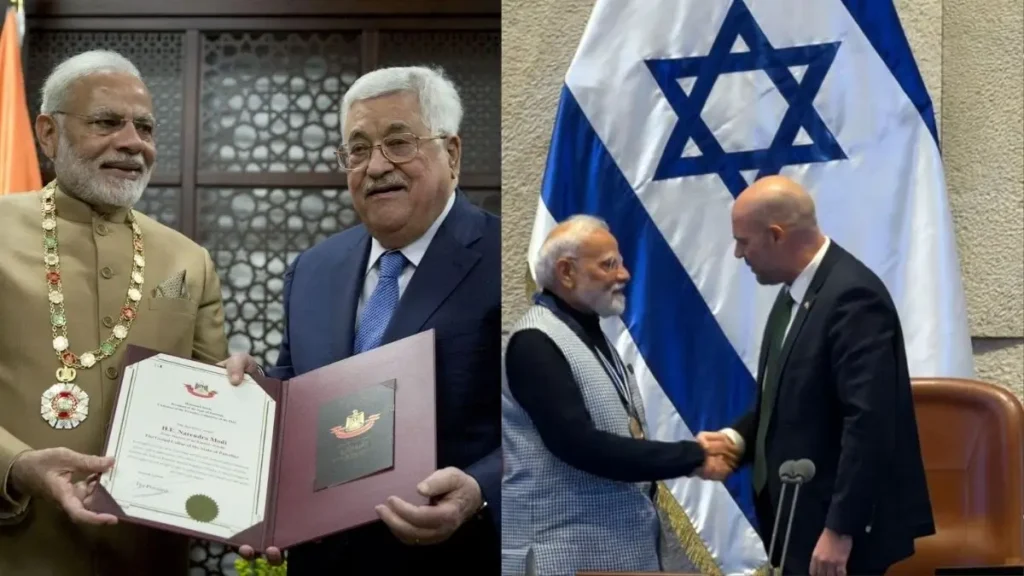
India Israel Palestine diplomatic recognition marks a historic moment as Narendra Modi becomes the first leader honoured by both nations, strengthening India’s balanced West Asia foreign policy and global diplomatic stature.
Historic Recognition: India Strengthens Diplomatic Ties as PM Modi Honoured by Both Israel and Palestine
Prime Minister Narendra Modi has achieved a rare and historic diplomatic milestone by being honoured with the highest awards from both Israel and Palestine, making him the first world leader to receive this dual recognition. On 25 February 2026, the Israeli Parliament, the Knesset, conferred the prestigious Speaker of the Knesset Medal upon PM Modi in Jerusalem. Previously in 2018, he was awarded the Grand Collar of the State of Palestine, the highest civilian honour extended to foreign leaders.
This dual recognition reflects India’s evolving and balanced foreign policy in the West Asian region, where New Delhi strives to maintain strong ties with both Israel and Palestine — historically sensitive partners due to longstanding geopolitical tensions. The conferment of these honours showcases global acknowledgment of India’s diplomatic efforts to promote cooperation, peace, and mutual understanding across diverse geopolitical landscapes.
🏅 Speaker of the Knesset Medal – Israel’s Highest Parliamentary Honour
On 25 February 2026, PM Modi received the Speaker of the Knesset Medal — the highest honour of the Israeli Parliament. This award was bestowed by Knesset Speaker Amir Ohana and represents Israel’s recognition of Modi’s significant contributions toward strengthening India–Israel strategic relations.
Prime Minister Modi’s address to the Israeli Parliament underscored shared values and highlighted deep collaboration in areas such as defence, technology, innovation, and trade. Israeli leaders described the ties with India as a “wondrous friendship,” highlighting mutual respect and growing partnership.
🇵🇸 Grand Collar of the State of Palestine – 2018 Recognition
In 2018, PM Modi was conferred the Grand Collar of the State of Palestine by Palestinian President Mahmoud Abbas. This prestigious award honours his contributions toward deepening India–Palestine ties and India’s consistent support for Palestinian aspirations.
Receiving both recognitions — from Israel and Palestine — is unprecedented and highlights India’s balanced diplomatic approach in a conflict-sensitive region. This achievement places India in a unique position on the global stage, particularly in West Asian geopolitics.
🗣️ Modi’s Message in the Knesset
During his address to the Israeli Parliament, PM Modi reiterated India’s firm stance against terrorism and expressed condolences for victims of global terror attacks. He also aligned with initiatives for enhanced peace and stability in the region, advocating dialogue and cooperation among nations.
His speech highlighted India’s long-standing policy of engaging constructively with all nations in West Asia while protecting its national interests and strategic partnerships.
🌐 Strategic Significance for India’s Foreign Policy
This historic recognition carries major strategic implications for India’s global diplomacy:
- It reinforces India’s balanced West Asia policy, engaging with diverse actors.
- It strengthens India’s bilateral relations with Israel and Palestine.
- It enhances India’s diplomatic stature on the world stage.
- It reflects India’s commitment to peace, stability, and cooperation across conflicting regions.

📌 Why This News Is Important (For Exam Preparation)
🧠 Significance for Government Exam Aspirants
This news is highly relevant for students preparing for government exams such as UPSC Civil Services (IAS/IPS), SSC, Banking, Railways, Defence and Teaching exams because it covers India’s foreign policy initiatives, diplomatic relations, and global strategic positioning — all important current affairs topics often featured in exam syllabi.
🌍 Understanding India’s Diplomatic Strategy
The dual honour reflects India’s evolving role in international politics — especially in the geopolitically crucial Middle East. India traditionally supported Palestine’s aspirations while building strong strategic ties with Israel, especially since the 1990s. This dual recognition highlights the success of that balanced diplomatic approach, demonstrating India’s ability to navigate complex regional politics without compromising strategic partnerships.
Exam questions often test aspirants on India’s foreign relations with West Asian countries, the significance of strategic partnerships, and how bilateral ties affect India’s security and economic interests. Recipients of such high honours symbolize the outcome of sustained diplomatic efforts and deeper bilateral cooperation, making this news significant for competitive exams.
📜 Historical Context: India’s Relations with Israel and Palestine
🇮🇳 India–Israel Diplomatic Relations
India formally recognised Israel in 1950, but full diplomatic ties were established only in 1992. Since then, bilateral relations have grown significantly, especially in defence, agriculture, technology, and trade. PM Narendra Modi became the first Indian Prime Minister to visit Israel in 2017, elevating the relationship to a Strategic Partnership.
🇵🇸 India’s Engagement with Palestine
India has historically supported Palestine’s right to statehood. It was among the early nations to recognise the Palestine Liberation Organisation (PLO) and later the State of Palestine. India’s balanced approach included supporting Palestinian development projects and cooperation in education and healthcare. In 2018, PM Modi became the first Indian PM to visit Palestine and received the Grand Collar of the State of Palestine for his efforts.
🕊️ Balanced West Asia Policy
India’s foreign policy in West Asia has aimed at maintaining strong ties with both Israel and Palestine, reflecting its commitment to peace and cooperation. This balanced engagement has helped India enhance its global influence while contributing to regional stability.
📊 Key Takeaways from “Historic Recognition: Modi Honoured by Israel and Palestine”
| S. No | Key Takeaway for Exam Aspirants |
|---|---|
| 1 | PM Narendra Modi became the first world leader to be honoured by both Israel and Palestine with their highest civilian recognitions. |
| 2 | He was conferred the Speaker of the Knesset Medal by the Israeli Parliament on 25 February 2026. |
| 3 | In 2018, he received the Grand Collar of the State of Palestine for strengthening India–Palestine relations. |
| 4 | The honours highlight India’s balanced West Asia policy, engaging with conflicting partners diplomatically. |
| 5 | The recognition underscores India’s growing global influence and strategic partnerships in defence, technology, innovation, and trade. |
Frequently Asked Questions (FAQs)
1. Who became the first leader to be honoured by both Israel and Palestine?
Narendra Modi became the first world leader to receive top honours from both Israel and Palestine, reflecting India’s balanced diplomatic approach in West Asia.
2. What is the highest honour given to PM Modi by Israel?
He was awarded the Speaker of the Knesset Medal, the highest parliamentary honour of Israel, conferred by the Israeli Parliament known as the Knesset.
3. When did PM Modi receive Palestine’s highest civilian honour?
He received the Grand Collar of the State of Palestine in 2018 during his historic visit to Palestine.
4. Why is this recognition important for India’s foreign policy?
It highlights India’s balanced West Asia policy, maintaining strong relations with both Israel and Palestine despite their long-standing conflict.
5. When were full diplomatic relations established between India and Israel?
Full diplomatic relations were established in 1992, though India had recognised Israel earlier in 1950.
6. Who awarded the Grand Collar of the State of Palestine to PM Modi?
The award was conferred by Palestinian President Mahmoud Abbas.
7. Why is West Asia important for India?
West Asia is strategically important for India due to energy security, trade routes, Indian diaspora presence, and defence cooperation.
8. Which exam topics does this news relate to?
It is relevant for International Relations, Indian Foreign Policy, Current Affairs, and West Asian geopolitics — important for UPSC, SSC, Banking, Railways, Defence, and State PCS exams.
Some Important Current Affairs Links

