
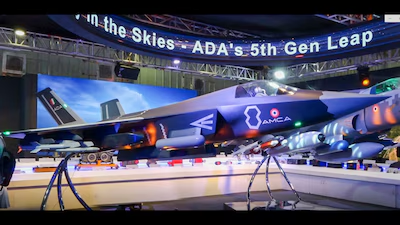
India France jet engine collaboration: India partners with France’s Safran to co-develop jet engines for AMCA, its next-gen stealth fighter. A ₹61,000 crore project with 100% technology transfer, boosting Atmanirbhar Bharat in defence.
India’s Collaboration with France’s Safran to Build Jet Engines for Next-Gen Fighter Aircraft
Strategic Defence Collaboration
India has embarked on a landmark collaboration with France’s aerospace giant, Safran, to co-develop and domestically manufacture powerful jet engines for its future Advanced Medium Combat Aircraft (AMCA)—a fifth-generation stealth fighter being designed indigenously. Defence Minister Rajnath Singh announced this initiative, signaling a major leap towards defence self-reliance.
Roadmap and Specifications
A detailed roadmap has been prepared by Safran in conjunction with India’s DRDO, outlining the engine’s development, testing, certification, and production phases. The engine is expected to deliver approximately 110–120 kilonewtons (kN) of thrust—making it one of the most powerful jet engines in the world.
Approval & Scale of the Project
The proposal to design and manufacture India’s indigenous fifth-generation AMCA fighter aircraft, with this new engine, was approved by the Cabinet Committee on Security (CCS). The overall project is valued at nearly ₹61,000 crore (approximately $7 billion), making it one of India’s most significant defence investments.
Push Towards Indigenous Capability
Prime Minister Modi, emphasizing the significance of indigenous development, likened jet engine manufacturing to India’s successes in vaccine production and digital infrastructure like UPI—asserting that “our scientists and youth must take up this direct challenge.”
What Differentiates This Engine?
This engine co-developed with Safran offers 100% technology transfer and ownership of intellectual property rights—ensuring that India gains full mastery over its design and manufacturing. It is set to power the Mark 2 variant of the AMCA and future platforms.

Why This News Is Important
Significance for India’s Defence Self-Reliance
India’s collaboration with Safran is a defining moment in its pursuit of Atmanirbhar Bharat (self-reliant India), especially in critical defence technologies. Jet engines are among the most complex systems to develop—requiring expertise in metallurgy, aerodynamics, and precision manufacturing. By securing full technology transfer, India is not just buying equipment—it is acquiring the capability to design and build such engines independently, reducing long-term reliance on foreign suppliers.
Boost to the Future of Indian Aerospace
This project aligns with other major defence initiatives—like producing F414 engines with GE for the Tejas Mk-2—which collectively strengthen India’s aerospace architecture. The co-development of the AMCA engine will elevate India’s role in global defence and enhance its technological ecosystem.
High Relevance for Aspirants
For students preparing for UPSC, state PSCs, banking, railways, teaching, police, defence services, and other competitive exams, this development is directly linked to topics under Science & Technology, International Relations, and Defence. It’s essential knowledge, reflecting India’s strategic initiatives, international collaboration, and R&D policy trajectory.
Historical Context: India’s Journey Towards Indigenous Jet Engines
The Kaveri Setback
In the 1990s, India initiated the Kaveri turbofan engine project to power the Tejas aircraft—a bold step toward self-reliance. However, due to performance shortcomings, the project could not meet operational requirements, symbolizing the complexity of aero-engine development.
Renewed Push & Strategic Options
In light of Kaveri’s limitations, India opened dialogue with global firms like GE (USA), Rolls-Royce (UK), and Safran (France). Each offered partnerships emphasizing technology transfer. Due to its long-term engagement with India and predictability, Safran emerged as the frontrunner. Southern facilities in Hyderabad, Bengaluru, and Goa already support Safran’s LEAP and M-88 engine components, strengthening its position.
AMCA’s Evolution & Strategic Approval
The AMCA programme began evolving over the 2010s. Initial engine requirements hovered around 100-105 kN thrust. By 2023, India and France agreed to collaborate on engine development under the Horizon 2047 roadmap. In 2024–2025, DRDO shortlisted Safran and Rolls-Royce; by mid-2025, India formally recommended the India–France partnership worth ₹61,000 crore.
Key Takeaways from This News
Key Takeaways from India-Safran Jet Engine Partnership
| S. No. | Key Takeaway |
|---|---|
| 1. | India and France’s Safran will co-develop and domestically manufacture jet engines for the AMCA, India’s indigenous fifth-generation fighter. |
| 2. | The engine will deliver approximately 110–120 kN of thrust, powering the upgraded variant of the AMCA fighter. |
| 3. | The Cabinet has approved the ₹61,000 crore ($7 billion) project, which includes 100% technology transfer and IP ownership. |
| 4. | This initiative complements India’s broader strategy for defence self-retaliance, alongside other projects like GE’s F414 engines for Tejas Mk-2. |
| 5. | The move marks a strategic milestone in indigenous aerospace development, and is highly relevant for competitive exams’ sectors like Science & Tech, IR, and Defence. |
Frequently Asked Questions (FAQs)
1. What is the purpose of the India–Safran collaboration?
The collaboration aims to co-develop and domestically manufacture advanced jet engines for India’s fifth-generation stealth fighter aircraft, the AMCA (Advanced Medium Combat Aircraft).
2. What is the expected thrust capacity of the new jet engine?
The new jet engine is projected to deliver 110–120 kN of thrust, placing it among the most powerful fighter jet engines globally.
3. Which committee approved the AMCA engine project?
The Cabinet Committee on Security (CCS) approved the project valued at approximately ₹61,000 crore.
4. Why is this project considered a milestone for India’s defence sector?
It ensures 100% technology transfer and intellectual property ownership, enabling India to gain full expertise in designing, manufacturing, and maintaining jet engines.
5. How does this project align with India’s self-reliance goals?
The partnership contributes directly to Atmanirbhar Bharat, reducing dependence on foreign defence suppliers and strengthening India’s indigenous aerospace industry.
6. Which past Indian engine project faced setbacks?
The Kaveri turbofan engine project in the 1990s was unsuccessful due to performance issues, highlighting the challenges of developing jet engines domestically.
7. Which other country’s company is partnering with India for jet engines apart from France?
The United States’ GE Aviation is working with India to produce F414 engines for the Tejas Mk-2 fighter aircraft.
8. What is AMCA?
The Advanced Medium Combat Aircraft (AMCA) is India’s indigenously developed fifth-generation stealth fighter jet currently under development by DRDO and HAL.
9. How does this collaboration strengthen India’s global position?
It positions India as one of the few countries with indigenous jet engine technology, boosting its strategic autonomy and defence exports potential.
10. Why is this news important for competitive exams?
It is relevant for topics under Science & Technology, International Relations, Defence, and Government Schemes, making it crucial for UPSC, SSC, Defence, Banking, and State PSC exams.
Some Important Current Affairs Links

