
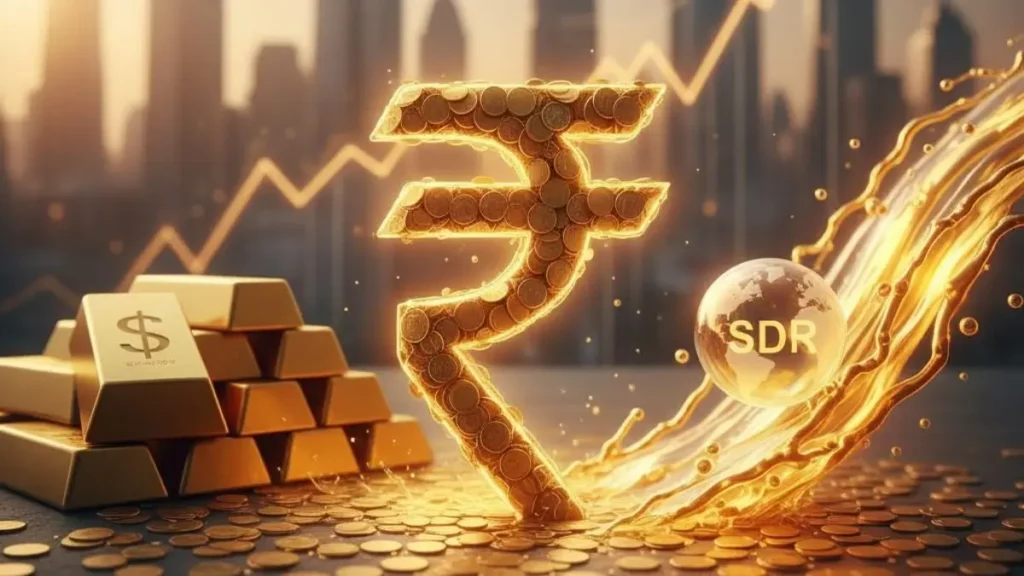
India forex reserves update shows India hitting an all-time high of USD 692.57 billion, driven by rising gold reserves and strong foreign currency assets—important for RBI policy, economy, and exam preparation.
India’s Forex Reserves Reach All-Time High
(Article for Government Exam Aspirants)
Surge in Reserves: Key Figures Explained
In the week ending November 14, 2025, India’s foreign exchange reserves soared by US $5.54 billion to reach US $692.57 billion, marking a historic high. The rebound followed a drop of about US $2.70 billion in the previous week.
Breaking down the components:
- Gold reserves increased by US $5.327 billion, reaching US $106.857 billion.
- Foreign currency assets (FCAs) rose by US $152 million, to US $562.29 billion.
- Special Drawing Rights (SDRs) with the International Monetary Fund (IMF) increased by US $56 million, to US $18.65 billion.
- India’s reserve position with the IMF showed an uptick of US $8 million, to US $4.779 billion.
Why the Jump in Gold Matters
The dominant factor behind this surge was the sharp rise in gold reserves. The increase signals two simultaneous effects: global gold prices climbed, and the Reserve Bank of India (RBI) appears to have added to its gold holdings strategically.
Gold reserves act as a hedge against currency fluctuations and global financial shocks. With India’s gold holdings crossing US $100 billion, the country gains a stronger buffer in times of external stress.
Strategic Currency Assets and Other Components
While the bulk of the increase came via gold, the FCA component also edged up. FCAs represent the RBI’s holdings of foreign-denominated assets such as the euro, pound, yen and others (including the US dollar). Their valuation in dollar terms depends on how these currencies perform relative to the dollar.
SDRs and the IMF reserve position form smaller parts of the overall reserves, but they are important for global liquidity and India’s standing in the international monetary system.
Implications for India’s Economy
India now stands in a stronger position to cover over 11 months of imports, which is a comfortable horizon in terms of import coverage. A high level of reserves gives the RBI and the Indian government considerable flexibility:
- It provides a buffer to manage external shocks such as a spike in oil prices or large capital outflows.
- It strengthens the rupee’s resilience and helps stabilize the currency in times of volatility.
- It boosts investor confidence, which is critical for attracting foreign direct investment (FDI) and portfolio flows.
Given the global environment of rising uncertainty—geopolitical tensions, volatile commodity prices, currency swings—a healthy reserve base is a key strategic asset for India.
Linkage to Exam-Relevant Topics
For aspirants preparing for banking, railways, defence, civil services, teaching, and police recruitment exams, this news touches important themes:
- Macroeconomic indicators: forex reserves, import coverage, currency stability.
- Role of central bank (RBI) in maintaining stability and reserves management.
- Impact of global factors (gold prices, commodity shocks) on domestic economy.
- India’s external sector strength and its implications for policy-making, fiscal/monetary stability.
Understanding this story helps with current affairs for topics like “India’s economic indicators”, “monetary policy & external sector”, and “importance of gold & reserves in banking/macro economy”.

Why This News Is Important
Relevance for External Sector Stability
A record high in forex reserves is a direct reflection of the robustness of India’s external sector. For exam aspirants, recognising that reserves serve as a buffer against global economic shocks, currency volatility and import payment pressures is essential.
Policy Implications for Central and Fiscal Agencies
With strong reserves, the RBI has greater leeway in navigating monetary policy—particularly in maintaining the rupee, managing inflation and handling capital flows. In addition, the government benefits from enhanced credibility in financial markets. This is crucial for banking and civil service exams where policy-framework questions often appear.
Indicator of Economic Strength
High reserves send a strong signal to investors, foreign lenders and rating agencies about India’s ability to meet its external obligations. For teaching and banking exam candidates, this is part of the macro-economic health assessment of the country, a frequent topic.
Strategic Significance in a Changing Global Environment
In the context of increasing geopolitical risks, rising global interest rates and commodity price volatility, India’s elevated reserve position is a strategic asset. For defence services and civil services aspirants, such macro indicators link to national security and economic resilience discussions.
Historical Context
Reserves management has been an evolving feature in India’s economic history. Over the decades:
- In the early 1990s, India faced a balance-of-payments crisis, which triggered the liberalisation programme of 1991. At that time, reserves dwindled to very low levels, motivating structural reforms.
- Since then, the RBI and the government have steadily augmented the reserve base through strong export growth, prudent fiscal policy and accumulation of foreign currency flows, including FDI and foreign institutional investment (FII).
- Gold has always played a strategic role as a hedge against external volatility, but its share has become more prominent in recent years, reflecting global uncertainties and rising gold prices.
- In recent years, India’s reserves have crossed key milestones (US $500 billion, US $600 billion), signalling improving external strength. The present high of US $692.57 billion is the culmination of this long-term build-up.
- Understanding this evolution helps exam aspirants link current numbers with historical efforts and policy frameworks aimed at external stability.
Key Takeaways from India’s Forex Reserves Surge
| S. No. | Key Takeaway |
|---|---|
| 1 | India’s forex reserves reached US $692.57 billion in the week ending November 14, 2025. |
| 2 | Gold reserves increased by US $5.327 billion to US $106.857 billion, forming the major share of the week’s rise. |
| 3 | Foreign currency assets rose modestly by US $152 million to US $562.29 billion. |
| 4 | Strong reserves enhance India’s ability to cover over 11 months of imports and boost currency stability. |
| 5 | Robust reserve levels support the RBI’s policy flexibility and strengthen India’s global financial credibility |
Frequently Asked Questions (FAQs)
1. What are forex reserves?
Forex reserves are external assets held by the Reserve Bank of India (RBI) in foreign currencies, gold, SDRs, and IMF reserve positions to support international transactions and stabilize the currency.
2. Why are India’s forex reserves increasing?
Reserves rise due to higher capital inflows, appreciation in valuation of foreign assets, increase in gold prices, and RBI’s strategic accumulation of foreign currencies and gold.
3. What contributes most to India’s forex reserves?
The largest component is Foreign Currency Assets (FCAs), followed by Gold, SDRs, and IMF reserve position.
4. Why is gold important in forex reserves?
Gold acts as a hedge during global uncertainties, enhances the credibility of reserves, and helps reduce risks associated with currency fluctuations.
5. What is the significance of high forex reserves for India?
High reserves strengthen the rupee, improve investor confidence, cover import bills, and provide the RBI flexibility in handling external shocks.
6. How much of India’s imports can current reserves cover?
With reserves at an all-time high, India can now cover more than 11 months of imports, which is considered a very comfortable level.
7. What are Special Drawing Rights (SDRs)?
SDRs are international reserve assets created by the IMF to supplement member countries’ official reserves.
8. How do forex reserves help the RBI manage the rupee?
RBI can buy or sell foreign currency using reserves to stabilize the rupee during volatility.
9. Why do government exam aspirants need to study forex reserves?
It is a key topic in economy, banking awareness, general studies, finance, and international trade, frequently appearing in exams like UPSC, SSC, Bank PO/Clerk, RBI Grade B, and State PSCs.
10. What happens if forex reserves decline sharply?
A steep fall may lead to rupee depreciation, reduced import capability, weakened investor confidence, and increased economic vulnerability.
Some Important Current Affairs Links

