
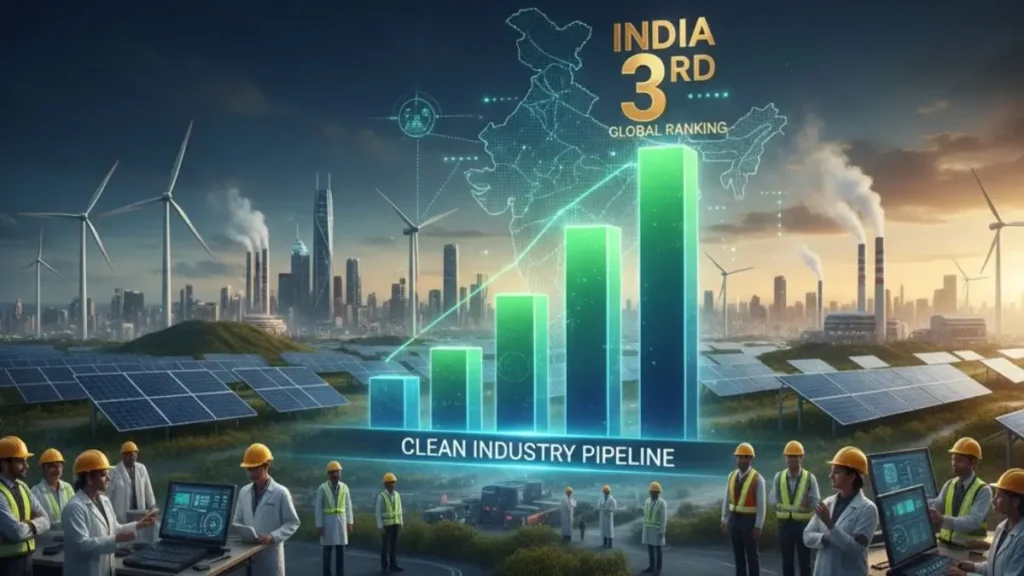
India clean industry pipeline strengthens as the nation ranks third globally with 65 low-emission industrial projects across key states, boosting sustainable manufacturing and supporting India’s net-zero 2070 goal.
India Climbs to Third in Global Clean Industry Pipeline
In a marked advancement in its industrial decarbonisation journey, India has risen to become the world’s third-largest country in terms of clean industry project pipelines, trailing only the United States and China. According to recent data, India now boasts 65 commercial-scale low-emission industrial projects in its pipeline, with an estimated investment potential exceeding US $150 billion.
Despite this promising scale, only six of those projects have advanced to the final investment decision (FID) stage so far, indicating that significant execution and financing hurdles remain.
Pipeline Composition: Scale and Sectors
Of the 65 projects lined up, the chemicals sector dominates, accounting for nearly 80 % of the total. This includes approximately 50 initiatives in clean ammonia and methanol production, aimed at generating 30–35 million tonnes of clean chemical output annually.
In addition to chemicals, India’s clean-industry pipeline includes major projects in the steel industry (focused on hydrogen-based iron reduction and carbon capture technologies) and emerging initiatives in cement, aluminium and aviation, which are piloting low-emission fuels, clinker substitutes and clean propulsion technologies, although these remain at early stages of development.
Geographic Spread and Strategic States
These projects are distributed across seven key states — Odisha, Andhra Pradesh, Karnataka, Gujarat, Rajasthan, Maharashtra and Tamil Nadu — selected for their existing industrial clusters, access to ports, renewable energy zones and enabling infrastructure.
This geographic spread underscores India’s strategic aim to align industrial growth with clean-energy integration, thereby positioning itself as a major clean-manufacturing hub globally.
Challenges to Execution
While the pipeline signals strong intent, the fact that only six projects have reached the FID stage highlights major challenges, including securing large scale financing, technology adaptation, regulatory clearances, infrastructure access (especially renewable energy supply), and supply-chain readiness for new low-emission industrial technologies. Analysts caution that unless these hurdles are addressed, the actual deployment of these projects could lag behind the ambition.
Broader Alignment with Net-Zero Goals
India’s improvement to third place globally in the clean-industry pipeline complements its broader commitment to achieving net-zero carbon emissions by 2070. The move aligns industrial ambitions with climate objectives and signifies a shift from purely growth-driven manufacturing to sustainable, low-carbon industrialisation. As India advances along this pathway, the outcomes of these pipeline projects will be critical in determining how competently the country transitions heavy industrial sectors toward cleaner production.

Why This News Is Important
Alignment with Examination Relevance
For students preparing for government exams (teachers, police officers, banking, railways, defence and civil service positions such as PSCS to IAS), this news is highly relevant. Many syllabi include topics like India’s industrial policy, sustainable development, climate change initiatives, and international position of India in global rankings. This story ties each of those together by showing India’s global standing, policy ambition and industrial strategy.
Strategic Significance
The fact that India has become the third-largest clean-industry pipeline globally has strategic implications. It demonstrates India’s emergence not just as an industrial growth engine, but as a participant in the global low-carbon transition. For civil service aspirants and banking/railways exam takers, understanding how India positions itself in global value chains, especially in emerging technologies like clean chemicals and hydrogen steelmaking, is increasingly important.
Economic and Employment Implications
This news also highlights major economic and employment angles: the pipeline is estimated to generate around 200,000 new jobs and abate 160–175 million tonnes of CO₂ annually. Such details matter for exam questions on employment policy, industrial development, climate-policy impact, and government scheme relevance.
Policy and Exam-Focused Context
From a policy perspective, this development showcases how states, central government and industry are converging to build clean manufacturing clusters in major states like Gujarat and Andhra Pradesh. Students preparing for teacher, defence or police officer roles may face questions on state-specific industrial policy, renewable energy integration, and state-centre coordination. Therefore, grasping the context of this pipeline gives a solid preparatory grounding.
Conclusion of Importance
In short, this news story is not only timely but rich with multidimensional relevance — for understanding India’s industrial transition, its climate commitments, employment generation and positioning in global clean-technology value chains. For exam-takers across sectors, this is a high-yield topic linking economy, environment, policy and geography.
Historical Context
Industrial Growth and Clean Transition in India
For decades, India’s industrial development model prioritized growth, scale and employment often at the cost of higher emissions and environmental stress. Heavy industries such as steel, cement, chemicals and aviation have historically been hard-to-abate sectors, meaning they incur high CO₂ emissions per unit of output and pose significant decarbonisation challenges.
Key Climate and Industrial Milestones
In 2021, India announced at the COP26 climate summit that it would aim to achieve net-zero carbon emissions by 2070, and reach 500 GW non-fossil power capacity by 2030. This set the stage for policy thrusts toward clean manufacturing, green hydrogen, and carbon-capture technologies.
Subsequent industrial policy measures — such as production linked incentives (PLI) for green hydrogen, green chemicals, carbon-capture utilisation and storage (CCUS) in heavy industries — have aimed to channel investments and technology into low-emission industrial processes.
Global Clean-Technology Competition
Globally, developed economies like the US and China have led in clean-manufacturing pipelines and investment. India’s recent rise into the third spot reflects a maturation of its policy framework, investment readiness and industrial ambition in the clean-technology field.
State-Led Industrial Clusters and Renewable Integration
States like Gujarat, Andhra Pradesh and Odisha have been proactive in establishing industrial clusters with integrated renewable-energy parks, port access and logistical connectivity — enabling a foundation for large-scale clean-industry deployment. The geographic spread of the 65 projects (in seven states) cited in the news reflects this state-level role in India’s industrial clean-transition.
Key Takeaways from India’s Advance in Clean Industry Pipeline
| S. No | Key Takeaway |
|---|---|
| 1 | India now ranks third globally in the clean-industry pipeline with 65 low-emission industrial projects. |
| 2 | The estimated investment potential of the pipeline is over US $150 billion, with job creation of around 200,000 new jobs and CO₂ abatement of 160–175 million tonnes per year. |
| 3 | Nearly 80 % of the projects are in the chemicals sector, primarily clean ammonia and methanol initiatives. |
| 4 | Only six projects have reached the final investment decision (FID) stage so far, indicating execution and financing bottlenecks. |
| 5 | The project pipeline is geographically concentrated across Odisha, Andhra Pradesh, Karnataka, Gujarat, Rajasthan, Maharashtra and Tamil Nadu, leveraging industrial clusters and renewable-energy zones. |
Frequently Asked Questions (FAQs)
1. What does it mean that India ranks third in the global clean industry pipeline?
India ranking third means that it has the third-highest number of planned or ongoing large-scale clean industrial projects worldwide, which focus on reducing emissions in heavy industries like steel, chemicals, and cement.
2. Which sectors are leading in India’s clean industry pipeline?
The chemicals sector is leading, especially in clean ammonia and methanol production, followed by projects in steel, cement, aluminium and aviation sectors.
3. How many of these projects have reached the final investment decision (FID) stage?
Out of the 65 projects, only 6 projects have so far reached the final investment decision (FID) stage, indicating that many are still in planning or feasibility stages.
4. What is the significance of these projects for India’s net-zero goals?
These projects will play a major role in reducing industrial carbon emissions, helping India move closer to its target of achieving net-zero emissions by 2070.
5. Which states are the major hubs for clean industry projects in India?
Key states include Odisha, Andhra Pradesh, Karnataka, Gujarat, Rajasthan, Maharashtra, and Tamil Nadu, chosen due to port access, industrial clusters and renewable-energy capacity.
6. How much CO₂ reduction is expected from these projects?
The pipeline is estimated to help reduce around 160–175 million tonnes of CO₂ emissions annually once projects become operational.
7. Why is there a delay in implementation of some projects?
Delays are mainly due to high financing requirements, need for advanced technological support, infrastructure challenges and policy clearances.
8. How will these projects benefit the Indian economy?
They will boost industrial competitiveness, create jobs, promote technological innovation and support India’s transition toward sustainable manufacturing.
Some Important Current Affairs Links

