
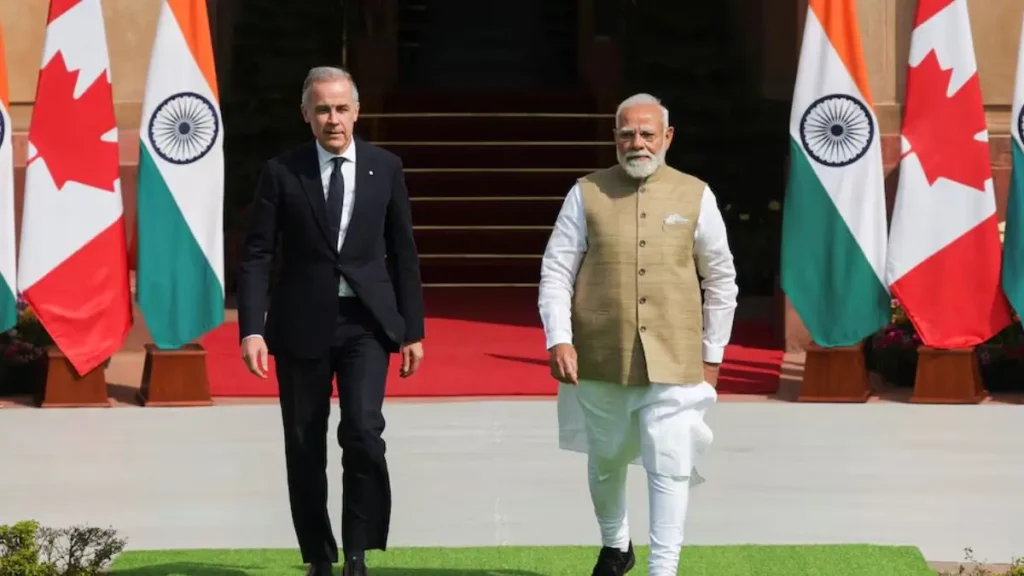
India Canada strategic energy partnership 2026 marks a major reset in bilateral relations as both countries revive CEPA trade talks, sign a uranium supply agreement, and aim to boost trade to $50 billion by 2030.
India–Canada Announce Strategic Energy Partnership, Revive CEPA Talks
Reset in Bilateral Relations Between India and Canada
India and Canada have announced a renewed strategic partnership aimed at strengthening cooperation in energy, trade, and technology. The announcement came during the official meeting between Narendra Modi and Mark Carney in March 2026. The two leaders released a joint statement outlining a roadmap to deepen bilateral relations after a period of diplomatic tension. The renewed partnership highlights collaboration across sectors such as clean energy, defence, artificial intelligence, trade, and the Indo-Pacific region.
The initiative marks an important effort by both countries to rebuild trust and strengthen economic cooperation. The leaders emphasized the guiding principle of “Vasudhaiva Kutumbakam – One Earth, One Family, One Future,” highlighting shared global responsibilities and cooperative development.
Launch of the India–Canada Strategic Energy Partnership
A major highlight of the announcement is the launch of the India–Canada Strategic Energy Partnership, which aims to expand collaboration across the entire energy value chain. The partnership will include cooperation in clean energy, conventional energy, civil nuclear energy, and critical minerals. Both nations also agreed to revive the Canada–India Ministerial Energy Dialogue to strengthen policy coordination and encourage investment in the energy sector.
The partnership will focus on emerging areas such as renewable energy, hydrogen technologies, biofuels, sustainable aviation fuel, battery storage systems, and carbon capture utilization and storage (CCUS). These sectors are expected to play a key role in the global transition toward sustainable energy systems.
Uranium Supply Agreement to Boost Nuclear Energy
Another significant development was the signing of a CAD 2.6 billion uranium supply agreement between the Canadian company Cameco and India’s Department of Atomic Energy. The agreement will provide long-term uranium supplies for India’s nuclear power plants.
This deal is expected to support India’s civil nuclear energy program and strengthen its clean energy transition goals. Nuclear energy is considered a stable and low-carbon source of power that helps reduce dependence on fossil fuels. By securing uranium supplies from Canada, India aims to improve energy security and diversify its energy sources.
Cooperation in Critical Minerals and Clean Technology
India and Canada also signed agreements to cooperate in the development of critical minerals such as lithium, cobalt, and rare earth elements. These minerals are essential for the manufacturing of batteries, electric vehicles, and renewable energy infrastructure. The partnership will support resilient supply chains and reduce dependency on limited global suppliers.
Additionally, both countries agreed to strengthen cooperation in clean energy technologies, including solar power, wind energy, and energy storage systems. Canada also expressed its intention to collaborate with global renewable initiatives such as the International Solar Alliance.
Revival of CEPA Trade Negotiations
India and Canada have also revived negotiations for the Comprehensive Economic Partnership Agreement (CEPA), a proposed free trade agreement aimed at boosting economic cooperation. The two countries signed the terms of reference to formally begin negotiations and aim to conclude the agreement by the end of 2026.
The proposed CEPA is expected to cover trade in goods and services, investment flows, and regulatory cooperation. The agreement could significantly increase bilateral trade and investment opportunities between the two nations.
Target to Expand Bilateral Trade by 2030
Both countries have set an ambitious target to expand bilateral trade to around $50 billion by 2030. Currently, trade between India and Canada is estimated at nearly $9 billion annually. Achieving this target will require stronger collaboration in sectors such as technology, agriculture, energy, and manufacturing.
The reconstitution of the India–Canada CEO Forum and increased engagement between industries are expected to support this goal. These initiatives will encourage private-sector investment and strengthen economic ties between the two countries.

Why This News is Important
Strengthening India’s Energy Security
The strategic energy partnership between India and Canada is significant because it helps India diversify its energy sources. By securing uranium supplies and expanding cooperation in clean energy technologies, India can reduce dependence on traditional fossil fuels and strengthen its energy security. This is particularly important as India’s energy demand continues to grow with economic development.
Boosting Bilateral Trade and Investment
The revival of CEPA negotiations represents a major step toward expanding economic ties between India and Canada. A successful free trade agreement could reduce tariffs, increase investment flows, and open new markets for businesses in both countries. With a target of increasing trade to $50 billion by 2030, the agreement has the potential to significantly boost economic growth and create employment opportunities.
Strategic Cooperation in Emerging Technologies
The partnership also highlights cooperation in emerging sectors such as renewable energy, hydrogen technologies, artificial intelligence, and critical minerals. These sectors are vital for the future global economy and energy transition. Strengthening collaboration in these fields can enhance technological innovation and create sustainable development opportunities.
Diplomatic Reset After Recent Tensions
The announcement also symbolizes a diplomatic reset in India–Canada relations after a period of strained ties. Renewed cooperation in trade, energy, and technology indicates both nations’ willingness to rebuild trust and pursue mutually beneficial partnerships.
Historical Context
Background of India–Canada Relations
India and Canada established diplomatic relations in 1947 and have maintained cooperation in trade, education, and technology. Canada has been an important supplier of natural resources such as pulses, fertilizers, and uranium to India.
Previous Trade Negotiations and Diplomatic Strains
Negotiations for a Comprehensive Economic Partnership Agreement between India and Canada began earlier but faced delays due to diplomatic tensions in recent years. Trade discussions were temporarily paused following political disagreements between the two countries in 2023.
However, both governments recognized the importance of economic cooperation and resumed discussions in 2026, marking a renewed commitment to strengthen bilateral relations. The revival of CEPA talks and the strategic energy partnership indicate a new phase of collaboration between the two nations.
Key Takeaways from This News
| S. No. | Key Takeaway |
|---|---|
| 1 | India and Canada launched a Strategic Energy Partnership covering clean energy, nuclear energy, and critical minerals. |
| 2 | A CAD 2.6 billion uranium supply deal was signed between Cameco and India’s Department of Atomic Energy. |
| 3 | Both countries revived negotiations for the Comprehensive Economic Partnership Agreement (CEPA). |
| 4 | India and Canada aim to conclude CEPA by 2026 and expand bilateral trade to $50 billion by 2030. |
| 5 | The partnership includes cooperation in renewable energy, hydrogen, AI, defence, and supply-chain resilience. |
FAQs: Frequently Asked Questions
1. What is the India–Canada Strategic Energy Partnership?
The India–Canada Strategic Energy Partnership is a bilateral initiative launched in 2026 to enhance cooperation in energy sectors such as clean energy, nuclear power, LNG, hydrogen, and critical minerals. It aims to strengthen energy security and support the global transition toward sustainable energy.
2. What is the Comprehensive Economic Partnership Agreement (CEPA)?
The Comprehensive Economic Partnership Agreement (CEPA) is a proposed free trade agreement between India and Canada covering trade in goods, services, investment, and other economic sectors. Both countries aim to conclude the agreement by 2026 to boost economic cooperation.
3. What is the significance of the uranium supply agreement between India and Canada?
India and Canada signed a CAD 2.6 billion uranium supply agreement between Canada’s Cameco Corporation and India’s Department of Atomic Energy. The agreement will supply uranium for India’s nuclear power plants and support the expansion of nuclear energy.
4. What trade target has been set by India and Canada?
Both countries have set a goal to increase bilateral trade to around $50 billion by 2030, which is expected to significantly expand economic cooperation and investment opportunities.
5. Which leaders announced the revival of India–Canada cooperation in 2026?
The announcement was made during a meeting between Indian Prime Minister Narendra Modi and Canadian Prime Minister Mark Carney, marking a strategic reset in bilateral relations.
6. What sectors will benefit from the India–Canada partnership?
The partnership covers several sectors including clean energy, nuclear power, renewable energy, hydrogen technology, defence cooperation, critical minerals, and emerging technologies such as artificial intelligence.
7. Why are critical minerals important in India–Canada relations?
Critical minerals such as lithium, cobalt, and rare earth elements are essential for electric vehicles, renewable energy systems, and advanced technologies. Cooperation between India and Canada aims to strengthen global supply chains for these minerals.
8. What role does nuclear energy play in India’s energy strategy?
Nuclear energy is a low-carbon and reliable source of electricity. India plans to expand its nuclear power capacity significantly to support clean energy goals and reduce dependence on fossil fuels.
Some Important Current Affairs Links

