
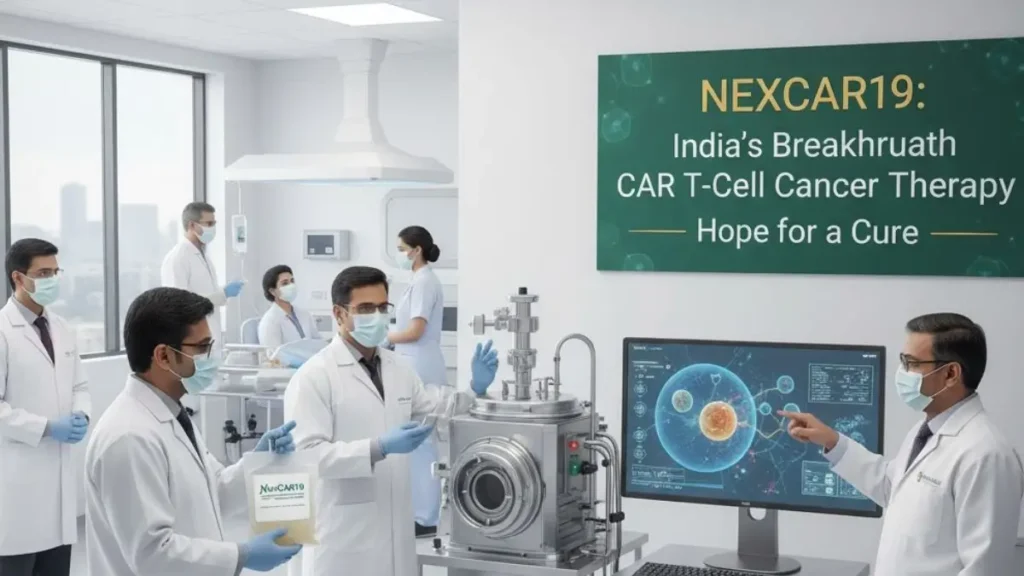
India’s first homegrown CAR T-Cell Therapy NexCAR19 launched in 2025, providing affordable advanced cancer treatment, boosting biotech innovation, and promoting self-reliance in healthcare.
Prime Minister Launches India’s First Homegrown CAR T‑Cell Therapy
In a landmark push for advanced healthcare innovation, Narendra Modi formally inaugurated NexCAR19 in November 2025 — heralded as India’s first domestically developed CAR T‑cell therapy. This breakthrough marks a major step in making state‑of‑the‑art cancer treatment accessible on Indian soil and reflects the broader strategic push under the “Make in India” agenda.
What is NexCAR19?
NexCAR19 is a form of chimeric antigen receptor (CAR) T‑cell therapy, where a patient’s own T‑cells are extracted, genetically engineered to recognise cancer‑specific antigens (especially in B‑cell blood cancers such as leukaemia and lymphoma), expanded in the lab, and then reinfused into the patient to attack malignant cells.
How Does the Therapy Work?
The therapy involves:
- Collection of T‑cells from the patient’s blood;
- Engineering those cells in the laboratory to express CARs targeting specific cancer antigens;
- Multiplication of the engineered cells in large numbers;
- Infusion of the enhanced cells back into the patient to identify and destroy cancer cells.
Significance for Indian Healthcare
The launch of NexCAR19 carries multiple implications:
- Domestic innovation: For the first time, India has developed its own CAR T‑cell therapy rather than relying on expensive foreign treatments, which can cost ₹3–4 crore per course.
- Self‑reliance and biotechnology growth: This achievement aligns with the broader national agenda of self‑sufficiency in high‑end biotech research and manufacturing.
- Global competitiveness: With NexCAR19, India joins the league of countries capable of developing advanced gene and cell‑based therapies — previously dominated by the US, China, and Germany.
- Collaborative research model: The project was developed by ImmunoACT (an IIT Bombay incubated startup) in collaboration with Tata Memorial Hospital, and supported by the Department of Biotechnology (DBT) and Biotechnology Industry Research Assistance Council (BIRAC).
Implications for Cancer Care and Public Health
Cancer remains a major public‑health challenge in India, with blood‑cancers like leukaemia contributing significantly to childhood and adult morbidity. NexCAR19 offers new hope particularly for patients whose cancers have relapsed or been unresponsive to conventional treatments like chemotherapy and radiation.
Moreover, because this therapy is developed in India, it has the potential to significantly reduce cost, improve accessibility in public hospitals, and broaden the reach to middle‑income patients. The local manufacturing and development mean less dependency on imported therapies, better adaptability to Indian patient‑profiles, and better cost‑control.
Implementation and Future Outlook
While the launch of NexCAR19 is a milestone, the full scale rollout will require regulatory approvals, scalability of production, infrastructure in hospitals for cell‑therapy processing, and cost‑management models to ensure reach beyond elite institutions. The government’s backing signals intent to integrate advanced biotech in healthcare strategy. Over time, India may develop additional gene‑ and cell‑therapy products, expanding beyond B‑cell malignancies to other cancers and even non‑cancer immune disorders.

Why This News Is Important
Relevance to Government‑Exam Candidates
For aspirants preparing for positions in teaching, banking, railways, defence, or civil services (such as PSCS and IAS), this development is relevant under multiple dimensions: Science & Technology (one of the key General Studies topics), Healthcare policy, Make in India agenda, and Biotechnology innovation. Understanding this news helps candidates link sectoral developments (health/biotech) with national priorities (self‑reliance, innovation, public healthcare).
Strategic Importance for India
The launch of NexCAR19 underscores India’s strategic shift from being a consumer of advanced treatments to becoming a producer of high‑end biotechnologies. It reflects governmental emphasis on domestic R&D, public‑private research collaborations, and aligning health tech with national capability. Recognising this helps students appreciate how policy, science and national goals intersect — knowledge that is frequently tested in exams in the form of facts and implications.
Broader Public‑Policy Implications
This news signals a potential change in public‑health access: reaching therapies that were once prohibitively expensive or imported may now become more affordable and available in India. For banking or civil‑service aspirants dealing with questions on health financing, insurance, and public distribution, this dimension is useful. Also, for defence or railways candidates, it points to how advanced biotech infrastructure might evolve in tandem with other sectors (e.g., veterans’ health, institutional hospitals etc.).
Historical Context of CAR T‑Cell Therapy in India and Globally
Global Evolution of CAR T‑Cell Therapy
The concept of CAR T‑cell therapy emerged in the late 20th/early 21st century, rooted in immunotherapy research. First approved treatments appeared in the US around 2017–2018 (for B‑cell leukaemia/lymphoma). Since then, countries such as the US, China, Germany have developed and commercialised CAR T therapies, typically costing hundreds of thousands of dollars per treatment.
Indian Biotechnology and Healthcare Innovation Drive
In India, for decades the focus was primarily on generic drugs, vaccines, and cost‑effective public health interventions. Advanced therapies such as cell‑gene treatments were largely imported and remained inaccessible for many patients due to cost and infrastructure limitations. Over recent years, under initiatives such as “Make in India”, “Atmanirbhar Bharat” and increased allocation to health R&D (via DBT, BIRAC, DST etc.), India has pushed to develop indigenous capability in biotech.
Preceding Milestones Before NexCAR19
Prior to NexCAR19, Indian institutions and startups pursued gene‑therapy research (for example, rare diseases, gene editing) and cell‑therapy trials (stem‑cell therapy). However, none had reached the commercial/launch stage of a CAR T product that could be described as fully home‑grown. The collaboration between IIT Bombay, ImmunoACT and Tata Memorial represents the maturation of that ecosystem.
Why Now?
The convergence of stronger funding for biotech, improved regulatory frameworks (e.g., faster clinical‑trial approvals), domestic demand for affordable advanced therapies, and enhanced research‑industry linkage set the stage for launch of NexCAR19 in 2025. It shows India entering the high‑technology medical innovation league, rather than remaining relegated to low‑cost manufacturing alone.
Key Takeaways from India’s First Homegrown CAR T‑Cell Therapy Launch
FAQs: Frequently Asked Questions
1. What is NexCAR19?
NexCAR19 is India’s first homegrown CAR T‑cell therapy designed to treat B‑cell blood cancers such as leukaemia and lymphoma by using genetically engineered T‑cells to attack cancer cells.
2. Who developed NexCAR19?
It was developed by ImmunoACT, an IIT Bombay incubated startup, in collaboration with Tata Memorial Hospital, and supported by the Department of Biotechnology (DBT) and BIRAC.
3. How does CAR T‑cell therapy work?
The patient’s T‑cells are collected, genetically engineered to target cancer cells, multiplied in the lab, and then infused back into the patient to destroy malignant cells.
4. Why is the launch of NexCAR19 important for India?
It reduces dependence on expensive imported therapies, boosts India’s biotechnology capabilities, increases access to advanced cancer treatments, and aligns with Make in India and Atmanirbhar Bharat initiatives.
5. Which cancers are targeted by NexCAR19?
Primarily B‑cell leukaemia and lymphoma, which are types of blood cancers that often relapse after conventional treatments.
6. What is the potential cost advantage of NexCAR19?
Since it is developed domestically, the therapy is expected to cost significantly less than imported CAR T therapies, making it more accessible for Indian patients.
7. What organizations supported the development of NexCAR19?
Department of Biotechnology (DBT) and Biotechnology Industry Research Assistance Council (BIRAC) provided funding and regulatory support for the project.
8. How is this news relevant for government-exam candidates?
It is relevant under General Studies, Science & Technology, Biotechnology, Health Policy, and Make in India initiatives, topics commonly covered in exams like UPSC, SSC, Banking, Railways, and Defence services.
Some Important Current Affairs Links

