
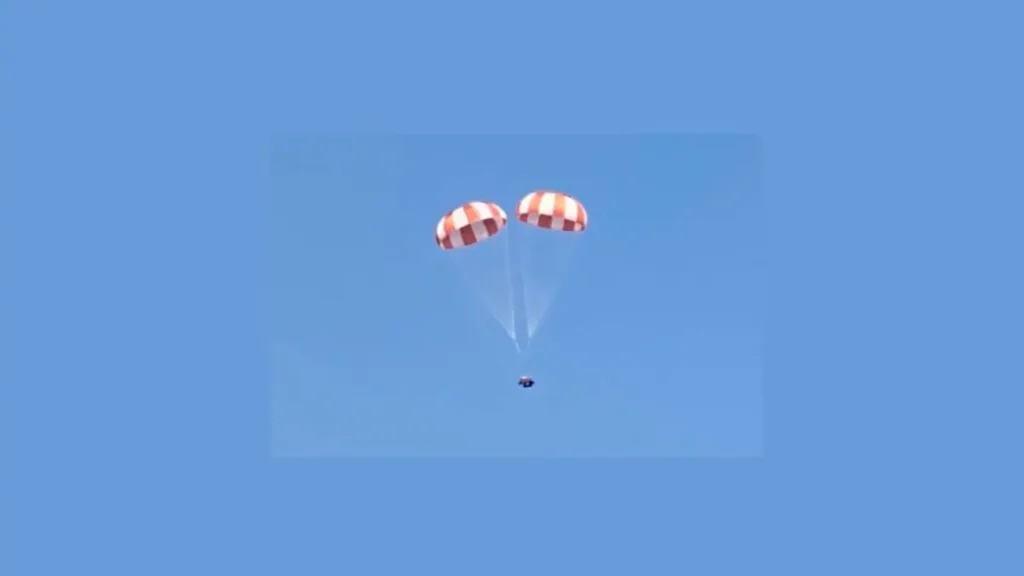
Gaganyaan drogue parachute test 2025 completed successfully by ISRO. Learn about India’s human spaceflight mission, crew module parachute system, and key mission updates.
ISRO Successfully Completes Drogue Parachute Tests for Gaganyaan Crew Module
Overview of the Mission Milestone
The Indian Space Research Organisation (ISRO) has achieved a significant advancement in India’s first human spaceflight mission — Gaganyaan, by successfully completing a series of qualification tests for the drogue parachutes of the crew module. Conducted at the Rail Track Rocket Sled (RTRS) facility of the Terminal Ballistics Research Laboratory (TBRL) in Chandigarh on 18–19 December 2025, these tests simulated real-world, high-speed conditions to assess the performance, stability, and reliability of the drogue parachutes under extreme conditions.
Understanding the Drogue Parachute System
The drogue parachutes are an essential part of the deceleration and recovery system in the Gaganyaan crew module. Positioned as the second stage of parachute deployment after the apex cover separation parachutes, the drogue parachutes serve two primary functions:
- Stabilisation of the capsule during atmospheric re-entry.
- Reduction of velocity to enable safe extraction of further parachutes.
Technical Details of the Tests
India’s crew module deceleration system comprises ten parachutes of four different types, which are deployed sequentially during descent. The sequence includes apex cover separation parachutes, drogue parachutes, pilot parachutes, and main parachutes — all designed to work in an orchestrated manner to ensure a controlled and safe landing. The recent tests rigorously evaluated the drogue parachute deployment reliability under varied simulated speed and aerodynamic stresses.
Collaborative Efforts Behind the Success
The successful completion of the drogue parachute tests was the result of inter-agency collaboration involving:
- ISRO
- Vikram Sarabhai Space Centre (VSSC)
- Defence Research and Development Organisation (DRDO)
- Aerial Delivery Research and Development Establishment (ADRDE)
- Terminal Ballistics Research Laboratory (TBRL)
These organisations collectively validated the parachute systems under rigorous test conditions, further strengthening India’s preparedness for human spaceflight.
Next Steps for Gaganyaan Mission
With another critical test milestone cleared, ISRO advances closer to its goal of launching astronauts to low Earth orbit and safely returning them back to Earth. These parachute qualification tests play a key role in ensuring astronaut safety during mission re-entry, which is a vital requirement before actual human spaceflight can be attempted.

Why This News Is Important for Government Exams
Relevance to National Science & Technology
The successful completion of these parachute tests underscores India’s indigenous capabilities in developing complex systems for human spaceflight. For government exams like UPSC, SSC, PSC, Banking, and Defence posts, understanding this milestone demonstrates the nation’s growing expertise in high-end aerospace and safety-critical technologies.
Integration of Multi-Agency Collaboration
This achievement highlights effective inter-agency collaboration involving ISRO, DRDO, and allied scientific bodies. Exams often ask about scientific governance, institutional partnerships, and technological ecosystems — and the Gaganyaan mission is a prime example.
Boost to India’s Human Spaceflight Ambition
Gaganyaan is India’s first human spaceflight programme, and each milestone — such as the drogue parachute tests — reflects progress toward sending Indian astronauts (Vyomanauts) safely into space. Questions related to space missions, astronaut safety, and spacecraft systems frequently appear in general studies and science & technology sections of competitive exams.
Strategic Importance
The Gaganyaan mission plays a part in strengthening India’s global space standing, reinforcing its capabilities in both civilian and defence spheres. Aspirants preparing for positions in defence services and public administration should be aware of such technological breakthroughs as they reflect national priorities and scientific advancements.
Historical Context: Gaganyaan Mission Background
Genesis of Gaganyaan
The Gaganyaan mission is India’s flagship Human Spaceflight Programme, announced by the Indian government to send Indian astronauts into low Earth orbit (approximately 400 km) and return them safely.
Evolution of Parachute System Testing
To ensure astronaut safety during descent, ISRO has been systematically testing various elements of the parachute deceleration system since 2022. These include:
- Integrated Air Drop Tests (IADT)
- Integrated Main Parachute Airdrop Tests (IMAT)
- Series of qualification tests for drogue and main parachutes
This phased approach is vital to qualify all systems before the human flight.
Collaborative Support
ISRO collaborates with DRDO and multiple defence laboratories to simulate extreme test conditions safely on the ground — a crucial step in validating equipment before actual flight.
Key Takeaways from “ISRO Completes Drogue Parachute Tests for Gaganyaan”
| S.No. | Key Takeaway |
|---|---|
| 1. | ISRO has successfully completed qualification tests for drogue parachutes for the Gaganyaan crew module. |
| 2. | The tests were conducted at the RTRS facility of the Terminal Ballistics Research Laboratory in Chandigarh on December 18–19, 2025. |
| 3. | Drogue parachutes play a crucial role in stabilising the crew module and reducing speed before deployment of main parachutes. |
| 4. | The parachute system consists of ten parachutes of four different types deployed in a specific sequence for safe descent. |
| 5. | This test milestone brings India closer to qualifying the Gaganyaan parachute system for human spaceflight. |
FAQs: Frequently Asked Questions
1. What is the Gaganyaan mission?
The Gaganyaan mission is India’s first human spaceflight program aimed at sending Indian astronauts into low Earth orbit and bringing them back safely.
2. What are drogue parachutes in the Gaganyaan mission?
Drogue parachutes are stabilization and deceleration systems deployed after apex cover separation parachutes to slow down the crew module and stabilize it during descent.
3. Where were the drogue parachute tests conducted?
The tests were conducted at the Rail Track Rocket Sled (RTRS) facility of the Terminal Ballistics Research Laboratory (TBRL) in Chandigarh.
4. How many types of parachutes are used in Gaganyaan’s crew module?
The Gaganyaan parachute system comprises ten parachutes of four different types: apex cover separation, drogue, pilot, and main parachutes.
5. Which organizations collaborated for these parachute tests?
The main collaborating organizations include ISRO, DRDO, VSSC, ADRDE, and TBRL.
6. Why are these parachute tests important?
These tests are critical to validate the safety and reliability of the crew module during re-entry into Earth’s atmosphere, which is essential before human flight.
7. When were these tests conducted?
The drogue parachute tests were successfully conducted on 18–19 December 2025.
8. What is the significance of these tests for India?
These tests demonstrate India’s indigenous capability in human spaceflight technology, strengthening its position in global space missions and advancing astronaut safety.
Some Important Current Affairs Links

