
Fiscal Health Index 2026 by NITI Aayog ranks Indian states on revenue, expenditure, debt, and sustainability. Learn top-performing states and fiscal management insights for exams.
NITI Aayog Releases Fiscal Health Index 2026 to Measure States’ Financial Strength
Introduction to Fiscal Health Index 2026
The National Institution for Transforming India (NITI Aayog) has released the Fiscal Health Index (FHI) 2026, a comprehensive report evaluating the fiscal performance, financial stability, and public finance management of Indian states for the financial year 2023–24. The report, unveiled at a ceremony in New Delhi by senior NITI Aayog officials, expands the scope of last year’s index by including 10 North Eastern and Himalayan States, in addition to the 18 major states evaluated in the previous edition.
What is the Fiscal Health Index?
The Fiscal Health Index (FHI) 2026 is a data‑driven analytical framework designed to assess the financial strength and governance quality of states in India. The index evaluates various aspects of state finances — such as revenue generation, expenditure quality, fiscal discipline, debt levels, and sustainability — to help policymakers, economists, and civil service aspirants understand how well states manage public funds.
Five Pillars of Fiscal Evaluation
The Fiscal Health Index uses five key parameters to assess state finances:
- Quality of Expenditure: Measures how efficiently states allocate and use public funds.
- Revenue Mobilisation: Evaluates the ability to generate tax and non‑tax revenue.
- Fiscal Prudence: Assesses responsible deficit and spending management.
- Debt Index: Tracks the level and structure of government debt.
- Debt Sustainability: Examines a state’s capacity to manage and repay debt over time.
This holistic framework ensures that states are ranked not just on revenue size but on overall fiscal resilience and governance quality.
Key Highlights from the 2026 Rankings
According to the Fiscal Health Index 2026:
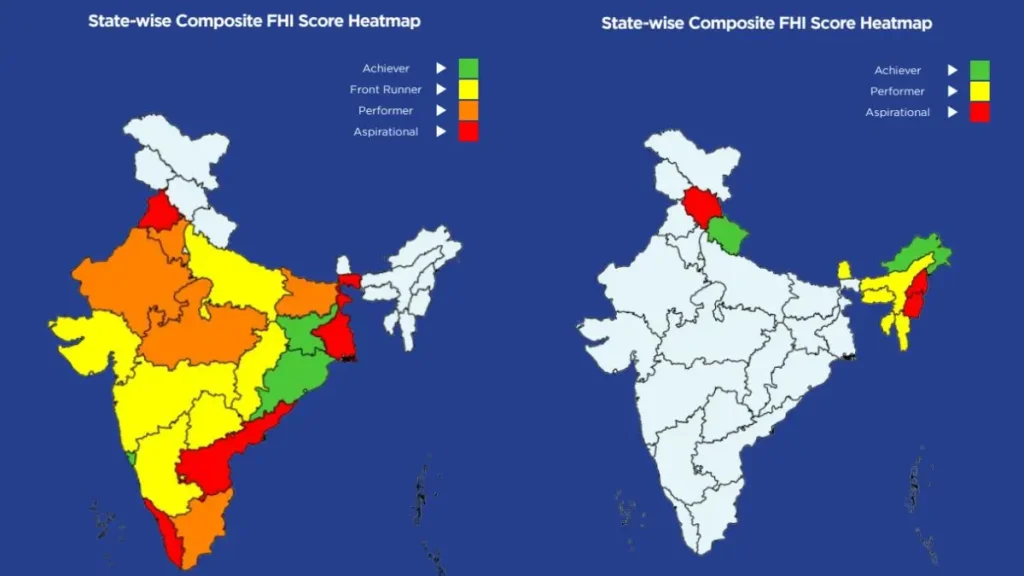
- Odisha emerged as the top‑ranked state, demonstrating strong financial performance and effective budget management.
- Other leading “Achiever” states include Goa and Jharkhand, known for disciplined expenditure and revenue balance.
- States such as Gujarat, Maharashtra, Telangana, Uttar Pradesh and Karnataka featured in the Front‑Runner category, showing stable fiscal performance.
- Madhya Pradesh, Haryana, Bihar, Tamil Nadu, and Rajasthan are categorized as Performers — decent fiscal management but with challenges.
- West Bengal, Kerala, Andhra Pradesh, and Punjab are placed in the Aspirational group, indicating fiscal stress and higher debt levels.
Among the North Eastern and Himalayan states, Arunachal Pradesh topped the rankings, showcasing strengthened expenditure quality and better revenue mobilisation compared to its peers.
Why the Fiscal Health Index Matters
This index plays a critical role in benchmarking state finances, fostering healthy competition among states, and highlighting areas requiring fiscal reforms. It also aids in policy making, budget planning, and monitoring of compliance with fiscal responsibility norms across India.
Impact on India’s Economy and Policy Landscape
With states responsible for crucial public services like education, healthcare, infrastructure, and agriculture, their fiscal performance significantly influences the overall economic stability of the country. A healthy fiscal position enables better funding for development projects and strengthens confidence among investors and international agencies. The FHI helps central and state governments to identify fiscal gaps and work toward sustainable public finance practices.

Why This News is Important
Significance for Competitive Exam Aspirants
The release of the Fiscal Health Index 2026 is a high‑value topic for exams such as UPSC Civil Services, State PSCs, SSC, Banking, Railways, Defence, and Teaching exams because it highlights India’s evolving fiscal governance framework. Questions related to fiscal management benchmarks, state rankings, and financial indicators can appear in various sections such as Economy, Indian Polity, Governance, and General Awareness.
Relevance to Public Policy and Finance
The index provides insights into how states manage revenue, expenditure, debt, and sustainability — core components of public finance syllabus. Understanding these parameters enhances aspirants’ grasp of fiscal federalism in India, the role of planning institutions like NITI Aayog, and implementation of fiscal reforms. Moreover, the inclusion of North Eastern and Himalayan states reflects policy focus on inclusive economic development, a topic relevant to modern Indian governance.
Historical Context
Evolution of the Fiscal Health Index in India
The Fiscal Health Index was first introduced by NITI Aayog in 2025 to provide a comprehensive and comparative assessment of state fiscal conditions. The inaugural report focused on 18 major states, categorising them based on their fiscal performance using a data‑driven composite index. Early editions identified states like Odisha as top performers and highlighted gaps in fiscal management across states.
Fiscal Federalism and Governance
Fiscal federalism in India has undergone significant evolution since economic reforms of the 1990s, when state finances became crucial for funding development projects and public services. Institutions like the Finance Commission and planning bodies such as NITI Aayog have played a vital role in shaping fiscal policy, revenue sharing, and efficient resource allocation among states.
Key Takeaways from Fiscal Health Index 2026
| S. No. | Key Takeaway |
|---|---|
| 1 | NITI Aayog released the Fiscal Health Index (FHI) 2026 to assess state finances comprehensively. |
| 2 | Odisha emerged as the top performing state in fiscal management. |
| 3 | The index evaluates states on five pillars: expenditure quality, revenue mobilisation, fiscal prudence, debt index, and debt sustainability. |
| 4 | States are grouped into Achiever, Front Runner, Performer, and Aspirational categories based on fiscal strength. |
| 5 | The 2026 edition expanded coverage to include North Eastern and Himalayan states for a more inclusive assessment. |
FAQs: Fiscal Health Index 2026
1. What is the Fiscal Health Index 2026?
The Fiscal Health Index (FHI) 2026 is an analytical framework released by NITI Aayog to evaluate the fiscal performance, financial stability, and governance quality of Indian states, including revenue, expenditure, and debt management.
2. Which state topped the Fiscal Health Index 2026?
Odisha secured the top rank in the 2026 FHI, demonstrating strong financial management and efficient utilization of public funds.
3. What parameters are used in the Fiscal Health Index?
The index evaluates states on five parameters:
- Quality of expenditure
- Revenue mobilisation
- Fiscal prudence
- Debt index
- Debt sustainability
4. Why is the Fiscal Health Index important for students preparing for exams?
The FHI provides insights into fiscal governance, public finance management, and state-level economic performance — topics frequently asked in exams like UPSC, SSC, PSC, Banking, Railways, and Defence.
5. Are North Eastern and Himalayan states included in FHI 2026?
Yes, for the first time, all 10 North Eastern and Himalayan states were included in the 2026 FHI to ensure a comprehensive and inclusive assessment.
6. Which states were categorized as “Aspirational” in 2026 FHI?
West Bengal, Kerala, Andhra Pradesh, and Punjab were placed in the Aspirational category, indicating fiscal stress and higher debt challenges.
7. How does the FHI help policymakers?
It identifies fiscal gaps, encourages healthy competition among states, and assists policymakers in implementing reforms for sustainable economic development.
Some Important Current Affairs Links

