
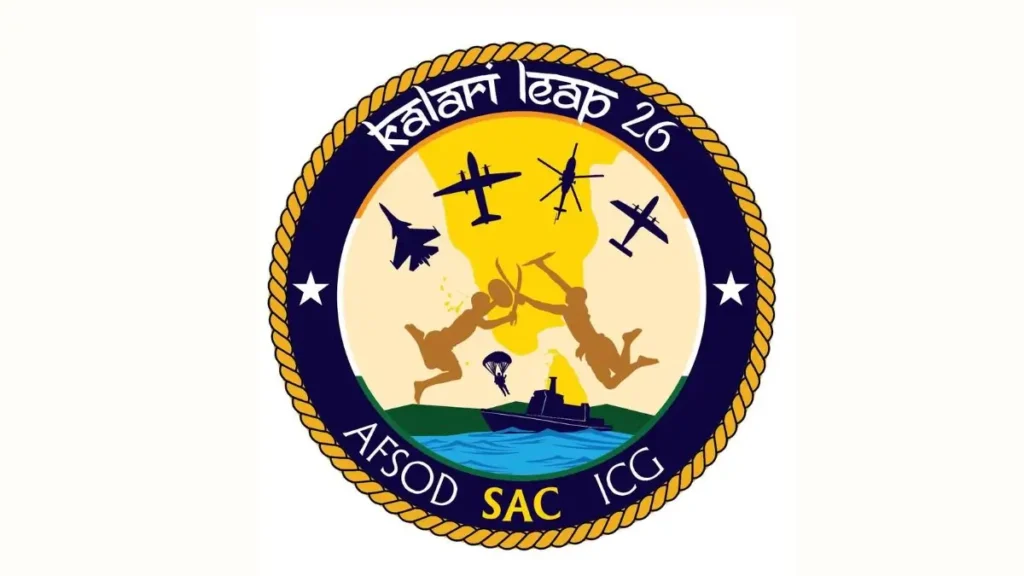
Exercise Kalari Leap 2026 highlights India’s coastal defence preparedness in Lakshadweep with joint operations by the Indian Air Force, Coast Guard, and special forces. Learn key facts, exam relevance, and strategic importance for UPSC, CDS, NDA, SSC, and PSC preparation.
Exercise Kalari Leap: Strengthening India’s Coastal Defence Capabilities
Exercise Kalari Leap was a high-tempo joint maritime exercise conducted by the Southern Air Command of the Indian Air Force (IAF) in the strategically significant Lakshadweep and Minicoy archipelago in the Arabian Sea. The drill was aimed at testing rapid operational deployment, coordinated planning, precision strikes, and multi-agency interoperability in a complex maritime environment — reinforcing India’s preparedness to defend its island territories and key sea routes.
📍 Strategic Importance of Lakshadweep and Minicoy
The Lakshadweep group of islands and Minicoy lie close to major international shipping lanes that connect the Middle East, Africa, and Asia. These sea routes are crucial for global trade and energy supplies. The location’s strategic value means that any threat or disruption here could have serious implications for national security and economic stability. Through Kalari Leap, the Armed Forces validated their capability to respond swiftly to emerging threats across these island territories.
🤝 Integration of Air, Maritime & Special Forces
The exercise was notable for its joint operations involving multiple agencies:
- The Indian Air Force provided aerial assets and executed air operations.
- The Indian Coast Guard contributed ships, Gemini boats, and Dornier 228 surveillance aircraft.
- The Armed Forces Special Operations Division (AFSOD) carried out specialized missions requiring precision and tactical expertise.
This integrated structure enhanced interoperability — a key requirement for modern warfare and coastal defence.
🚀 Core Operational Drills: Anti-Ship Strikes & SAR Missions
Kalari Leap included several important operational simulations:
- Anti-ship strike exercises assessed the ability to neutralize hostile maritime assets.
- Maritime Search and Rescue (SAR) drills validated coordinated humanitarian responses to sea emergencies.
- Rapid force projection ensured quick insertion and response capability in dynamic scenarios.
- Joint planning underlined the importance of seamless cooperation between agencies in island defence missions.
🛡️ Boosting Maritime Security and Defence Readiness
Overall, the exercise proved India’s growing emphasis on integrated maritime security and defence readiness in the Indian Ocean Region (IOR). With evolving geopolitical challenges in the Arabian Sea, exercises like Kalari Leap not only demonstrate operational strength but also serve as a deterrent to potential threats.

📌 Why This News Is Important for Government Exam Aspirants
📘 Relevance to Defence & Security Current Affairs
In government exams like SSC CGL, UPSC Civil Services (IAS/PCS), CAPF, CDS, NDA, and banking exams, questions on India’s defence exercises and maritime security are common. The Kalari Leap exercise highlights important themes such as tri-service integration, coastal defence strategies, maritime surveillance, and joint operational readiness, which help aspirants understand India’s evolving security priorities.
🌍 Understanding Strategic Security Concepts
Modern competitive exams often test dynamic concepts beyond static facts — such as strategic geography, defence cooperation, and national security infrastructure. Kalari Leap provides a real-world application of these themes, illustrating how India projects power in its maritime domain.
🧠 Integration Across Forces
The inclusion of the IAF, Indian Coast Guard, and AFSOD in a single exercise demonstrates the importance of joint force operations in contemporary defence strategy — a topic frequently asked in syllabus like General Studies Paper-3 (UPSC) and current affairs sections of banking and railways exams.
📜 Historical Context: India’s Coastal & Maritime Defence Evolution
India’s maritime security has gained prominence due to its long coastline (over 7,500 km) and its strategic position in the Indian Ocean Region (IOR). Over the years, numerous exercises like TROPEX, Sea Vigil, Malabar, Konkan, and Sagar Kavach have been conducted to enhance inter-agency coordination, coastal defence mechanisms, and operational readiness.
Lakshadweep and Minicoy, due to their location near vital sea lanes, have been a focus of security planning to ensure safe maritime commerce and to deter asymmetric threats such as piracy, smuggling, or hostile intrusions. Exercises like Kalari Leap reflect India’s proactive strategy to fortify its island fronts and maintain stability in the Arabian Sea.
📊 Key Takeaways from “Exercise Kalari Leap Highlights Coastal Defence Strength”
| S.No. | Key Takeaway |
|---|---|
| 1 | Kalari Leap was a joint maritime exercise conducted by the Indian Air Force’s Southern Air Command. |
| 2 | It took place in the Lakshadweep and Minicoy archipelago, key strategic island regions. |
| 3 | The exercise tested rapid force projection, joint planning, and precision operations in maritime conditions. |
| 4 | Multi-agency participation included the IAF, Indian Coast Guard, and AFSOD. |
| 5 | Key drills involved anti-ship strike simulations and maritime search and rescue operations. |
Frequently Asked Questions (FAQs)
1. What is Exercise Kalari Leap?
Exercise Kalari Leap is a joint maritime defence exercise conducted by the Indian Air Force under the Southern Air Command to enhance coastal security and rapid deployment capabilities in island territories.
2. Where was Exercise Kalari Leap conducted?
The exercise was conducted in the Lakshadweep and Minicoy island region in the Arabian Sea, a strategically important maritime zone.
3. Which forces participated in Exercise Kalari Leap?
The exercise involved the Indian Air Force, Indian Coast Guard, and the Armed Forces Special Operations Division (AFSOD), demonstrating joint operational capability.
4. What was the main objective of the exercise?
The main objective was to test rapid force projection, anti-ship strike capabilities, maritime search and rescue (SAR) operations, and multi-agency coordination in island defence scenarios.
5. Why is Lakshadweep strategically important for India?
Lakshadweep lies near key international shipping lanes in the Arabian Sea, making it crucial for maritime trade security, energy routes, and strategic surveillance.
6. What is meant by rapid force projection?
Rapid force projection refers to the capability of deploying military assets quickly to strategic locations to respond to threats.
7. What types of operations were simulated during the exercise?
The drill included anti-ship strike simulations, aerial surveillance, special operations missions, and search and rescue operations.
8. How is this exercise relevant for UPSC and other government exams?
Questions related to defence exercises, maritime security, island territories, and joint commands frequently appear in UPSC GS Paper-III, CDS, NDA, CAPF, SSC, Railways, and State PSC exams.
9. What is the importance of jointness in modern warfare?
Jointness ensures seamless coordination between air, naval, and land forces, enhancing operational efficiency and national security preparedness.
10. How does Exercise Kalari Leap strengthen India’s maritime doctrine?
It reinforces India’s focus on island security, maritime domain awareness, and deterrence in the Indian Ocean Region (IOR).
Some Important Current Affairs Links

