
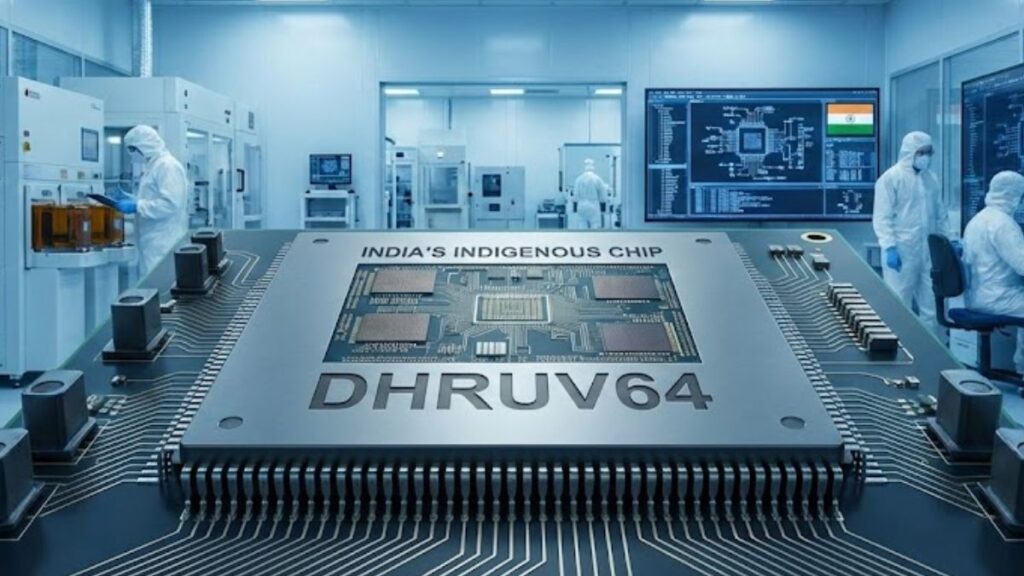
DHRUV64 Indigenous Microprocessor India Launch: Learn about India’s first 1.0 GHz 64-bit dual-core chip, its RISC-V architecture, applications in 5G, IoT, and industrial automation, and government initiatives.
India Launches Its First 1.0 GHz, 64-Bit Dual-Core Indigenous Microprocessor DHRUV64
Introduction to DHRUV64 — A Technological Breakthrough
India has achieved a major milestone in its technology landscape with the launch of the DHRUV64, the country’s first fully indigenous 1.0 GHz, 64-bit dual-core microprocessor. Developed by the Centre for Development of Advanced Computing (C-DAC) under the Microprocessor Development Programme (MDP) of the Ministry of Electronics and Information Technology (MeitY), this chip marks a significant stride in India’s journey toward technological self-reliance and semiconductor capability.
What Is DHRUV64 and Its Key Features
DHRUV64 is designed as a 64-bit, dual-core processor with a clock speed of 1.0 GHz, developed using the RISC-V open-source architecture. This architecture allows developers to design and customize hardware without the burden of expensive licensing fees associated with proprietary designs like ARM or x86
The microprocessor also supports superscalar and out-of-order execution, enabling the chip to issue and execute multiple instructions efficiently, improving overall performance. Built on a 28 nm process node, it provides a stable and reliable platform suitable for real-world embedded computing.
Strategic Importance of Indigenous Chip Design
Traditionally, India has relied heavily on imported processors; nearly 20% of global microprocessor consumption happens domestically but most chips are foreign-designed. The launch of DHRUV64 marks a foundational move toward reducing this dependency and strengthening India’s sovereign control over critical semiconductor technologies.
Potential Applications Across Sectors
Though not designed to compete with high-end desktop or mobile processors, DHRUV64 is targeted for strategic, industrial, and commercial applications. These include:
- 5G network infrastructure
- Automotive electronics
- Consumer electronics
- Industrial automation
- Internet of Things (IoT) systems
Such application areas underline how the processor can enhance India’s capacity in sectors crucial for digital transformation and infrastructure growth.
Support from National Initiatives
The DHRUV64 project is supported under several government initiatives aimed at empowering domestic semiconductor design and innovation:
- Digital India RISC-V (DIR-V) Programme
- Chips to Startup (C2S)
- India Semiconductor Mission (ISM)
- Design Linked Incentive (DLI)
- Indian Nanoelectronics Users Programme (INUP-i2i)
These programs collectively build a strong foundation for semiconductor research, development, and commercialization in India.
Conclusion: A Step Toward Atmanirbhar Bharat in Semiconductors
The unveiling of DHRUV64 is not just a technical accomplishment but a strategic move toward realizing Atmanirbhar Bharat (self-reliant India). By creating a domestic microprocessor ecosystem, India is paving the way for future innovations, reducing foreign dependency, and strengthening national security through technological autonomy.

🧠 Why This News Is Important for Exam Aspirants
Boost to Technological Self-Reliance
India’s unveiling of the DHRUV64 microprocessor signifies a major leap forward in reducing dependency on foreign designed chips. Until now, most processors used in Indian technology systems were imported or designed abroad. With DHRUV64, India moves toward creating a robust indigenous semiconductor ecosystem, which has strong implications for national security and technological prowess.
Application Across Key Sectors
The processor isn’t just a symbol; it has real strategic and commercial applications — from 5G networks to industrial automation, IoT devices, and automotive systems. For government exams that focus on science & technology, economics, and innovation, knowing these real-life impacts helps in answering questions related to digital infrastructure and indigenous manufacturing.
Government Initiatives and Schemes
DHRUV64 sits at the heart of multiple government initiatives such as Digital India RISC-V, India Semiconductor Mission, and Chips to Startup. Understanding these schemes gives candidates insight into India’s policy framework for technological growth — a key area often tested in PSC, UPSC, SSC, banking, and other competitive exams.
Relevance to Current Affairs and Policy
Semiconductor design and manufacturing have international strategic relevance, especially given global chip shortages and supply-chain issues in recent years. India’s move adds context to how nations are prioritizing self-sufficiency in technology. This can be connected with UPSC GS Paper III topics such as Technology, Security, and Economic Development.
Exam Keywords and Concepts
For competitive exams, this topic links with key phrases such as:
- Indigenous microprocessor development
- RISC-V architecture
- Digital India initiatives
- Atmanirbhar Bharat in technology
Knowing these terms enhances candidates’ ability to write high-scoring answers in exams like UPSC CSE, SSC CGL, State PSCs, banking, and defence services.
📜 Historical Context
Early Efforts in Indigenous Chip Design
India’s journey into semiconductor design began years ago with academic and research institutions such as IIT Madras (SHAKTI) and IIT Bombay (AJIT) working on prototype processors. These early efforts laid the foundation for more advanced projects in microprocessor technology.
National Policy Initiatives
The Government of India has progressively launched policies to promote semiconductor manufacturing and design within the country. Key among them is the Microprocessor Development Programme (MDP) under MeitY, which provides strategic focus and funding for homegrown processor development.
Rise of RISC-V and Open Source Architecture
The adoption of the RISC-V open-source hardware architecture is a strategic choice. Unlike other architectures requiring licensing fees, RISC-V allows Indian designers to innovate without financial barriers — a key step in democratizing chip design and boosting self-reliance in semiconductors.
Earlier Indian Microprocessors
Before DHRUV64, processors like THEJAS32 and THEJAS64 were developed as part of the Digital India RISC-V programme. These earlier processors helped build design expertise and set the stage for DHRUV64.
📊 Key Takeaways from India Launches DHRUV64
| S.No. | Key Takeaway |
|---|---|
| 1 | DHRUV64 is India’s first fully indigenous 1.0 GHz, 64-bit dual-core microprocessor. |
| 2 | It was developed by C-DAC under the Microprocessor Development Programme (MDP) of MeitY. |
| 3 | The processor uses RISC-V open-source architecture, eliminating licensing fees. |
| 4 | It supports applications in 5G, automotive systems, industrial automation, consumer electronics & IoT. |
| 5 | The launch advances India’s goal of tech self-reliance and strengthens the domestic semiconductor ecosystem. |
FAQs on India’s DHRUV64 Indigenous Microprocessor
1. What is DHRUV64?
DHRUV64 is India’s first 1.0 GHz, 64-bit dual-core indigenous microprocessor developed by C-DAC under MeitY’s Microprocessor Development Programme (MDP). It is based on RISC-V open-source architecture.
2. Which organization developed DHRUV64?
The Centre for Development of Advanced Computing (C-DAC) developed DHRUV64 under the Ministry of Electronics and Information Technology (MeitY).
3. What architecture does DHRUV64 use?
It uses the RISC-V open-source architecture, which allows customization without expensive licensing fees, supporting India’s goal of self-reliance in semiconductor design.
4. What are the key applications of DHRUV64?
DHRUV64 is designed for applications in 5G infrastructure, industrial automation, automotive electronics, IoT systems, and consumer electronics.
5. Why is DHRUV64 important for India?
It strengthens India’s indigenous semiconductor ecosystem, reduces reliance on imported chips, and aligns with the Atmanirbhar Bharat initiative in technology.
6. Which government programs support the DHRUV64 project?
It is supported under programs like Digital India RISC-V, Chips to Startup, India Semiconductor Mission, Design Linked Incentive (DLI), and INUP-i2i.
7. What is the process node used in DHRUV64?
The microprocessor is built on a 28nm process node, making it suitable for embedded computing and industrial applications.
8. How does DHRUV64 enhance national security?
By creating domestic microprocessor capability, India reduces dependence on foreign chips for strategic and defense applications.
9. How does DHRUV64 compare with previous Indian processors?
Earlier processors like THEJAS32 and THEJAS64 laid the foundation, but DHRUV64 is India’s first dual-core 64-bit processor with real-world application potential.
10. What is the significance of RISC-V in DHRUV64?
RISC-V provides open-source hardware design, encouraging innovation, customization, and cost-effective semiconductor development.
Some Important Current Affairs Links

