
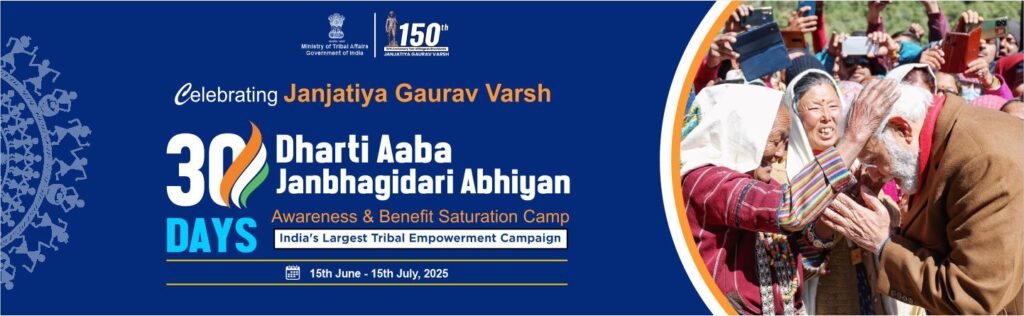
Dharti Aaba Janbhagidari Abhiyan 2025, India’s biggest tribal empowerment campaign, covers over 1 lakh villages, delivering Aadhaar, Ayushman Bharat, PM-Kisan, and more to tribal communities.
Dharti Aaba Janbhagidari Abhiyan – India’s Largest Tribal Empowerment Movement
Nationwide Campaign for Tribal Inclusion
On June 15, 2025, the Ministry of Tribal Affairs launched the Dharti Aaba Janbhagidari Abhiyan (DAJA) — touted as India’s largest-ever tribal empowerment initiative. Spanning until June 30, the campaign is part of the Janjatiya Gaurav Varsh (Nov 15, 2024 – Nov 15, 2025), meant to honor tribal pride and identity at the centenary of Bhagwan Birsa Munda’s legacy It is outreach-oriented, with a camp-based and community-led approach, focused on saturating remote villages with welfare schemes and services.
Scope & Scale of the Outreach
This ambitious drive is set to cover over 1 lakh tribal villages, including 549 tribal districts and 207 Particularly Vulnerable Tribal Group (PVTG) habitations across all 31 states and UTs In just the first nine days, 22,000+ empowerment camps were organized, reaching nearly 53 lakh tribal beneficiaries offering key public welfare schemes at their doorstep.
Services Delivered & Entitlements Covered
The DAJA camps aimed at full saturation of central schemes — including Aadhaar, Ayushman Bharat health cards, PM-Kisan, PM Ujjwala, PM Jan Dhan, scholarships, pensions, insurance, legal aid, forest rights, and livelihood training By day nine, the campaign facilitated:
- ~1.38 lakh Aadhaar enrollments 📌
- ~1.68 lakh Ayushman Bharat card issuance
- ~46,000 PM-Kisan registrations
- ~22,000 PM Ujjwala connects
- ~32,000 PM Jan Dhan accounts opened
Five Core Pillars of DAJA
- Janbhagidari – Direct community participation
- Saturation – All eligible households covered
- Cultural Inclusion – Preserving tribal languages, arts
- Convergence – Coordinated delivery by ministries, CSOs, youth
These pillars emphasize systemic inclusion with cultural dignity and grassroots empowerment.
Community Engagement & Cultural Pride
DAJA mobilizes youth volunteers, NSS, MY Bharat, civil society and tribal leaders under PM-JANMAN and Dharti Aaba Janjatiya Gram Utkarsh Abhiyan (DAJGUA) Cultural events like folk dances, art displays, and festivals celebrate tribal heritage alongside scheme delivery ― honoring Birsa Munda, affectionately called “Dharti Aaba” (“Father of the Earth”)
Implementation & District-Level Drives
For instance, East Singhbhum in Jharkhand launched over 275 camps across 231 panchayats from June 15 to 30, targeting unregistered tribal beneficiaries for 35+ central & state schemes, supported by “awareness chariots” to boost camp participation Active involvement from district officials ensures real-time enrollments and registrations.
Vision & Alignment with Government Goals
DAJA echoes the “Sabka Saath, Sabka Vikas, Sabka Vishwas, Sabka Prayas” mantra. It is a flagship step toward Antyodaya, wealth and dignity for tribal India, fully aligned with the goal of a Viksit Bharat by 2047
2. Why This News Is Important
Enhances Exam-Relevant Understanding
For candidates preparing for civil services, banking, railways, police, defence, or teacher recruitment, DAJA is a landmark current affairs topic in General Studies – Social Justice & Governance. Its scale, timeline, objectives, and holistic model will likely feature in prelims and mains.
Demonstrates Government Focus on Tribal Welfare
Understanding this initiative illustrates how public policy targets tribal inclusion, last-mile service delivery, and cultural empowerment. These align with constitutional provisions, welfare frameworks like PVTG priorities, and schemes such as PM-JANMAN and DAJGUA.
Analytical Edge in Answers
Candidates can critically analyze the DAJA model—especially its camp-based saturation, grassroots participation, cultural integration, and inter-ministerial convergence—to craft balanced responses. The campaign offers rich material for GS questions, essay topics on social inclusion, and evaluative insights.
3. Historical Context & Background
Evolution of Tribal Empowerment in India
Post-independence, India’s tribal inclusion has progressed from constitutional safeguards to community development schemes like EMRS, Van Dhan Kendras, and PM‑Aadi Adarsh Gram Yojana. The PVTG-focused PM-JANMAN (2023) and DAJGUA (Oct 2024) mark major recent investments
Significance of Birsa Munda & Janjatiya Gaurav Varsh
Birsa Munda, revered as “Dharti Aaba,” symbolizes tribal pride and resistance. His birth anniversary (Nov 15) was declared Janjatiya Gaurav Divas (2021), and Janjatiya Gaurav Varsh (Nov 15, 2024–Nov 15, 2025) is a year-long celebration underscoring tribal identity
Shift to Saturation-Based Model
Earlier welfare efforts often suffered from low penetration. DAJA’s camp-based saturation drive with real-time registrations marks a paradigm shift—a bold approach to ensure universal coverage and empower the last mile.
4. Key Takeaways from Dharti Aaba Janbhagidari Abhiyan
| # | Key Takeaway |
|---|---|
| 1 | DAJA launched: June 15–30, 2025, covering 1 lakh+ tribal villages in 31 states/UTs. |
| 2 | Scope: Includes all 549 tribal districts and 207 PVTG habitations. |
| 3 | First 9 days: 22,000+ camps reached 53 lakh tribals. |
| 4 | Major services: Aadhaar, Ayushman Bharat, PM‑Kisan, Ujjwala, Jan Dhan, pensions, scholarships. |
| 5 | Five pillars: Janbhagidari, Saturation, Cultural Inclusion, Convergence, Last‑Mile Delivery. |
FAQs: Frequently Asked Questions
1. What is the Dharti Aaba Janbhagidari Abhiyan (DAJA)?
It is India’s largest-ever tribal empowerment campaign launched by the Ministry of Tribal Affairs, aimed at ensuring saturation of welfare schemes in tribal areas between June 15 and June 30, 2025.
2. Why is it called “Dharti Aaba”?
“Dharti Aaba” refers to Birsa Munda, a revered tribal freedom fighter and social reformer, who is a symbol of tribal pride and resistance.
3. What are the five pillars of the DAJA campaign?
The five core pillars are: Janbhagidari (public participation), Saturation, Cultural Inclusion, Convergence of departments, and Last-Mile Delivery.
4. How many tribal districts and villages are covered?
The campaign spans 1 lakh tribal villages, 549 tribal districts, and 207 PVTG habitations across 31 states and UTs.
5. Which schemes were included in the DAJA campaign?
The campaign facilitated key schemes like Aadhaar, Ayushman Bharat, PM-Kisan, PM Ujjwala, Jan Dhan, scholarships, pensions, insurance, forest rights, and livelihood opportunities.
6. What is the Janjatiya Gaurav Varsh?
It is a year-long celebration (Nov 15, 2024 – Nov 15, 2025) to honor tribal culture and history, especially marking the 100th year of Birsa Munda’s legacy.
7. Which state or district has shown notable implementation?
East Singhbhum, Jharkhand, launched 275+ empowerment camps across 231 panchayats as part of the DAJA outreach.
Some Important Current Affairs Links

