
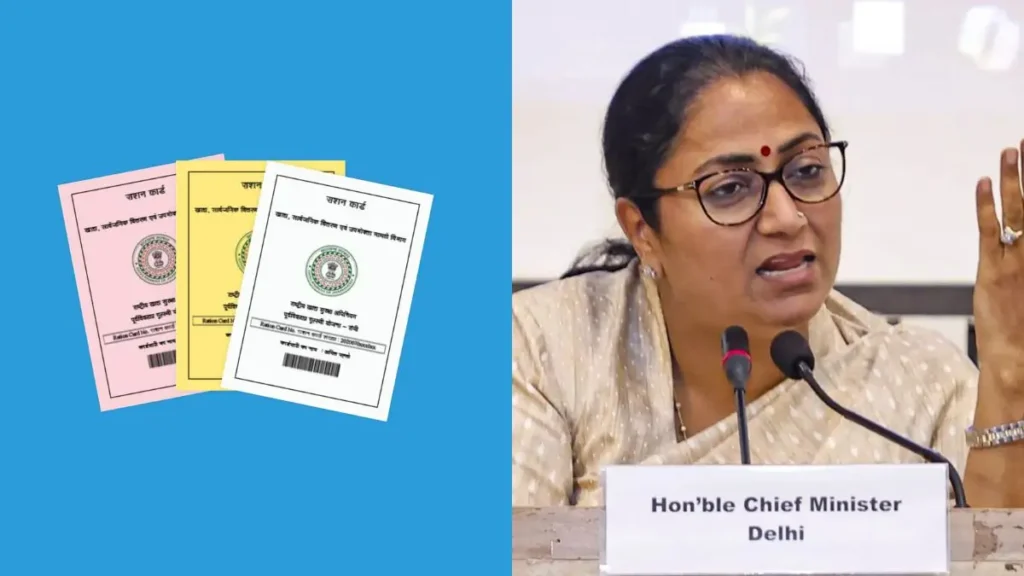
Delhi ration card reform 2026 brings a higher income eligibility limit of ₹2.5 lakh, cancellation of fake ration cards, and major Public Distribution System reforms important for UPSC, SSC, Banking, Railways, Defence, and State PCS exams.
Introduction to the New Reform
The Government of Delhi has announced a major reform in the ration card system by proposing an increase in the annual income eligibility limit from ₹1.2 lakh to ₹2.5 lakh. The move aims to expand the benefits of subsidised food grains to a larger section of economically weaker and lower middle-class families living in the national capital.
The announcement was made by Delhi Chief Minister Rekha Gupta during a press conference where the government also revealed that more than 7.72 lakh ration cards had been cancelled after an extensive audit process.
Objective Behind the Policy Change
The reform has been introduced to ensure that deserving families affected by inflation and rising living costs are not excluded from welfare schemes. Many households in urban areas struggle with food expenses despite earning slightly above the earlier income threshold. By increasing the limit to ₹2.5 lakh annually, the government intends to provide food security to a broader population.
The decision is expected to strengthen the implementation of the Public Distribution System (PDS), which distributes subsidised food grains under the provisions of the National Food Security Act.
Large-Scale Audit and Cancellation of Cards
Alongside the proposed expansion, the Delhi government carried out a verification drive to remove ineligible beneficiaries from the ration card database. According to official data, around 7.72 lakh ration cards were identified as invalid and subsequently cancelled.
The audit found several irregularities, including:
- Beneficiaries exceeding income limits
- Duplicate ration cards
- Deceased individuals listed as beneficiaries
- Families not collecting ration for a long period
Officials stated that approximately 1.44 lakh beneficiaries were removed because they no longer met the income criteria, while thousands of duplicate and inactive records were also eliminated.
Resumption of New Ration Card Issuance
An important aspect of the reform is the reopening of applications for new ration cards. Reports indicate that no new ration cards had been issued in Delhi for nearly 13 years. The government has now restarted the process through the e-District online portal.
Citizens can apply online for:
- New ration cards
- Addition of family members
- Correction of existing information
The digitalisation of the process is intended to improve transparency and reduce corruption.
New Eligibility and Exclusion Rules
The Delhi government has also introduced stricter eligibility norms to prevent misuse of welfare schemes. Under the revised rules, several categories of individuals will remain ineligible for ration cards. These include:
- Income-tax payers
- Government employees
- Owners of four-wheelers
- Residents of A to E category colonies
- Households with electricity consumption above prescribed limits
Additionally, Aadhaar details for all family members have been made mandatory.
Impact on Public Welfare
The proposed reform is expected to significantly improve food security in Delhi. With inflation affecting urban households, subsidised food support can reduce the financial burden on low-income families. Experts believe that widening eligibility while simultaneously removing fake beneficiaries can make welfare delivery more efficient.
The reform also highlights the growing importance of technology-based governance in India. Online applications, digital verification, Aadhaar linkage, and transparent grievance systems are increasingly becoming part of welfare administration across states.

Why This News is Important
Importance for Government Exam Preparation
This development is important for aspirants preparing for competitive examinations such as UPSC, SSC, Banking, Railways, State PCS, Defence, and Teaching examinations because it relates to governance, welfare schemes, social justice, and food security policies.
Questions related to the Public Distribution System, welfare reforms, poverty alleviation, and implementation of the National Food Security Act are frequently asked in current affairs sections of examinations. Candidates are expected to understand how governments use policy measures to improve access to essential services.
Significance in Social Welfare Administration
The reform demonstrates how state governments are attempting to balance welfare expansion with transparency and accountability. While the increase in income limit aims to include more deserving beneficiaries, the cancellation of fake or inactive ration cards shows efforts to reduce leakages in welfare schemes.
The move is also important because it reflects the broader trend of digitisation in public administration. Online applications, Aadhaar verification, and digital grievance systems are becoming key tools in improving governance efficiency in India.
Economic and Political Relevance
The reform comes at a time when inflation and rising living costs are affecting urban populations. Food subsidy schemes play an important role in protecting vulnerable sections of society from economic hardship.
Politically, welfare reforms related to food security often influence public opinion and governance models. Therefore, such developments are highly relevant for current affairs and public policy discussions.
Historical Context
Evolution of the Public Distribution System in India
India’s Public Distribution System (PDS) was introduced to ensure food security for economically weaker sections of society. Over time, the system evolved into one of the world’s largest food subsidy programmes. Under the PDS, eligible households receive food grains such as rice, wheat, and sugar at subsidised rates.
The system became more structured after the implementation of the National Food Security Act in 2013, which legally entitled eligible families to receive subsidised food grains. The Act aimed to cover nearly two-thirds of India’s population.
Delhi’s Earlier Food Security Reforms
Earlier in 2026, the Delhi government introduced the Delhi Food Security Rules, which increased the annual income eligibility limit from ₹1 lakh to ₹1.2 lakh. The rules also introduced online-only applications, Aadhaar-based verification, and stronger screening mechanisms.
The latest proposal to raise the limit further to ₹2.5 lakh represents a significant expansion of the welfare framework in the national capital.
Digital Governance and Welfare Delivery
In recent years, governments across India have increasingly relied on technology to improve welfare delivery systems. Aadhaar linkage, Direct Benefit Transfer (DBT), biometric authentication, and online grievance systems are examples of digital governance reforms aimed at reducing corruption and improving transparency.
Delhi’s latest ration card reform is part of this broader transformation in India’s welfare administration system.
Key Takeaways from This News
| S.No. | Key Takeaway |
|---|---|
| 1 | Delhi plans to increase ration card income eligibility from ₹1.2 lakh to ₹2.5 lakh annually. |
| 2 | Around 7.72 lakh invalid ration cards were cancelled after a large-scale audit. |
| 3 | New ration card applications have resumed through the online e-District portal after nearly 13 years. |
| 4 | Aadhaar linkage and digital-only applications have been made mandatory for transparency. |
| 5 | The reform aims to improve food security while reducing leakages in the Public Distribution System (PDS). |
FAQs Related to Delhi Ration Card Reform
1. What is the new income limit proposed for ration card eligibility in Delhi?
The Delhi government has proposed increasing the annual income eligibility limit for ration cards from ₹1.2 lakh to ₹2.5 lakh.
2. Why has the Delhi government increased the income limit?
The increase aims to include more economically weaker and lower middle-class families affected by rising inflation and living costs.
3. What is the Public Distribution System (PDS)?
The Public Distribution System is a government welfare scheme that provides subsidised food grains such as wheat, rice, and sugar to eligible citizens.
4. Which law governs food security in India?
Food security in India is mainly governed by the National Food Security Act (NFSA), 2013.
5. How many ration cards were cancelled in Delhi after the audit?
Around 7.72 lakh ration cards were cancelled after verification due to duplicate, inactive, or ineligible records.
6. What are the major reasons for cancellation of ration cards?
The main reasons include:
- Duplicate ration cards
- Income above eligibility limit
- Death of beneficiaries
- Long-term inactivity in ration collection
7. What is Aadhaar’s role in the new ration card reform?
Aadhaar linkage has been made mandatory for verification and to reduce fraud in welfare distribution.
8. Can new ration cards now be issued in Delhi?
Yes, the Delhi government has restarted issuing new ration cards through the online e-District portal after nearly 13 years.
9. Which categories of people are excluded from ration card eligibility?
The following are generally excluded:
- Income-tax payers
- Government employees
- Four-wheeler owners
- Families living in certain high-income colonies
10. Why is this topic important for competitive examinations?
The topic is important because it is related to:
National Food Security Act
Social welfare schemes
Governance reforms
Food security
Public administration
Digital governance
Some Important Current Affairs Links

