
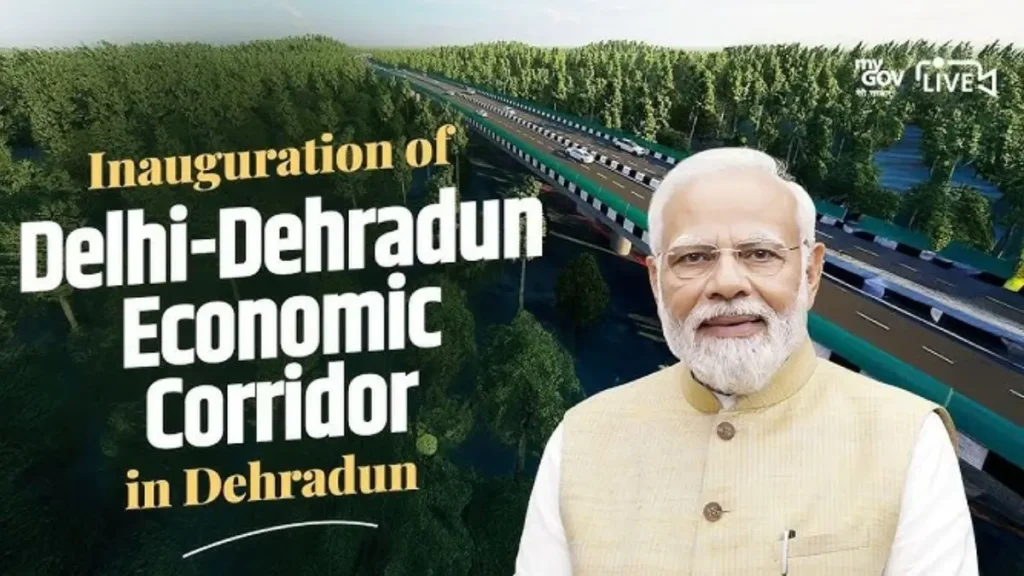
Delhi Dehradun Economic Corridor 2026 inaugurated by Narendra Modi reduces travel time to 2.5 hours, boosts tourism, economy, and regional connectivity.
Delhi–Dehradun Economic Corridor Inaugurated: A New Era for Regional Connectivity
Introduction: Landmark Infrastructure Boost by Narendra Modi
Prime Minister Narendra Modi inaugurated the Delhi–Dehradun Economic Corridor on April 14, 2026, marking a significant milestone in India’s infrastructure development. The corridor is designed to strengthen connectivity between the national capital and Uttarakhand, fostering economic growth, tourism, and regional integration.
Project Overview and Key Features
The Delhi–Dehradun Economic Corridor is a 213-kilometre-long, six-lane access-controlled expressway constructed at an estimated cost of over ₹12,000 crore. It passes through Delhi, Uttar Pradesh, and Uttarakhand, connecting major towns like Baghpat, Shamli, and Saharanpur.
One of its most notable features is the reduction in travel time between Delhi and Dehradun from nearly 6 hours to just about 2.5 hours, making travel faster and more efficient.
Environmental Sustainability and Wildlife Protection
A key highlight of this project is its eco-friendly design. The corridor includes a 12-kilometre-long elevated wildlife corridor, one of the longest in Asia, built across the Rajaji National Park region.
This infrastructure ensures safe passage for wildlife such as elephants and other species, minimizing human-animal conflict and preserving biodiversity.
Economic and Regional Development Impact
The expressway is expected to significantly boost regional economic development. Improved connectivity will promote:
- Tourism in Uttarakhand
- Trade and logistics efficiency
- Real estate growth along the corridor
Intermediate regions like western Uttar Pradesh are expected to witness increased investment and infrastructure expansion.
Integration with National Infrastructure Network
The corridor integrates with major expressways such as:
- Delhi–Mumbai Expressway
- Delhi–Meerut Expressway
- Delhi–Katra Expressway
This integration enhances India’s overall logistics network, supporting faster movement of goods and passengers.
Challenges and Ongoing Issues
Despite its inauguration, certain sections of the corridor are not fully operational due to land acquisition disputes. A notable issue involves a property in Uttar Pradesh delaying the construction of a critical exit ramp.
This highlights the complexities of infrastructure development in densely populated regions.

Why This News is Important
Boost to Infrastructure Development
The Delhi–Dehradun Economic Corridor represents India’s commitment to building world-class infrastructure. Such projects are crucial for achieving faster economic growth and improving connectivity between regions.
Impact on Economy and Employment
The corridor will generate employment opportunities during and after construction. It will also improve logistics efficiency, reducing transportation costs and boosting trade.
Strategic Importance for Tourism
Uttarakhand is a major tourist and pilgrimage destination, including Char Dham sites. Improved connectivity will enhance tourism, contributing significantly to the local economy.
Environmental Significance
The inclusion of a wildlife corridor sets an example of sustainable infrastructure development, balancing growth with ecological conservation.
Relevance for Competitive Exams
Questions related to infrastructure projects, government initiatives, and economic corridors are frequently asked in exams like UPSC, SSC, Banking, and State PSCs.
Historical Context: Evolution of Expressway Development in India
Growth of Highway Infrastructure
India’s expressway development gained momentum with initiatives like the Golden Quadrilateral Project in the early 2000s. Since then, the government has focused on building high-speed corridors.
Policy Push in Recent Years
Programs such as Bharatmala Pariyojana have accelerated the development of economic corridors to improve logistics efficiency and connectivity.
Previous Major Expressways
Projects like the Delhi–Mumbai Expressway and Purvanchal Expressway have set benchmarks for modern highway construction in India.
Shift Towards Sustainable Infrastructure
Recent projects increasingly incorporate eco-friendly features like wildlife crossings, reflecting a shift towards sustainable development.
Key Takeaways from Delhi–Dehradun Economic Corridor News
| S.No. | Key Takeaway |
|---|---|
| 1 | Inaugurated on April 14, 2026 by PM Narendra Modi |
| 2 | 213 km long, six-lane access-controlled expressway |
| 3 | Travel time reduced from ~6 hours to 2.5 hours |
| 4 | Includes a 12 km elevated wildlife corridor for ecological protection |
| 5 | Expected to boost tourism, trade, and regional development |
FAQs: Delhi–Dehradun Economic Corridor
1. What is the Delhi–Dehradun Economic Corridor?
It is a 213 km long, six-lane access-controlled expressway connecting Delhi to Dehradun, aimed at improving connectivity and boosting regional development.
2. Who inaugurated the Delhi–Dehradun Economic Corridor?
The corridor was inaugurated by Narendra Modi on April 14, 2026.
3. What is the total cost of the project?
The project has been developed at an estimated cost of over ₹12,000 crore.
4. How much travel time is reduced due to this corridor?
Travel time between Delhi and Dehradun has been reduced from around 6 hours to approximately 2.5 hours.
5. Which states does the corridor pass through?
The corridor passes through Delhi, Uttar Pradesh, and Uttarakhand.
6. What is the significance of the wildlife corridor in this project?
A 12 km elevated wildlife corridor has been constructed to allow safe movement of animals and reduce human-wildlife conflict.
7. Which national park is associated with this corridor?
The corridor passes near Rajaji National Park, where wildlife protection measures have been implemented.
8. How will the corridor benefit the economy?
It will enhance trade, improve logistics efficiency, boost tourism, and attract investments in nearby regions.
9. Under which government initiative does this project fall?
It aligns with the broader infrastructure push under the Bharatmala Pariyojana.
10. Why is this project important for competitive exams?
It is relevant for questions on infrastructure, economic corridors, government schemes, and sustainable development.
Some Important Current Affairs Links

