
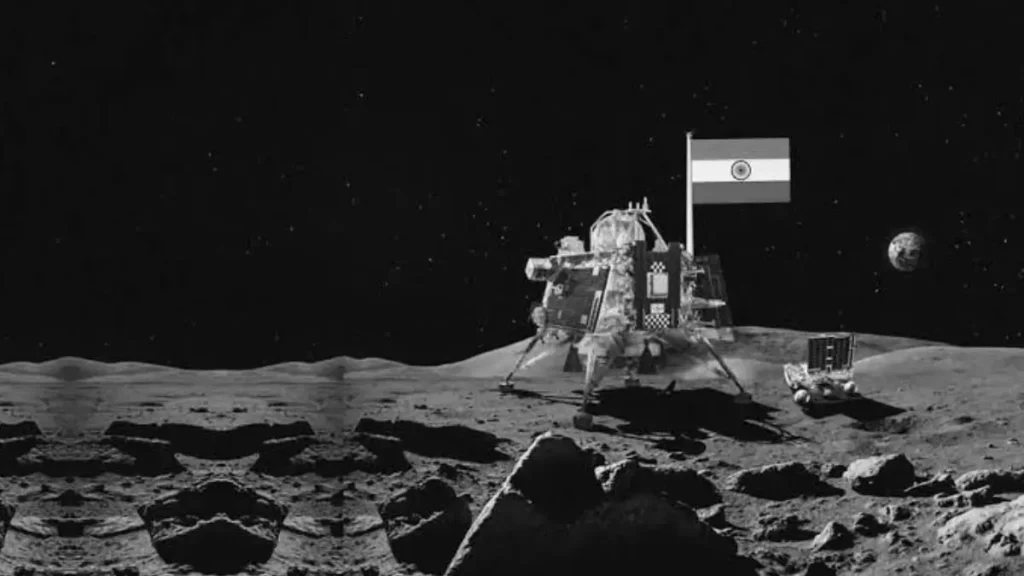
Chandrayaan 4 landing site details and ISRO lunar sample mission explained for competitive exams, covering Moon south pole exploration and key facts students must know.
ISRO Selects Landing Site for Chandrayaan-4 Mission: A Giant Leap in India’s Lunar Exploration
The Indian Space Research Organisation (ISRO) has officially identified a landing site near the Moon’s South Pole for its highly anticipated Chandrayaan-4 mission. The decision marks a key milestone in India’s space exploration journey as the nation prepares for its first ever lunar sample-return mission. This complex mission is expected to launch around 2028 and will build on the remarkable success of previous missions such as Chandrayaan-1, Chandrayaan-2 and the historic soft landing of Chandrayaan-3.
Why Mons Mouton Is the Chosen Site
After evaluating multiple candidate regions, ISRO scientists selected a specific area known as MM-4 in the Mons Mouton region for the Chandrayaan-4 landing. Mons Mouton lies in the Moon’s South Polar region, a location considered highly valuable for scientific research due to its rugged terrain, potential water-ice presence, and unique geological characteristics. The site was chosen following extensive analysis of satellite imagery and surface hazards to ensure a safer and more precise soft landing.
The chosen landing area measures approximately 1 km × 1 km with a mean slope of about 5 degrees — relatively gentle compared to other potential zones. It also offers the highest number of hazard-free grids, making it suitable for a precision touchdown by the lander module.
Understanding the Magnitude of Chandrayaan-4 Mission
Unlike earlier lunar missions, Chandrayaan-4 will be one of the most technologically advanced efforts undertaken by ISRO. It is designed not just to land on the Moon but also to collect lunar soil and rock samples and return them safely to Earth — a feat achieved so far by only a handful of nations.
The spacecraft will consist of five key modules:
- Propulsion Module (PM) – for deep space manoeuvres
- Transfer Module (TM) – for Earth–Moon transfer operations
- Descender Module (DM) – to execute a soft lunar landing
- Ascender Module (AM) – to lift collected samples off the lunar surface
- Re-entry Module (RM) – to return the samples to Earth safely
This multi-modular design reflects the mission’s complexity and showcases India’s advances in space engineering.
Challenges and Scientific Importance
The Moon’s South Polar region presents significant challenges due to its rugged terrains, steep slopes, temperature extremes, and limited direct radio contact with Earth. However, the presence of permanently shadowed regions near the South Pole has raised great scientific interest because they may trap water ice deposits — a crucial resource for future lunar bases and human exploration.
ISRO’s ability to identify a safer landing site within this demanding environment demonstrates the nation’s growing expertise in precision navigation, deep-space communication and hazard analysis — key capabilities for future interplanetary missions.
How This Mission Builds on Indian Lunar Legacy
India’s lunar exploration story has been one of gradual technical mastery:
- Chandrayaan-1 (2008) confirmed the presence of water molecules on the Moon.
- Chandrayaan-2 (2019) deployed an orbiter successfully though its lander did not touchdown.
- Chandrayaan-3 (2023) achieved a soft lunar landing near the South Pole — a first for India.
- Chandrayaan-4 (2028) aims to take the next leap by bringing lunar samples back to Earth.
This step-by-step progression reflects India’s growing technical capabilities and strategic commitment to space exploration.

Why This News Is Important for Competitive Exams
The Strategic Value of India’s Space Program
The identification of a landing site for Chandrayaan-4 is not just another headline — it represents a major milestone in India’s space science and technology sector, a topic frequently asked in government exams such as UPSC, SSC, banking and defence recruitment tests.
This mission showcases India’s technological maturity in deep-space exploration. Unlike past missions focused solely on lunar orbiting or soft landing, Chandrayaan-4 aims to collect and return lunar surface samples to Earth — a capability that places India among a select group of spacefaring nations.
Students preparing for exams should understand the scientific, strategic and geopolitical implications of this mission. As global powers such as the U.S., China and Russia intensify Moon exploration, India’s sample-return mission enhances its global scientific reputation, contributes to lunar geology research, and supports future human-led missions.
Relevance to Social, Economic and Technological Sections
Current affairs questions often connect space missions to broader themes like scientific advancement, international collaboration, and technological self-reliance. Chandrayaan-4 reflects all these dimensions. It demonstrates how space technology drives innovation back on Earth, inspires STEM education, and expands India’s participation in global space research.
Thus, understanding this news helps students prepare not just for direct science questions but also for general studies sections involving national achievements, government policies, and India’s position in the world.
Historical Context: India’s Journey to the Moon
Early Milestones in India’s Space Exploration
India’s space program began in the early 1960s with the establishment of ISRO — a national space agency tasked with advancing scientific research and technological development in space. Over the decades, ISRO has steadily grown, undertaking complex satellite launches, navigation missions, and interplanetary probes.
Chandrayaan Series: From Orbiter to Sample Return
- Chandrayaan-1 (2008): India’s first lunar mission which orbited the Moon and made the landmark discovery of water molecules on the lunar surface.
- Chandrayaan-2 (2019): While its orbiter continues to function, the lander failed to make a successful touchdown.
- Chandrayaan-3 (2023): Achieved a soft landing near the Moon’s South Pole, demonstrating India’s improved landing technology.
The Leap Ahead: Chandrayaan-4 (2028)
Chandrayaan-4 will not only land on the Moon but also collect and return lunar surface samples to Earth — an accomplishment achieved by only a few countries worldwide. This mission marks a significant advancement in precision landing, robotic sampling, orbital docking and deep-space communication.
Key Takeaways from Chandrayaan-4 Landing Site News
| S. No. | Key Takeaway |
|---|---|
| 1 | ISRO selected MM-4 in the Mons Mouton region near the Moon’s South Pole as the landing site for Chandrayaan-4. |
| 2 | Chandrayaan-4 is India’s first lunar sample-return mission aimed at bringing Moon samples to Earth. |
| 3 | The mission involves five spacecraft modules for landing, sampling, ascent, transfer, and Earth re-entry. |
| 4 | The selected site was chosen for its lowest hazard rate and optimal terrain suitable for a precision soft landing. |
| 5 | This mission builds on past Chandrayaan successes and marks a major technological leap for India’s space program. |
FAQs Related to the Chandrayaan-4 Landing Site News
1. What is the main objective of Indian Space Research Organisation’s Chandrayaan-4 mission?
The primary objective of Chandrayaan-4 is to conduct India’s first lunar sample-return mission by collecting soil and rock samples from the Moon and bringing them safely back to Earth for scientific analysis.
2. Where will Chandrayaan-4 land on the Moon?
The mission is planned to land near the Mons Mouton region close to the Moon’s South Pole, an area considered scientifically valuable due to the possible presence of water ice and unique geological features.
3. Why is the Moon’s South Pole important for space research?
The South Pole contains permanently shadowed regions that may hold frozen water. This water can support future human missions by providing drinking water, oxygen, and rocket fuel components.
4. How is Chandrayaan-4 different from previous Indian lunar missions?
Unlike earlier missions that focused on orbiting or soft landing, Chandrayan-4 aims to collect and return lunar samples, making it technologically more complex and advanced.
5. When is Chandrayaan-4 expected to launch?
The mission is tentatively targeted for launch around 2028, depending on technological readiness and mission planning.
6. How many modules are involved in Chandrayaan-4?
The mission will include five modules: propulsion, transfer, descender, ascender, and re-entry modules.
7. Which earlier mission achieved India’s first soft landing on the Moon?
India achieved its first soft landing with Chandrayaan-3 in 2023.
8. Why is this news important for competitive exams?
It highlights India’s achievements in science and technology, a frequent topic in UPSC, SSC, defence, and banking exams.
Some Important Current Affairs Links

